wonzh

産業用ロボット関節シャフトの精密加工と耐摩耗用途

Industrial robots are increasingly integrated into modern manufacturing, assembly lines, and logistics operations. The performance, precision, and reliability of these robots largely depend on the design and quality of their joint shafts. As critical load-bearing and motion-transmitting components, joint shafts must maintain high dimensional accuracy, withstand repetitive motion cycles, and resist wear caused by friction, torque fluctuations, and environmental contaminants. Optimizing the precision and durability of robot joint shafts requires a multidisciplinary approach, combining advanced machining techniques, material science, surface engineering, and tribology. The functional importance of robot joint shafts A robot’s joint shaft serves as the rotational axis for its links, transmitting torque from motors to the connected arm […]

産業用ロボット関節シャフトの精密加工と耐摩耗用途 続きを読む »

食品加工機械におけるドライブシャフトの耐食戦略

Food processing machinery operates in environments that are inherently corrosive and hygienically demanding. Components such as mixers, conveyors, extruders, and pumps are continuously exposed to water, acidic or alkaline cleaning solutions, salt, and food ingredients. Among these components, drive shafts are critical, transmitting rotational power from motors to equipment while maintaining precise alignment and torque. Failure due to corrosion can lead to downtime, contamination, and costly maintenance. Ensuring the longevity and reliability of drive shafts in food processing requires a combination of material selection, surface engineering, protective coatings, and maintenance practices. Corrosion challenges in food processing environments Food processing environments present several corrosion challenges: Corrosion on drive shafts can manifest

食品加工機械におけるドライブシャフトの耐食戦略 続きを読む »

深海鉱山機械における軸受および伝動部品の耐圧設計

Deep-sea mining represents one of the most challenging environments for mechanical engineering. Equipment such as subsea drills, hydraulic manipulators, and seabed excavation vehicles must operate at depths exceeding 3,000 meters, where hydrostatic pressures can surpass 30 MPa, temperatures are near freezing, and seawater presents highly corrosive and abrasive conditions. In these applications, bearings and transmission components are critical elements that directly affect system reliability, operational efficiency, and safety. Designing these components to withstand extreme pressure requires a multidisciplinary approach, integrating materials science, tribology, structural mechanics, and system-level engineering. Challenges in deep-sea mechanical systems The primary challenges for bearings and transmission elements in deep-sea mining equipment arise from three factors: high

深海鉱山機械における軸受および伝動部品の耐圧設計 続きを読む »

食品・医薬品機器における衛生的シール選択の論理

In food processing and pharmaceutical manufacturing, maintaining product purity, process safety, and regulatory compliance is paramount. Hygienic seals are critical components that prevent contamination, maintain pressure integrity, and ensure the operational reliability of pumps, mixers, valves, and filling machines. Selecting the right seal for sanitary applications is a complex task that requires understanding the interplay between material properties, seal geometry, system pressure, temperature, chemical exposure, and cleanability. Misjudged seal selection can lead to microbial contamination, product recalls, downtime, or accelerated wear. Defining hygienic seals Hygienic or sanitary seals are designed specifically for applications where cleanliness, sterility, and process safety are critical. They typically operate under low to moderate pressure, often

食品・医薬品機器における衛生的シール選択の論理 続きを読む »

石油掘削・生産設備における高温・高圧シールのエンジニアリング・パスウェイ

Oil and gas drilling and production operations involve some of the most extreme environments encountered in industrial engineering. Drill strings, blowout preventers (BOPs), subsea Christmas trees, and high-pressure valves routinely operate under temperatures exceeding 150°C and pressures surpassing 100 MPa. In these conditions, sealing systems are not mere components—they are critical safety and reliability elements whose performance directly impacts operational continuity, environmental compliance, and personnel safety. Developing seals for high-temperature, high-pressure (HTHP) applications in oil and gas requires a systematic engineering pathway that integrates material selection, structural design, surface engineering, and predictive lifecycle management. Understanding the operating environment HTHP sealing challenges arise from three primary factors: A comprehensive seal design

石油掘削・生産設備における高温・高圧シールのエンジニアリング・パスウェイ 続きを読む »

深海機器用耐圧シールの材料と構造の革新

Deep-sea environments represent one of the most extreme operating conditions for engineering systems. At depths of 3,000 to 6,000 meters, hydrostatic pressure can exceed 30 to 60 megapascals, accompanied by low temperatures, corrosive seawater, and limited maintenance accessibility. In this context, sealing systems are not merely auxiliary components; they are mission-critical barriers that determine whether subsea vehicles, sensors, and energy infrastructure can function safely and reliably. Traditional sealing approaches developed for surface or shallow-water applications are often inadequate for these conditions. Over the past decades, significant progress has been made in both material science and structural design to create seals capable of withstanding extreme pressure, cyclic loading, and long-term exposure

深海機器用耐圧シールの材料と構造の革新 続きを読む »

高速ポンプにおけるメカニカルシールとパッキンシールの比較:技術的比較

Sealing technology in high-speed rotating equipment is a critical determinant of reliability, efficiency, and safety in industries such as petrochemicals, power generation, water treatment, and pharmaceuticals. Among all sealing solutions used in centrifugal pumps, two approaches dominate practice: mechanical seals and traditional packing (stuffing box) seals. Although both aim to prevent fluid leakage along a rotating shaft, their operating principles, failure modes, maintenance strategies, and lifecycle performance differ fundamentally. Understanding these differences is essential for rational engineering selection rather than defaulting to tradition or lowest initial cost. This article provides a technically grounded comparison tailored to high-speed pump applications. Operating principles of the two sealing systems Mechanical seals operate as

高速ポンプにおけるメカニカルシールとパッキンシールの比較:技術的比較 続きを読む »

高圧油圧システムにおけるダイナミックシールの信頼性設計ロジック

Dynamic sealing is one of the most critical yet frequently underestimated disciplines in high-pressure hydraulic engineering. In pumps, cylinders, motors, and valves, seals must simultaneously contain fluid under extreme pressure, accommodate continuous motion, and survive harsh thermal, chemical, and mechanical environments. A failure in a dynamic seal rarely remains isolated; it often cascades into leakage, contamination, energy loss, downtime, and safety risks. This article explains the fundamental logic behind reliable dynamic seal design in high-pressure hydraulic systems, integrating tribology, materials science, contact mechanics, and system-level engineering. System-level role of dynamic seals In a hydraulic system, dynamic seals serve three interconnected functions. First, they maintain pressure integrity by preventing fluid escape

高圧油圧システムにおけるダイナミックシールの信頼性設計ロジック 続きを読む »

ダイナミックシールとスタティックシール:基本的な違いと工学的選択の論理

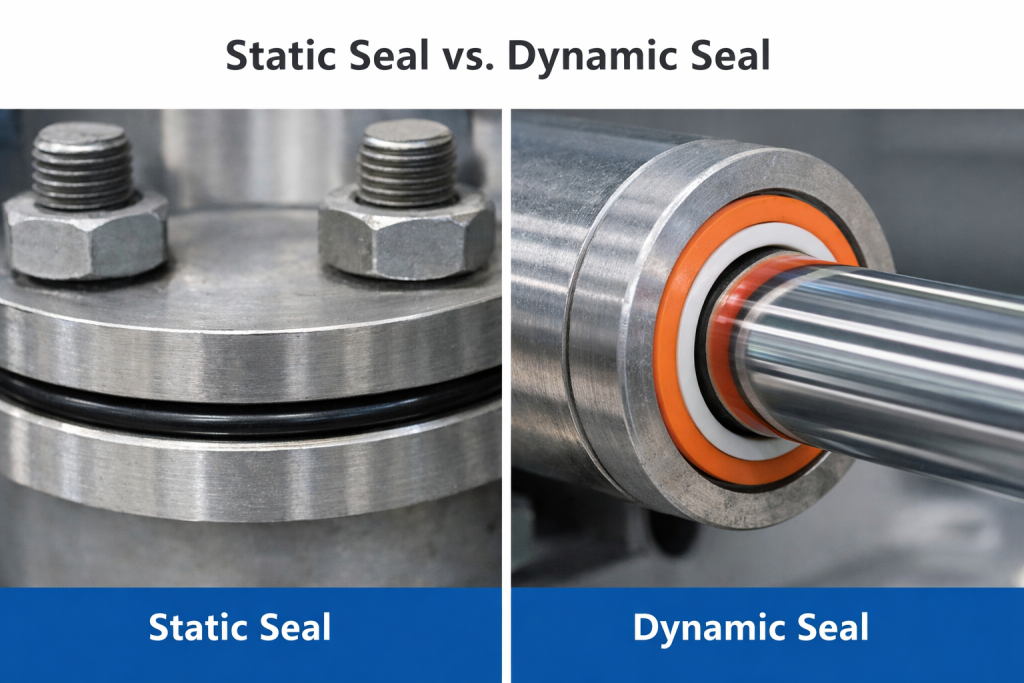
Seals are critical components in industrial machinery, chemical processing, hydraulic systems, and aerospace applications. Despite their ubiquity, engineers often misunderstand the fundamental differences between dynamic seals and static seals, leading to suboptimal performance, premature failure, or unnecessary costs. Understanding these differences is essential for rational material selection, geometry design, and long-term reliability planning. This article examines the physical principles, functional distinctions, and engineering logic behind selecting the right seal type for specific applications. Defining dynamic and static seals Dynamic seals are designed to maintain a leak-tight interface between surfaces that are in relative motion. Examples include: Dynamic seals must accommodate friction, wear, and pressure fluctuations while maintaining a continuous seal

ダイナミックシールとスタティックシール:基本的な違いと工学的選択の論理 続きを読む »

シール表面の粗さがリーク率と寿命に与える影響

Sealing technology is a cornerstone of modern industrial systems, from chemical reactors and high-pressure pumps to hydraulic cylinders and aerospace components. While seal materials, geometry, and operating conditions are frequently emphasized, the surface roughness of the sealing interface is often an overlooked yet critical factor that directly affects leakage rates, wear, and service life. This article explores the scientific and engineering principles behind surface roughness, quantifies its impact on seal performance, and provides guidance for engineers to optimize sealing interfaces. Understanding surface roughness Surface roughness refers to the microscopic peaks and valleys present on the mating surfaces of a seal and its counterface. Even highly polished components retain some microtopography

シール表面の粗さがリーク率と寿命に与える影響 続きを読む »

jaJapanese