製品知識

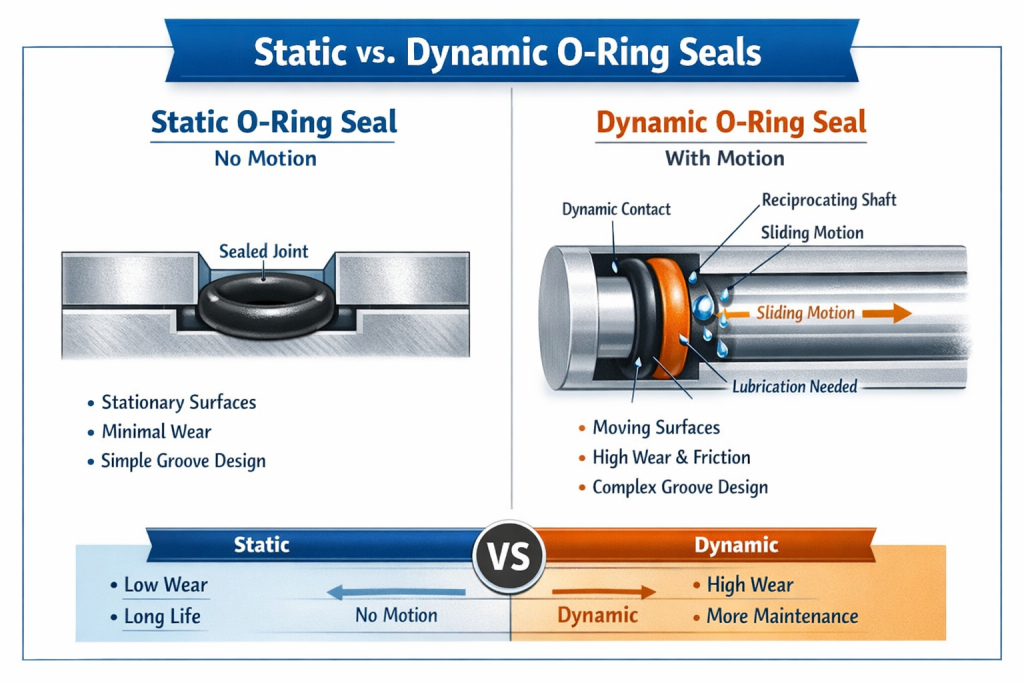
静的O-リングシールと動的O-リングシールの違いとは?

O-rings are among the most widely used sealing elements in industrial equipment due to their simplicity, reliability, and cost-effectiveness. However, their performance depends heavily on whether they are used in static or dynamic applications. Understanding the difference is essential for proper material selection, groove design, and long-term reliability. 1. What Is a Static O-Ring Seal? A static O-ring seal is used in applications where there is no relative motion between the sealing surfaces. Typical Applications How It Works The O-ring is compressed between two stationary surfaces. The compression creates initial sealing force, and system pressure further energizes the seal by pushing the O-ring against the groove wall. Key Characteristics Common […]

静的O-リングシールと動的O-リングシールの違いとは? 続きを読む »

メカニカルシールとパッキンシールの比較:コスト比較と連続運転機器への適合性

Sealing solutions are critical in pumps, compressors, and other rotating machinery. The choice between mechanical seals and traditional packing (gland) seals affects equipment reliability, maintenance costs, and operational efficiency. For continuous-running industrial equipment, selecting the most appropriate sealing technology requires careful consideration of performance, lifespan, and total cost of ownership. Understanding Mechanical Seals and Packing Seals Cost Considerations Performance in Continuous-Running Equipment Total Cost of Ownership (TCO) Perspective While packing seals may appear cheaper initially, mechanical seals often provide a lower total cost of ownership in continuous-running equipment: Conclusion For continuous-running industrial equipment, mechanical seals generally outperform packing seals in terms of reliability, energy efficiency, and long-term cost savings. Packing

メカニカルシールとパッキンシールの比較:コスト比較と連続運転機器への適合性 続きを読む »

重機用ドライブシャフトをカスタマイズする方法:材料の選択から熱処理の最適化まで

Drive shafts are critical components in heavy-duty industrial machinery, transmitting torque, supporting loads, and maintaining rotational stability. In demanding applications such as mining equipment, construction machinery, or large compressors, standard shafts often cannot meet performance and durability requirements. Customization is therefore essential to ensure operational reliability, extend service life, and optimize maintenance intervals. 1. Understanding Application Requirements The first step in shaft customization is to analyze the actual operating conditions: A thorough understanding of these factors forms the foundation for effective customization. 2. Material Selection Material choice directly affects mechanical performance, wear resistance, and fatigue life. Common options for heavy-duty drive shafts include: Material selection must balance strength, toughness, machinability,

重機用ドライブシャフトをカスタマイズする方法:材料の選択から熱処理の最適化まで 続きを読む »

重機用ドライブシャフトをカスタマイズする方法:材料の選択から熱処理の最適化まで

Drive shafts are critical components in heavy-duty industrial machinery, transmitting torque and supporting loads while maintaining alignment and rotational stability. In demanding applications—such as mining equipment, construction machinery, or large compressors—standard shafts often fail to meet performance or durability requirements. Customization is therefore essential to ensure operational reliability, extend service life, and optimize maintenance intervals. 1. Understanding Application Requirements The first step in shaft customization is to define operational parameters: A thorough understanding of these factors forms the foundation of an effective customization process. 2. Material Selection Material selection directly affects mechanical performance, wear resistance, and fatigue life. Common options for heavy-duty drive shafts include: Material choice is guided by

重機用ドライブシャフトをカスタマイズする方法:材料の選択から熱処理の最適化まで 続きを読む »

頻発するベアリング故障の根本原因分析:設置ミスか荷重設計の問題か?

Bearings are critical components in industrial machinery, ensuring smooth rotation, supporting loads, and maintaining system efficiency. Frequent bearing failures not only increase maintenance costs but also lead to unscheduled downtime, reduced productivity, and potential secondary damage to shafts, seals, and gears. Understanding whether failures are caused by installation errors, load design issues, or a combination of both is essential for implementing effective engineering solutions. Understanding Bearing Failure Mechanisms Bearings can fail due to a variety of mechanisms, often categorized into fatigue-related, wear-related, and lubrication-related failures. In industrial practice, repeated failures usually indicate systemic issues rather than isolated defects. Common failure symptoms include: Analyzing these symptoms helps differentiate between installation errors

頻発するベアリング故障の根本原因分析:設置ミスか荷重設計の問題か? 続きを読む »

エアコンプレッサーの異常なエネルギー消費に対するエンジニアリングのトラブルシューティングロジック:リーク、ベアリング、ローターの問題?

Abnormal energy consumption in air compressor systems is a common yet often misdiagnosed problem in industrial facilities. Compressed air is widely recognized as one of the most expensive utilities in manufacturing, and even small inefficiencies can lead to significant operational costs over time. When power consumption increases without a proportional rise in air output, the root cause is typically structural rather than electrical. In most cases, the issue can be traced to one of three primary categories: system leakage, bearing degradation, or rotor-related mechanical inefficiency. A structured engineering diagnostic approach is essential to avoid unnecessary part replacement and production downtime. Understanding the Baseline: Power-to-Output Ratio Before initiating component-level inspection, the

エアコンプレッサーの異常なエネルギー消費に対するエンジニアリングのトラブルシューティングロジック:リーク、ベアリング、ローターの問題? 続きを読む »

高温用途のシール材の選び方:工学的比較と故障事例分析

High temperature is one of the most critical factors affecting sealing reliability in industrial equipment. Whether in air compressors, thermal oil pumps, steam systems, metallurgical machinery, or chemical reactors, elevated temperatures significantly alter the mechanical, thermal, and chemical properties of sealing materials. Seal failure under high-temperature conditions can result in media leakage, energy loss, bearing contamination, lubricant degradation, unplanned downtime, and even safety incidents. Effective material selection is therefore not a matter of experience alone, but a structured engineering decision based on operating boundaries, material science, and failure mechanisms. Engineering Impact of High Temperature on Sealing Materials Temperature influences sealing performance in multiple ways. First, elastic degradation occurs when elastomeric

高温用途のシール材の選び方:工学的比較と故障事例分析 続きを読む »

エアコンプレッサー漏れの根本原因分析とエンジニアリングソリューション

Air leakage is one of the most common yet underestimated reliability issues in compressed air systems. It directly leads to energy loss, reduced system efficiency, unstable pressure, overheating, and accelerated component wear. In many industrial facilities, minor leakage is tolerated as unavoidable. However, from an engineering perspective, most leakage problems are predictable, measurable, and correctable through systematic analysis and design optimization. Compressed air is often referred to as the “fourth utility” in industrial plants. Studies consistently show that leakage losses can account for 20–30% of total compressed air production in poorly maintained systems. Therefore, identifying root causes and implementing engineering-based corrective actions is critical for operational efficiency and long-term cost

エアコンプレッサー漏れの根本原因分析とエンジニアリングソリューション 続きを読む »

カスタムドライブシャフトのエンドツーエンド解析:設計から製造、検証まで

Drive shafts are among the most critical power transmission components in industrial equipment. They are widely used in electric motors, gearboxes, pumps, compressors, wind turbines, robotics joints, automated production lines, and heavy machinery. Unlike standard shafts, custom drive shafts must be precisely tailored to specific operating conditions, loads, environments, and assembly interfaces. Their reliability depends not only on material selection but also on a systematic engineering process covering requirements definition, structural design, precision machining, surface treatment, assembly, and performance validation. This article provides a structured framework for understanding the complete lifecycle of custom drive shafts, helping design engineers, procurement specialists, and maintenance professionals make more informed decisions. 1. Requirements Definition:

カスタムドライブシャフトのエンドツーエンド解析:設計から製造、検証まで 続きを読む »

メタルベアリングとセラミックベアリングの比較:長期運転コストの現実的な比較

Bearings are foundational components in rotating machinery, determining not only mechanical performance but also maintenance expenditure, energy efficiency, and system reliability over the entire equipment lifecycle. In recent years, ceramic bearings—especially hybrid ceramic bearings—have been increasingly adopted in high-speed motors, compressors, pumps, robotics, and precision manufacturing equipment. This trend has led to an important question in engineering decision-making: Are ceramic bearings truly more cost-effective than traditional metal bearings in the long run? A meaningful answer requires more than comparing purchase prices. It demands a holistic evaluation that includes service life, failure risk, energy consumption, maintenance frequency, environmental tolerance, and application-specific performance. Fundamental differences in material properties Conventional industrial bearings are

メタルベアリングとセラミックベアリングの比較:長期運転コストの現実的な比較 続きを読む »

jaJapanese