テクニカルガイド

メタルシールと非メタルシール:産業システムにおける境界とコストトレードオフの再考

In industrial engineering, sealing is often treated as a secondary design consideration—a consumable chosen at the end of the design cycle. This mindset is increasingly dangerous. As operating pressures rise, chemical environments become harsher, and reliability expectations tighten, the choice between metal seals and non-metal seals has evolved into a strategic engineering decision rather than a simple procurement call. Rather than framing the debate as “which is better,” a more productive question is: where are the true application boundaries, and how should cost be evaluated over the entire system lifecycle? Why the metal vs. non-metal question matters more than ever Modern equipment operates closer to physical limits than in the […]

メタルシールと非メタルシール:産業システムにおける境界とコストトレードオフの再考 続きを読む »
FFKM、FKM、PTFE:過酷な条件に最適なシール材の選び方

Sealing technology plays a decisive role in the reliability, safety, and efficiency of modern industrial systems. In environments characterized by high pressure, extreme temperatures, aggressive chemicals, or high-speed motion, the choice of sealing material can determine whether equipment operates smoothly or fails catastrophically. Among the most widely used high-performance sealing materials are perfluoroelastomers (FFKM), fluoroelastomers (FKM), and polytetrafluoroethylene (PTFE). Each material offers unique advantages and limitations, making material selection a critical engineering decision rather than a simple procurement choice. This article examines the fundamental properties of FFKM, FKM, and PTFE, compares their performance under extreme conditions, and provides a practical framework for selecting the optimal sealing material based on application

FFKM、FKM、PTFE:過酷な条件に最適なシール材の選び方 続きを読む »

高精度機械部品の公差と表面処理

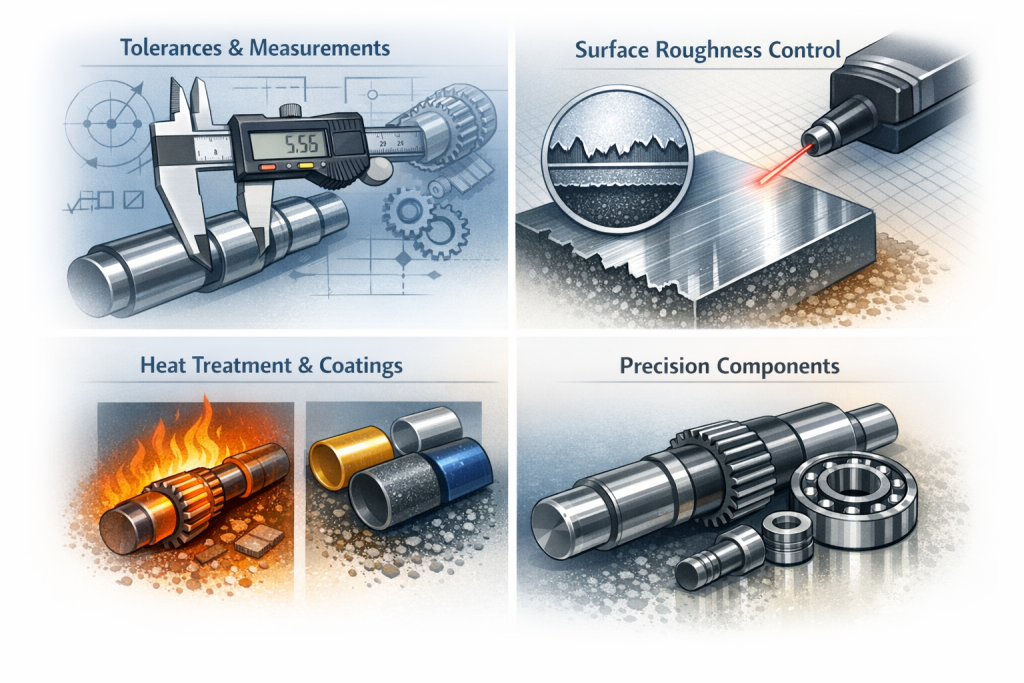
High-precision mechanical components are essential in industries such as aerospace, automotive, robotics, semiconductor equipment, medical devices, and advanced manufacturing. The performance, reliability, and service life of these components depend not only on material selection and design but also on two critical engineering factors: dimensional tolerances and surface treatments. Together, these elements determine how well a part fits, functions, and withstands real-world operating conditions. This article examines why tolerances and surface treatments matter, how they are specified, and how they interact to ensure the success of high-precision components in demanding applications. The Role of Dimensional Tolerances in Precision Engineering Dimensional tolerance defines the allowable variation in a component’s size, shape, and

高精度機械部品の公差と表面処理 続きを読む »

設計から製造まで:カスタム・トランスミッション・コンポーネントのエンド・ツー・エンド・プロセス

Custom transmission components—such as shafts, gears, couplings, and related powertrain parts—are critical to the performance, reliability, and efficiency of industrial machinery. Unlike standard parts, custom components must be tailored to specific operating conditions, loads, and system constraints. Achieving high-quality results requires a structured, multidisciplinary process that integrates engineering design, materials science, manufacturing technology, and quality assurance. This article outlines the full lifecycle of custom transmission components, from initial concept to final delivery. 1. Requirement Definition and System Analysis The process begins with a clear definition of functional and operational requirements. Engineers work closely with equipment manufacturers or end users to understand how the component will be used within a larger

設計から製造まで:カスタム・トランスミッション・コンポーネントのエンド・ツー・エンド・プロセス 続きを読む »

産業用ベアリングのセラミック材料採用が増えている理由

1. Introduction: From Steel to Ceramics – A Paradigm Shift For more than a century, industrial bearings have relied primarily on high-carbon chromium steel (such as AISI 52100) as the dominant rolling element material. Steel bearings have powered everything from automobiles and turbines to machine tools and industrial motors. However, as industries push toward higher speeds, harsher environments, greater energy efficiency, and longer maintenance intervals, traditional steel bearings are reaching their performance limits. Over the past two to three decades, ceramic materials—particularly silicon carbide (SiC), silicon nitride (Si₃N₄), and zirconia (ZrO₂)—have emerged as increasingly attractive alternatives for rolling elements and hybrid bearings. Today, ceramic bearings are no longer niche products;

産業用ベアリングのセラミック材料採用が増えている理由 続きを読む »

jaJapanese