
Sealing technology plays a decisive role in the safety, efficiency, and reliability of high-pressure equipment. In industries such as oil and gas, chemical processing, power generation, hydraulic systems, and aerospace, seals are often the last barrier preventing fluid leakage, contamination, or catastrophic system failure. Unlike standard low-pressure applications, high-pressure environments impose extreme mechanical, thermal, and chemical stresses on sealing components. As a result, both material selection and structural design must be carefully engineered to meet demanding operational conditions.
This article explores the fundamental principles behind seal materials and structural design in high-pressure equipment, highlighting how engineering decisions influence performance, durability, and system integrity.
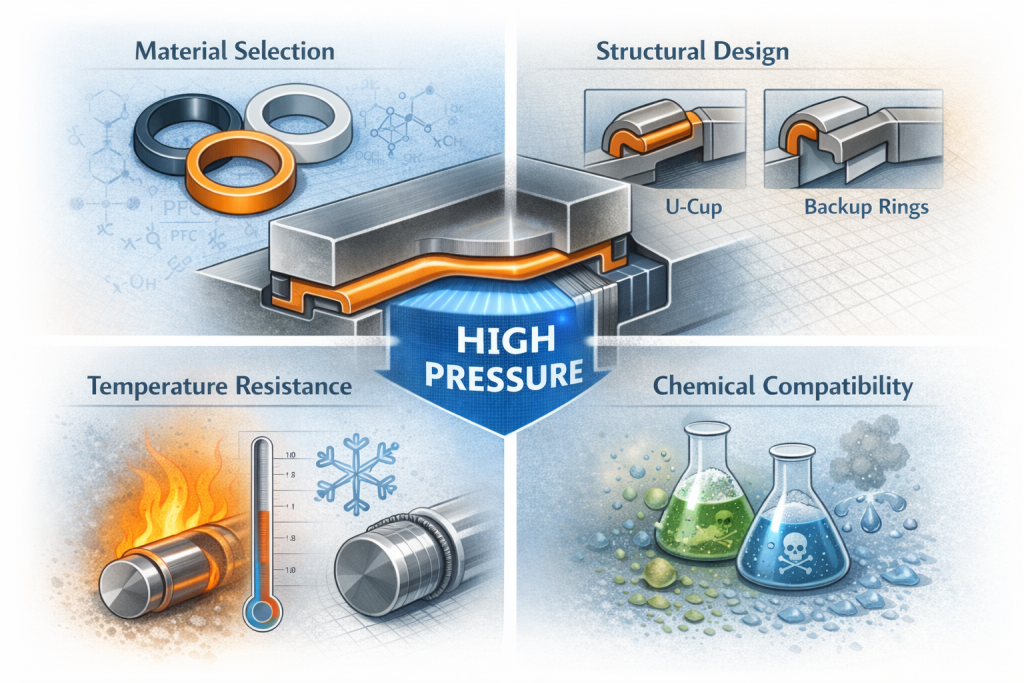
Functional Requirements of High-Pressure Seals
A seal in high-pressure equipment must fulfill multiple functions simultaneously. Its primary role is to prevent fluid leakage under extreme pressure differentials. At the same time, it must accommodate relative motion between components, resist chemical degradation, tolerate temperature fluctuations, and maintain mechanical integrity over long service cycles.
In dynamic systems such as hydraulic cylinders, pumps, or rotating shafts, seals must also minimize friction while maintaining tight contact with mating surfaces. In static applications like pressure vessels or flanged joints, seals must maintain compression and resilience even under long-term loading or thermal expansion.
The complexity of these requirements means that high-pressure seals cannot be treated as simple rubber rings; they are precision-engineered components that integrate materials science, mechanics, and manufacturing technology.
Material Selection: Balancing Strength, Elasticity, and Stability
Material selection is one of the most critical aspects of seal design. In high-pressure environments, common elastomers such as natural rubber are often insufficient due to limited pressure resistance, thermal stability, or chemical compatibility. Instead, engineers rely on advanced polymers and composite materials.
Fluoroelastomers such as FKM are widely used in high-temperature and chemically aggressive environments. They offer excellent resistance to oils, fuels, and many industrial chemicals while maintaining elasticity under pressure. However, they can be relatively stiff at low temperatures, which may limit their use in cryogenic or cold environments.
For extreme conditions, perfluoroelastomers such as FFKM provide superior chemical resistance and thermal stability, making them suitable for semiconductor manufacturing, aerospace, and high-purity chemical processing. These materials can withstand harsh solvents and elevated temperatures but come at significantly higher cost.
In applications involving very high pressure or sliding contact, thermoplastics such as PTFE, PEEK, or UHMWPE are often incorporated into seal structures. These materials exhibit low friction, excellent wear resistance, and high compressive strength. They are frequently used as backup rings or primary sealing elements in combination with elastomers to enhance overall performance.
Metal seals, including stainless steel or copper gaskets, are used in ultra-high-pressure or high-temperature systems where elastomers would fail. These seals rely on plastic deformation to create a tight barrier and are commonly found in pressure vessels, valves, and critical industrial pipelines.
Structural Design: Managing Pressure and Deformation
The structural design of high-pressure seals is just as important as material selection. A well-designed seal must distribute stress evenly, prevent extrusion, and maintain stable contact with mating surfaces under varying pressure conditions.
One common approach is the use of U-cup or V-ring seal profiles in hydraulic systems. These shapes are designed so that internal pressure pushes the sealing lips more firmly against the contact surface, improving sealing performance as pressure increases. This self-energizing effect allows seals to function effectively over a wide pressure range.
In very high-pressure environments, elastomer seals are often supported by backup rings made of rigid polymers or metals. These backup rings prevent the softer sealing material from extruding into small gaps between components. Without such reinforcement, elastomers could deform, tear, or fail prematurely under extreme loads.
For rotating shafts, engineers must balance sealing effectiveness with friction control. Lip seals or mechanical seals are carefully designed to maintain a thin lubricating film while preventing leakage. Excessive contact pressure can cause overheating and wear, while insufficient pressure can lead to fluid escape.
Temperature Effects on Seal Performance
Temperature has a profound impact on seal behavior. At high temperatures, elastomers may soften, lose elasticity, or undergo chemical degradation. At low temperatures, they may become brittle and lose sealing capability.
To address this, engineers select materials with appropriate thermal properties and design seals that can accommodate expansion and contraction. In some cases, spring-energized seals are used to maintain consistent contact force across a broad temperature range.
In high-temperature systems such as turbines or chemical reactors, metal seals or specialized high-temperature polymers are often required. These materials can maintain structural stability where conventional elastomers would fail.
Chemical Compatibility and Environmental Considerations
In chemical processing or offshore applications, seals must resist corrosion, swelling, or degradation caused by aggressive fluids such as acids, solvents, or seawater. Incompatible materials can absorb chemicals, swell, and lose mechanical strength, leading to leakage or failure.
Engineers conduct thorough compatibility testing before selecting seal materials. This may include immersion tests, pressure cycling, and long-term aging studies to simulate real operating conditions.
In environmentally sensitive industries, seals must also prevent hazardous leaks that could cause safety risks or regulatory violations. This makes reliability and material durability even more critical.
Manufacturing Precision and Surface Interaction
Even the best-designed seal will fail if the mating surfaces are poorly manufactured. High-pressure seals require smooth, precise contact surfaces to function properly. Surface roughness, misalignment, or dimensional inaccuracies can lead to uneven stress distribution, wear, and leakage.
For dynamic seals, the surface finish of shafts or cylinder walls must be carefully controlled to balance lubrication retention and friction reduction. Too rough a surface can damage the seal, while too smooth a surface may prevent proper lubrication film formation.
Testing and Validation in Real Conditions
Before deployment, high-pressure seals undergo rigorous testing. This includes pressure cycling, temperature variation, chemical exposure, and mechanical endurance tests. In critical industries, seals may also be tested in full-scale equipment rather than isolated laboratory conditions.
Failure analysis plays an important role in continuous improvement. By studying worn or damaged seals, engineers can refine material choices, adjust structural design, and enhance overall system reliability.
Integration with System Design
Seals should not be designed in isolation. Their performance depends on the overall system architecture, including component alignment, pressure control, lubrication strategy, and maintenance procedures.
A well-integrated approach considers how seals interact with bearings, shafts, housings, and fluid systems. This holistic perspective helps prevent unexpected failures and extends equipment lifespan.
Conclusion
The design of seals for high-pressure equipment is a complex engineering discipline that requires deep understanding of materials science, mechanics, and manufacturing technology. Effective sealing solutions depend on the careful balance between material properties, structural geometry, and operating conditions.
By selecting appropriate materials, optimizing seal profiles, and ensuring high manufacturing precision, engineers can significantly improve system reliability, reduce maintenance costs, and enhance safety in demanding industrial environments.
As industries continue to push toward higher pressures, harsher conditions, and longer service life expectations, advanced sealing technology will remain a cornerstone of modern engineering.

 English
  Korean
  Japanese
  Russian
  Arabic
  Spanish
  German
  French
  Italian
  Portuguese
  Chinese
  Dutch
Dutch  Polish
  Czech
Czech  Hungarian
  Finnish
  Swedish
  Vietnamese
  Thai
Thai  Turkish