
1. Introduction: A New Landscape of Global Manufacturing
For decades, Germany and Japan have been widely regarded as the world’s leaders in precision manufacturing. Their reputations rest on deep engineering traditions, high-quality industrial standards, advanced machine tools, and highly skilled workforces. Companies such as Siemens, Bosch, FANUC, NSK, DMG Mori, Mazak, and Mitutoyo have long symbolized reliability, innovation, and long-term technological mastery.
China’s rise as a manufacturing powerhouse was initially associated more with mass production, cost efficiency, and industrial scale than with ultra-precision engineering. However, over the past 15 to 20 years, this perception has shifted significantly. China has invested heavily in high-end manufacturing, automation, advanced materials, digital factories, and intelligent industrial systems.
This leads to a key question: can China’s precision manufacturing sector truly challenge the long-established dominance of Germany and Japan in high-end engineering industries?
To answer this, it is necessary to examine technological capability, workforce development, supply chain maturity, innovation ecosystems, industrial policy, and real-world performance in critical sectors such as aerospace, semiconductors, electric vehicles, and precision machinery.
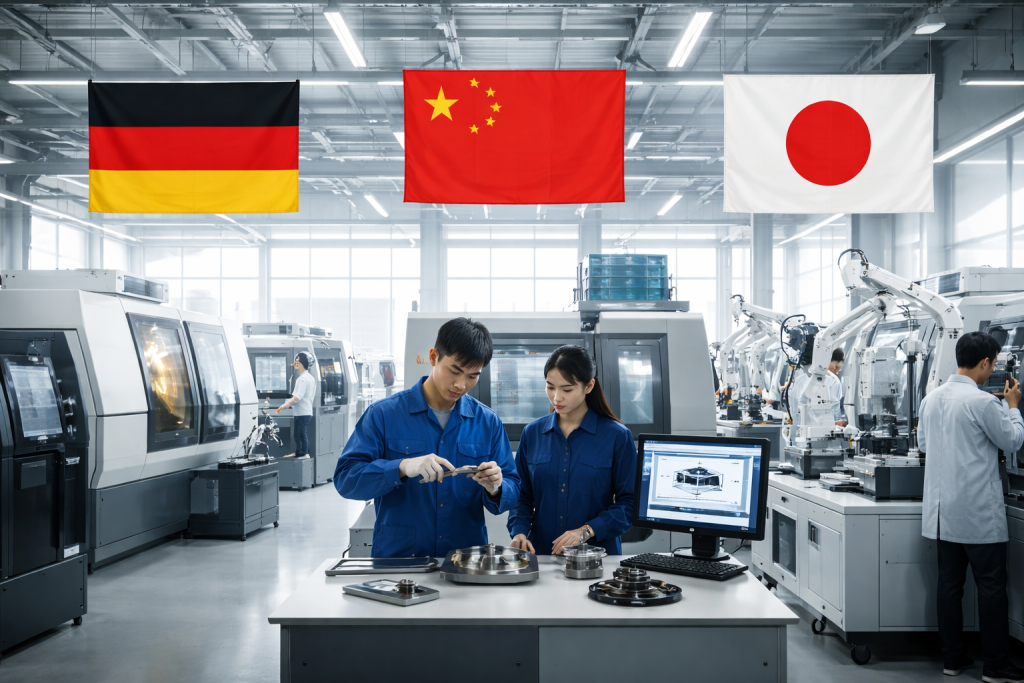
2. What Defines Precision Manufacturing?
Precision manufacturing is not simply about producing parts, but about producing them with extreme accuracy, consistency, and reliability.
It is typically characterized by:
- Very tight tolerances, often at micron or sub-micron levels
- Use of advanced machine tools such as CNC machining centers, ultra-precision grinders, and laser processing systems
- Application of high-performance materials including advanced ceramics, specialty steels, and composite materials
- Robust quality control systems incorporating metrology, statistical process control, and digital inspection technologies
- Strong engineering research and development capabilities
- Stable and reliable supply chains for critical components
Industries that rely most heavily on precision manufacturing include aerospace, semiconductor equipment, electric vehicles, robotics, medical devices, high-speed machine tools, advanced bearings, seals, and optical systems.
Germany and Japan have historically excelled in these fields, but China has been rapidly expanding its capabilities.
3. Germany and Japan as Traditional Leaders
3.1 Germany’s industrial strengths
Germany’s manufacturing model is often described as deeply rooted in engineering discipline and long-term industrial stability.
Key advantages include:
- A strong vocational education system that combines apprenticeships with formal technical training
- World-class machine tool manufacturers such as DMG Mori and Trumpf
- Leadership in automotive engineering through companies like Volkswagen, BMW, and Mercedes-Benz
- Advanced industrial automation driven by firms such as Siemens and Bosch
- A culture that emphasizes reliability, quality, and incremental innovation
German manufacturing is particularly strong in precision machining, industrial robotics, automotive components, and high-performance mechanical systems. The country’s industrial ecosystem is supported by close collaboration between universities, research institutes, and private companies.
3.2 Japan’s industrial strengths
Japan’s manufacturing philosophy is closely associated with continuous improvement, often referred to as Kaizen, and highly efficient lean production systems.
Major strengths include:
- Ultra-precise machine tools from companies such as Mazak and Okuma
- Advanced robotics developed by FANUC and Yaskawa
- World-leading bearing manufacturers including NSK and NTN
- Strong expertise in materials science, especially advanced ceramics
- A deep commitment to minimizing defects and maximizing reliability
Japan has traditionally dominated fields such as precision bearings, semiconductor manufacturing tools, high-end optical equipment, and advanced robotics. Its approach tends to focus on gradual refinement rather than rapid disruption.
4. China’s Rapid Progress in Precision Manufacturing
4.1 Large-scale investment in high-tech industry
Over the past decade, China has made high-end manufacturing a national strategic priority through initiatives such as Made in China 2025, industrial internet development programs, and smart manufacturing policies. Massive investments have been directed toward robotics, automation, digital factories, and advanced materials research.
As a result, China has made significant improvements in areas including CNC machine tools, industrial robotics, electric vehicle manufacturing, advanced ceramics such as silicon carbide, and AI-driven quality control systems.
Unlike Germany and Japan, China combines industrial scale with rapid technological adoption, enabling faster upgrading across entire industries.
4.2 Leadership in digital manufacturing
One area where China may have a relative advantage is digital manufacturing.
Many Chinese factories now use artificial intelligence for defect detection, digital twins for process simulation, and internet-connected sensors for real-time monitoring of machine performance. Big data analytics and predictive maintenance systems are increasingly common in modern Chinese manufacturing facilities.
This digital capability allows China to compensate for some traditional weaknesses in mechanical engineering by optimizing processes through software, automation, and data-driven decision-making.
4.3 Advances in high-performance materials
China has made notable progress in materials critical to precision engineering, including silicon carbide ceramics, high-strength steels, advanced composites, specialized coatings, and precision optical glass.
These materials are essential for industries such as semiconductor equipment, aerospace, high-speed bearings, and medical devices. While Japan still leads in certain niche materials, China is closing the gap rapidly.
5. Areas Where China Still Lags Behind
Despite impressive progress, China still faces several challenges when compared with Germany and Japan at the highest level of precision manufacturing.
One key area is ultra-high-end machine tools. Germany and Japan continue to dominate the most advanced systems used for ultra-precision grinding, five-axis machining, and nano-level manufacturing. Chinese machine tools have improved significantly but do not yet consistently match the very best European and Japanese equipment in the most demanding applications.
Another challenge lies in talent and engineering culture. Germany and Japan benefit from decades of accumulated technical expertise and deeply embedded engineering traditions. China still faces a shortage of highly experienced senior engineers in some specialized fields, although this gap is gradually narrowing through investment in technical education and research institutions.
Brand trust is also an important factor. In high-end markets such as aerospace, semiconductors, and medical devices, many global customers still prefer German or Japanese suppliers due to long-established reputations for reliability. China must continue demonstrating consistent quality to fully gain international confidence.
6. Areas Where China May Surpass
Despite current limitations, China has strong potential to outperform Germany and Japan in certain emerging fields.
In electric vehicles, China is already a global leader in battery technology, motor manufacturing, and large-scale automation. This gives Chinese companies a major advantage in next-generation transportation systems and related precision components.
In renewable energy, China dominates the production of wind turbines, solar panels, and power transmission equipment. The precision components used in these systems are improving rapidly, further strengthening China’s industrial position.
In semiconductor equipment, China remains behind countries such as Japan, the United States, and the Netherlands in lithography technology. However, it is making significant progress in areas such as etching equipment, wafer handling systems, and advanced materials for chip manufacturing, suggesting that its role in this industry will continue to grow.
7. A Realistic Perspective on Competition
Rather than framing the question as whether China will replace Germany and Japan, a more realistic perspective is that all three countries will coexist as leaders in different areas of precision manufacturing.
Germany is likely to maintain strength in high-end industrial machinery and automotive engineering. Japan will probably remain dominant in ultra-precision components and robotics. China, meanwhile, is well positioned to lead in digital manufacturing, electric vehicles, and large-scale advanced production systems.
Each country has distinct advantages rather than one being universally superior.
8. The Role of Global Supply Chains
Modern manufacturing is increasingly interconnected. Many advanced products involve contributions from multiple countries. A semiconductor tool might combine Japanese optics, German mechanical systems, and Chinese subassemblies. An electric motor might use Chinese magnets, Japanese bearings, and European control electronics.
This suggests that future competition will be based more on integrated global networks than on isolated national industries.
9. Conclusion
China can indeed challenge Germany and Japan in precision manufacturing, but the outcome will not be absolute dominance by any single country.
China is rapidly catching up in many areas, particularly digital manufacturing, electric vehicles, renewable energy, and smart factory systems. At the same time, Germany and Japan retain strong advantages in ultra-precision machine tools, specialized materials, and long-established engineering traditions.
Over the next decade, global precision manufacturing is likely to evolve into a three-pillar system in which Germany, Japan, and China each play leading but complementary roles.
 English
  Korean
  Japanese
  Russian
  Arabic
  Spanish
  German
  French
  Italian
  Portuguese
  Chinese
  Dutch
Dutch  Polish
  Czech
Czech  Hungarian
  Finnish
  Swedish
  Vietnamese
  Thai
Thai  Turkish