
High-precision mechanical components are essential in industries such as aerospace, automotive, robotics, semiconductor equipment, medical devices, and advanced manufacturing. The performance, reliability, and service life of these components depend not only on material selection and design but also on two critical engineering factors: dimensional tolerances and surface treatments. Together, these elements determine how well a part fits, functions, and withstands real-world operating conditions.
This article examines why tolerances and surface treatments matter, how they are specified, and how they interact to ensure the success of high-precision components in demanding applications.
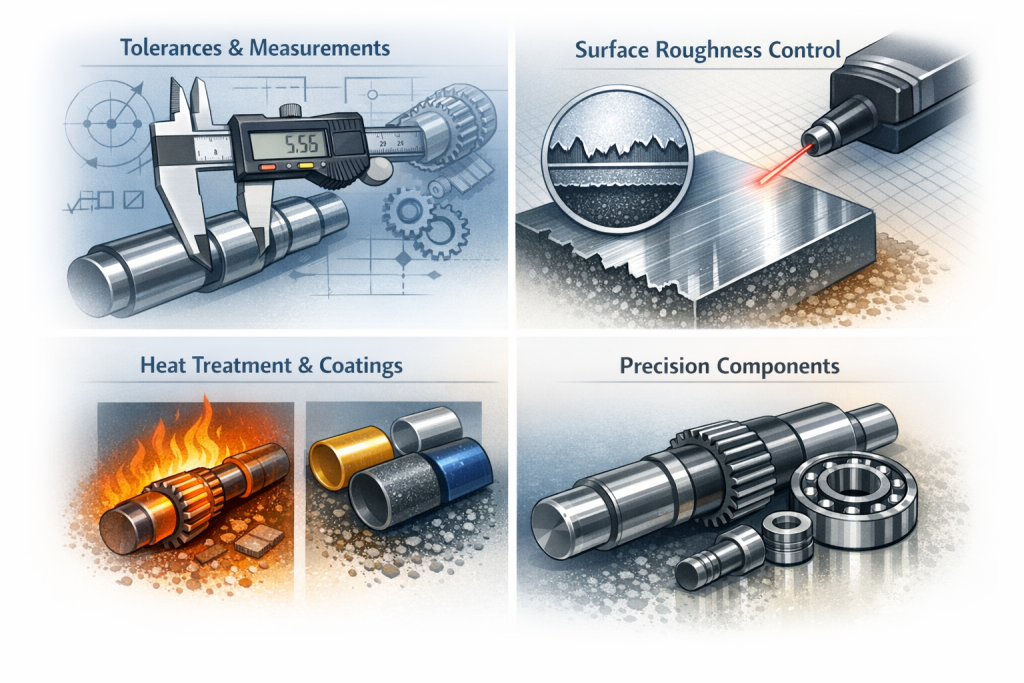
The Role of Dimensional Tolerances in Precision Engineering
Dimensional tolerance defines the allowable variation in a component’s size, shape, and position. In high-precision systems, even micrometer-level deviations can cause misalignment, excessive friction, vibration, noise, or premature failure.
Tolerances are particularly important for mating parts such as shafts and bearings, gears and housings, or pistons and cylinders. If a shaft is too large, it may create excessive interference and lead to overheating or seizure. If it is too small, it may introduce looseness, causing instability and wear.
Engineers rely on geometric dimensioning and tolerancing (GD&T) principles to control critical features such as concentricity, parallelism, flatness, and roundness. Modern manufacturing tools, including CNC machining and coordinate measuring machines (CMM), allow precise control and verification of these parameters.
Surface Roughness and Functional Performance
Surface roughness refers to the microscopic texture of a component’s surface. Even parts that appear smooth to the naked eye contain tiny peaks and valleys at the microscopic level. These features strongly influence friction, wear, lubrication retention, and fatigue life.
In high-speed or high-load applications, a rough surface can increase friction, generate heat, and accelerate wear. Conversely, an overly polished surface may reduce lubricant retention, leading to boundary lubrication conditions and potential surface damage.
As a result, engineers must specify an optimal surface finish rather than simply aiming for the smoothest possible surface. Typical surface roughness values are defined using parameters such as Ra or Rz and are selected based on the component’s function.
Surface Treatments and Their Engineering Benefits
Surface treatments modify only the outer layer of a material while preserving the core properties of the component. This approach is particularly valuable for high-precision parts that require both strength and durability.
Common surface treatments include heat treatment processes such as carburizing, nitriding, or induction hardening. These methods increase surface hardness, improving wear resistance while maintaining a tough and ductile core that can absorb shock loads.
Coating technologies such as hard chrome plating, physical vapor deposition (PVD), or ceramic coatings are also widely used. These coatings can reduce friction, enhance corrosion resistance, and extend component life in harsh environments. In semiconductor or medical applications, special coatings may also improve cleanliness or biocompatibility.
Interaction Between Tolerances and Surface Treatments
Tolerances and surface treatments are not independent considerations; they must be coordinated during design and manufacturing.
For example, certain heat treatments can cause slight dimensional distortion due to thermal expansion and phase changes in the material. Engineers must account for this by leaving machining allowances before treatment and performing final grinding or honing afterward.
Similarly, coating thickness must be included in dimensional calculations. A shaft coated with a hard layer must be machined undersized beforehand so that the final coated dimension meets functional requirements.
This integration of dimensional control and surface engineering is a hallmark of advanced precision manufacturing.
Manufacturing Control and Quality Assurance
Producing high-precision components requires strict process control. Modern factories use CNC machining, precision grinding, and automated inspection systems to ensure that parts meet both dimensional and surface requirements.
Quality assurance typically includes dimensional measurement with CMM, surface roughness testing, hardness verification after heat treatment, and sometimes non-destructive testing to detect internal defects.
Documentation is also essential. Material certificates, heat treatment records, and inspection reports provide traceability and build trust with customers in regulated industries.
Application Examples
In aerospace gear systems, tight tolerances and specialized surface treatments reduce noise, vibration, and fatigue failure under extreme loads.
In medical implants, precise tolerances ensure proper fit, while biocompatible coatings prevent corrosion and improve safety.
In semiconductor manufacturing equipment, ultra-precise surfaces and coatings minimize particle contamination and enhance operational stability.
總結
Tolerances and surface treatments are foundational elements of high-precision mechanical engineering. Tolerances ensure that parts fit and function correctly within complex systems, while surface treatments enhance durability, wear resistance, and environmental performance.
The most successful designs emerge when engineers treat these two aspects as an integrated system rather than separate requirements. By combining advanced design tools, precision manufacturing, and rigorous quality control, manufacturers can deliver components that meet the highest standards of performance, reliability, and longevity.

 Chinese
  English
  Korean
  Japanese
  Russian
  Arabic
  Spanish
  German
  French
  Italian
  Portuguese
  Dutch
Dutch  Polish
  Czech
Czech  Hungarian
  Finnish
  Swedish
  Vietnamese
  Thai
Thai  Turkish