
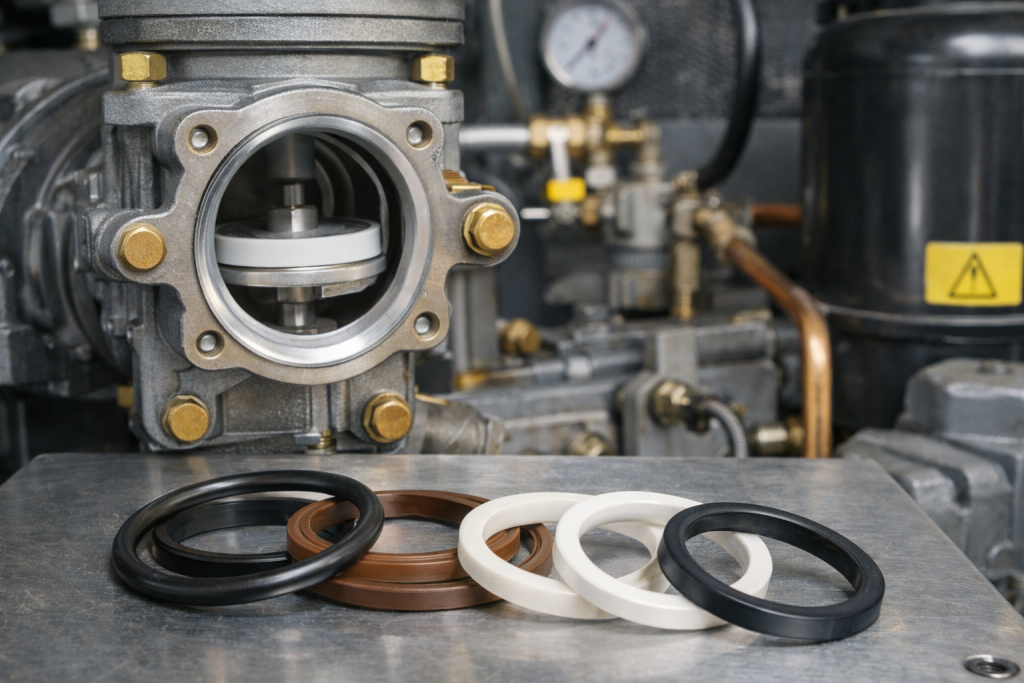
Exhaust valves are critical components in air compressors, controlling the release of compressed air while maintaining system pressure and efficiency. The sealing elements within these valves play a vital role in preventing air leakage, reducing energy loss, and ensuring reliable operation over long-term service. Choosing the appropriate seal material for exhaust valves is essential, as these components are exposed to high pressures, fluctuating temperatures, lubricants, and potential chemical contaminants.
Understanding the material properties, operational requirements, and environmental conditions is key to designing exhaust valve seals that maximize performance and durability.
Operational Challenges of Exhaust Valve Seals
Exhaust valve seals face multiple stressors during operation:
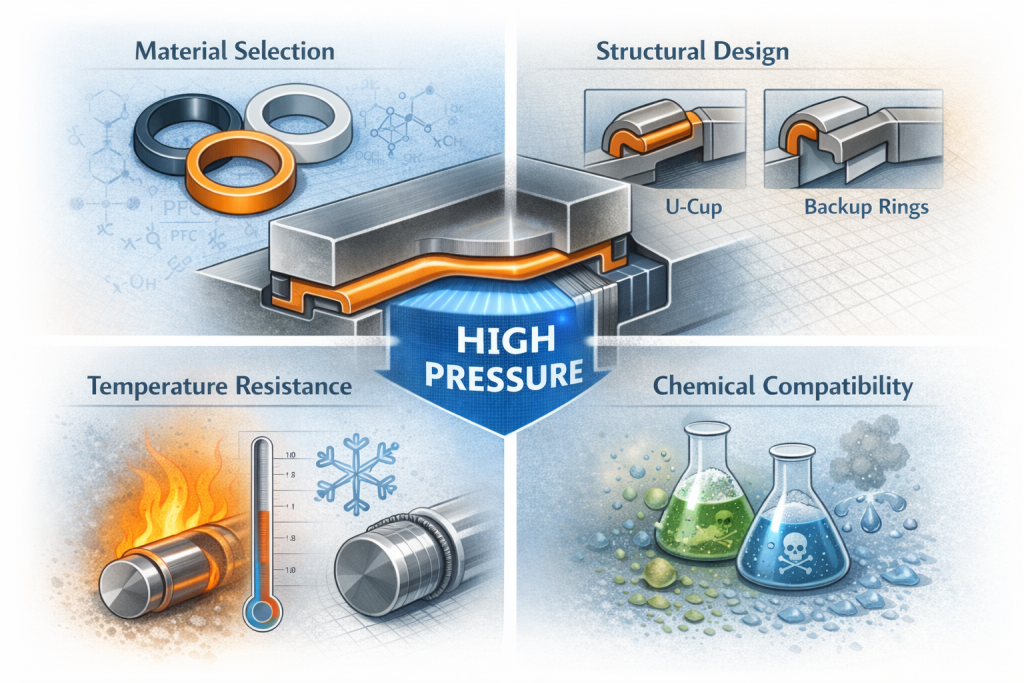
- High pressure: Air compressors operate under significant pressure, often exceeding 10 bar for industrial applications, which subjects seals to extrusion and deformation.
- Temperature fluctuations: Compression generates heat, and repeated cycling between high and low temperatures can accelerate material aging and reduce elasticity.
- 化學品接觸: Lubricants, condensates, or cleaning agents may interact with seal materials, causing swelling, chemical degradation, or surface hardening.
- Dynamic stress: Rapid opening and closing cycles produce mechanical wear, particularly on lip seals or O-rings, which may compromise the sealing interface.
These challenges highlight the importance of selecting materials that balance mechanical resilience, chemical resistance, and thermal stability.
Common Seal Materials
Selecting a suitable material requires consideration of the operational environment and expected lifetime. Common materials include:
- NBR (Nitrile Butadiene Rubber): Widely used for general-purpose applications due to good oil resistance, mechanical strength, and cost-effectiveness. NBR performs well at moderate temperatures (up to 100°C) but may degrade under high heat or aggressive chemicals.
- FKM (Fluoroelastomer): Offers excellent resistance to high temperatures, chemical attack, and oil exposure, making it suitable for industrial compressors operating in harsh environments.
- EPDM (Ethylene Propylene Diene Monomer): Highly resistant to heat, water, and steam but less effective against petroleum-based lubricants. Ideal for compressors using water-lubricated systems.
- PTFE (Polytetrafluoroethylene): Exhibits outstanding chemical resistance, low friction, and high-temperature stability. PTFE seals are often used for extreme conditions but may require careful dimensional design due to lower elasticity.
Composite or hybrid seals, such as FKM-coated PTFE or PTFE-embedded elastomers, combine the benefits of chemical resistance, low friction, and mechanical resilience, making them ideal for demanding exhaust valve applications.
Design Considerations
Material selection alone is insufficient; proper seal design enhances performance:
- Lip geometry: Dynamic seals benefit from precisely engineered lip shapes that maintain contact without excessive friction.
- Surface finish: Mating surfaces should be smooth, with roughness values (Ra) typically below 0.8 μm to reduce wear and improve sealing integrity.
- 備份戒指: For high-pressure applications, backup rings prevent seal extrusion and extend operational life.
- Compression tolerance: Seals must be compressed within recommended limits to avoid permanent deformation or leakage.
Optimizing design parameters ensures that selected materials perform reliably under both static and dynamic conditions.
Maintenance and Operational Best Practices
Prolonging the service life of exhaust valve seals also depends on operational practices:
- 潤滑: Use compatible lubricants to reduce friction and prevent chemical attack on elastomeric seals.
- Temperature control: Monitor operating temperatures and allow for cooling cycles to minimize thermal degradation.
- Periodic inspection: Regularly check for leaks, cracks, or hardening of seals to enable early replacement and prevent system inefficiency.
- Clean operating conditions: Prevent dust, debris, or condensate accumulation in valve assemblies, which can accelerate wear.
Integrating maintenance with real-time monitoring—such as pressure and flow sensors—can detect early signs of seal wear and optimize replacement schedules.
Case Application
In a rotary screw air compressor operating at 12 bar and 90°C, FKM seals are often combined with PTFE backup rings for exhaust valves. This combination provides chemical and thermal resistance, reduces friction during valve cycling, and maintains sealing integrity over thousands of hours of operation. The system is further protected by regular inspection of valve seats and proper lubrication to reduce wear.
總結
Exhaust valve seals are essential for the efficiency, safety, and longevity of air compressors. Careful selection of materials such as NBR, FKM, EPDM, or PTFE—combined with optimized seal design, lubrication, and maintenance—ensures reliable performance in both standard and demanding operational environments.
By understanding the interaction between materials, operating conditions, and design parameters, engineers can extend the service life of exhaust valve seals, reduce energy losses, and minimize downtime, contributing to more sustainable and cost-effective compressor operations.
 Chinese
  English
  Korean
  Japanese
  Russian
  Arabic
  Spanish
  German
  French
  Italian
  Portuguese
  Dutch
Dutch  Polish
  Czech
Czech  Hungarian
  Finnish
  Swedish
  Vietnamese
  Thai
Thai  Turkish