
Industrial furnaces operate under some of the harshest mechanical conditions in manufacturing. Continuous exposure to temperatures ranging from 200°C to over 1000°C, combined with heavy loads, thermal cycling, dust contamination, and oxidation, makes bearing selection a critical reliability factor.
This technical guide outlines proven high-temperature vòng bi solutions, material considerations, lubrication strategies, and installation practices used in steel plants, cement kilns, glass production lines, and heat-treatment systems.
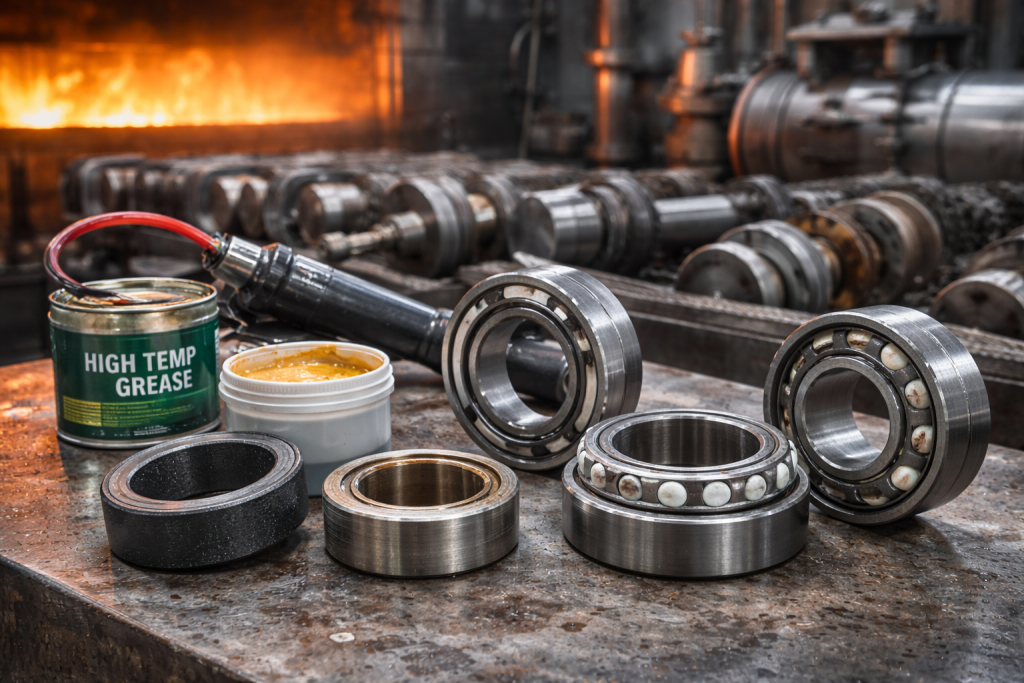
1. Operating Challenges in Furnace Applications
Industrial furnaces such as those found in steel reheating lines or rotary kilns impose several combined stresses:
- Extreme ambient heat
- Radiant heat exposure
- Thermal expansion of shafts and housings
- Scale and abrasive dust contamination
- Intermittent or continuous rotation
- Slow-speed heavy loads
- Limited lubrication access
In facilities such as ArcelorMittal steel plants or Heidelberg Materials cement operations, bearing failure in furnace conveyor rolls or kiln drives can cause significant downtime and safety risks.
2. Bearing Type Selection for High-Temperature Environments
2.1 Spherical Roller Bearings
Best for:
- Heavy loads
- Shaft misalignment
- Moderate-to-high temperatures (up to ~250–300°C with special heat treatment)
Ưu điểm:
- High radial load capacity
- Tolerance for shaft deflection
- Widely available in heat-stabilized versions
Manufacturers such as SKF and Schaeffler Group offer furnace-grade variants with C4/C5 clearance and stabilized rings.
2.2 Cylindrical Roller Bearings
Best for:
- High radial loads
- High-speed furnace fans
- Axial displacement applications
Ưu điểm:
- Lower friction than spherical designs
- High temperature stability with proper lubrication
2.3 Ceramic Hybrid Bearings
Used in:
- Furnace fan motors
- High-speed blower systems
Benefits:
- Silicon nitride rolling elements resist heat
- Reduced thermal expansion
- Improved insulation against stray currents
These are often recommended for electrically driven furnace systems.
2.4 Solid Lubricated or Graphite Bearings
For temperatures exceeding 350°C–400°C, conventional grease fails.
Solutions include:
- Graphite-plugged bearings
- Solid lubricant inserts
- Dry-film lubrication coatings
These are common in glass furnaces and heat-treatment conveyor systems.
3. Các yếu tố vật liệu
3.1 Heat-Stabilized Bearing Steel
Standard bearing steel (100Cr6) loses hardness above 120°C–150°C.
Heat-stabilized versions are treated to retain dimensional stability up to:
- S1: 200°C
- S2: 250°C
- S3: 300°C
Beyond this range, alternative materials are required.
3.2 High-Temperature Alloys
Applications above 400°C may require:
- Tool steels
- Special alloy steels
- Stainless bearing grades
- Nickel-based alloys (extreme cases)
Material selection must consider oxidation resistance and creep strength.
4. Lubrication Strategies in Furnace Conditions
Lubrication is the most common failure point in high-temperature bearings.
4.1 High-Temperature Grease
For 150°C–250°C:
- Lithium complex
- Polyurea
- Calcium sulfonate
For 250°C–300°C:
- Synthetic base oils
- PFPE-based lubricants
Relubrication intervals must be shortened due to oxidation.
4.2 Oil Circulation Systems
Used in:
- Furnace fans
- Continuous high-speed systems
Ưu điểm:
- Heat removal
- Contamination control
- Longer bearing life
4.3 Dry or Solid Lubrication
For >350°C:
- Graphite
- Molybdenum disulfide
- Solid polymer matrices
Essential where grease carbonization would occur.
5. Thermal Expansion and Clearance Management
High heat causes shaft and housing expansion. Improper clearance selection leads to:
- Preload
- Increased friction
- Early spalling
- Cage failure
Best practices:
- Use C4 or C5 internal clearance
- Allow one floating bearing position
- Avoid rigid axial locking at both ends
Failure to design for thermal growth is a leading cause of furnace bearing damage.
6. Sealing in High-Temperature Areas
Standard rubber seals degrade rapidly above 120°C.
Options include:
- Metal shields
- Labyrinth seals
- Ceramic fiber barriers
- Air purge systems
In cement kilns and steel furnaces, labyrinth sealing combined with positive air pressure is highly effective against dust ingress.
7. Typical Furnace Bearing Failure Modes
- Lubricant carbonization
- Thermal cracking
- Oxidation corrosion
- Excessive internal preload
- Cage deformation
- Scale contamination
Root cause analysis often shows lubrication breakdown combined with thermal misalignment.
8. Installation Best Practices
- Preheat bearings before mounting (controlled induction heating)
- Never exceed recommended heating limits
- Avoid hammering
- Verify shaft tolerance (h6 typical)
- Check axial float after installation
- Monitor temperature during first 24 hours of operation
Condition monitoring using vibration and thermography is strongly recommended.
9. Application Examples
Steel Reheating Furnace Roller Table
- Heat-stabilized spherical roller bearings
- C4 clearance
- Labyrinth seal
- High-temperature grease
Cement Rotary Kiln Support Rollers
- Large spherical roller bearings
- Oil circulation system
- Floating bearing arrangement
Glass Furnace Conveyor
- Graphite-lubricated bearings
- Heat shields
- Low-speed operation
10. Reliability Improvement Strategy
To maximize service life:
- Select heat-stabilized bearings
- Design for thermal expansion
- Upgrade sealing systems
- Use appropriate lubrication method
- Implement predictive maintenance
When properly engineered, furnace bearing life can increase by 30–60%, significantly reducing downtime and maintenance costs.
Kết luận
High-temperature bearing performance in industrial furnaces depends on correct engineering decisions rather than brand selection alone. Material stability, lubrication type, internal clearance, and sealing design must be evaluated together.
Industrial facilities operating in steel, cement, glass, and heat-treatment sectors should conduct periodic bearing audits to ensure systems are aligned with operating temperature and load conditions.
Selecting the right high-temperature bearing solution is not just a component choice—it is a system-level reliability decision.
 Vietnamese
  English
  Korean
  Japanese
  Russian
  Arabic
  Spanish
  German
  French
  Italian
  Portuguese
  Chinese
  Dutch
Dutch  Polish
  Czech
Czech  Hungarian
  Finnish
  Swedish
  Thai
Thai  Turkish