
Custom transmission components—such as shafts, gears, couplings, and related powertrain parts—are critical to the performance, reliability, and efficiency of industrial machinery. Unlike standard parts, custom components must be tailored to specific operating conditions, loads, and system constraints. Achieving high-quality results requires a structured, multidisciplinary process that integrates engineering design, materials science, manufacturing technology, and quality assurance. This article outlines the full lifecycle of custom transmission components, from initial concept to final delivery.
1. Requirement Definition and System Analysis
The process begins with a clear definition of functional and operational requirements. Engineers work closely with equipment manufacturers or end users to understand how the component will be used within a larger system. Key considerations include torque levels, rotational speed, load profiles, shock or impact conditions, temperature range, and environmental exposure such as moisture, dust, or corrosive media.
At this stage, system-level analysis is crucial. A shaft or gear does not operate in isolation; it interacts with bearings, housings, motors, and other transmission elements. Misalignment, vibration sensitivity, or lubrication limitations must be identified early to avoid costly redesigns later in the process.
2. Conceptual Design and Engineering Evaluation
Once requirements are defined, engineers develop preliminary design concepts. This involves selecting appropriate transmission architecture—such as spur gears, helical gears, or custom gear profiles—and determining whether a solid or hollow shaft is most suitable.
Computer-aided design (CAD) tools are used to create initial models, while finite element analysis (FEA) helps predict stress distribution, deformation, and potential failure points. At this stage, trade-offs between weight, strength, manufacturability, and cost are carefully evaluated. The goal is to create a design that balances performance with practical production feasibility.
3. Material Selection and Surface Engineering
Material choice is one of the most critical decisions in the lifecycle of custom transmission components. High-strength alloy steels are commonly used for shafts, while carburized or nitrided steels are preferred for gears due to their excellent wear resistance and fatigue performance.
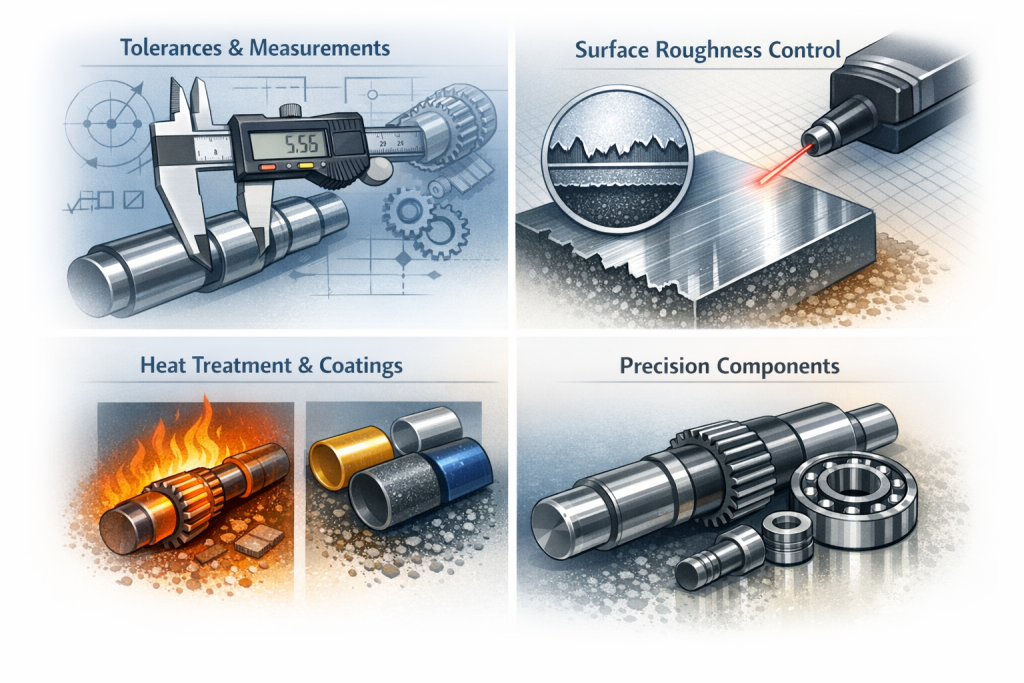
Surface engineering further enhances component durability. Heat treatments such as quenching, tempering, carburizing, or induction hardening are applied to improve hardness and fatigue life. In harsh environments, protective coatings or corrosion-resistant alloys may be necessary. The material and treatment strategy must align with both mechanical demands and manufacturing capabilities.
4. Detailed Design and Tolerance Specification
After conceptual approval, engineers refine the design with precise dimensions and tolerances. This includes specifying shaft diameters, keyways, spline geometry, gear module, tooth profile, backlash, and surface roughness.
Tolerances are critical for ensuring proper fit with mating components. Overly tight tolerances increase manufacturing cost, while loose tolerances can cause vibration, noise, or premature failure. A balanced approach is required, often guided by industry standards such as ISO or AGMA for gears and shafts.
5. Manufacturing Planning and Process Selection
With finalized drawings, manufacturers develop a production plan. This involves selecting appropriate processes such as CNC machining, gear hobbing, grinding, broaching, or spline cutting. For complex components, multiple operations may be required, including rough machining, heat treatment, and precision finishing.
Process control is essential to maintain dimensional accuracy and surface quality. Advanced machining centers, high-precision grinding machines, and automated inspection systems are often employed to ensure repeatability and consistency.
6. Prototyping and Validation Testing
Before full-scale production, prototypes or pilot parts are typically manufactured. These samples undergo mechanical testing, including hardness measurement, fatigue testing, and sometimes real-world performance trials in actual machinery.
If issues are detected—such as unexpected vibration, wear patterns, or assembly difficulties—design adjustments are made. This iterative loop between design and testing is a hallmark of high-quality custom engineering.
7. Quality Assurance and Inspection
Quality assurance is integrated throughout the manufacturing process. Critical inspections include dimensional verification using coordinate measuring machines (CMM), surface roughness testing, hardness checks, and non-destructive testing methods such as magnetic particle or ultrasonic inspection to detect internal defects.
For gears, specialized equipment measures tooth profile accuracy, pitch error, and contact pattern. Only components that meet strict acceptance criteria proceed to final delivery.
8. Final Production and Delivery
Once validated, components move into full-scale production. Batch consistency is maintained through standardized procedures, documented process parameters, and continuous monitoring. Finished parts are packaged appropriately to prevent damage during transport and delivered with technical documentation, including material certificates, inspection reports, and maintenance recommendations.
9. Installation, Monitoring, and Lifecycle Support
The process does not end at delivery. Many manufacturers provide installation guidance, alignment checks, and operational recommendations. In high-criticality applications, condition monitoring systems—such as vibration analysis or oil analysis—may be used to track component performance over time.
Feedback from field performance often informs future design improvements, creating a continuous cycle of learning and optimization.
Kết luận
The journey from design to manufacturing of custom transmission components is a complex but highly structured process that integrates engineering analysis, material science, precision manufacturing, and rigorous quality control. By following a systematic workflow—from requirement definition to lifecycle support—manufacturers can deliver components that not only meet but often exceed customer expectations in performance, reliability, and durability.
For industries relying on high-performance machinery, investing in a robust end-to-end development process is not just a technical necessity, but a strategic advantage.

 Vietnamese
  English
  Korean
  Japanese
  Russian
  Arabic
  Spanish
  German
  French
  Italian
  Portuguese
  Chinese
  Dutch
Dutch  Polish
  Czech
Czech  Hungarian
  Finnish
  Swedish
  Thai
Thai  Turkish