
O-rings are among the most widely used sealing elements in industrial equipment due to their simplicity, reliability, and cost-effectiveness. However, their performance depends heavily on whether they are used in static or dynamic applications. Understanding the difference is essential for proper material selection, groove design, and long-term reliability.
1. What Is a Static O-Ring Seal?
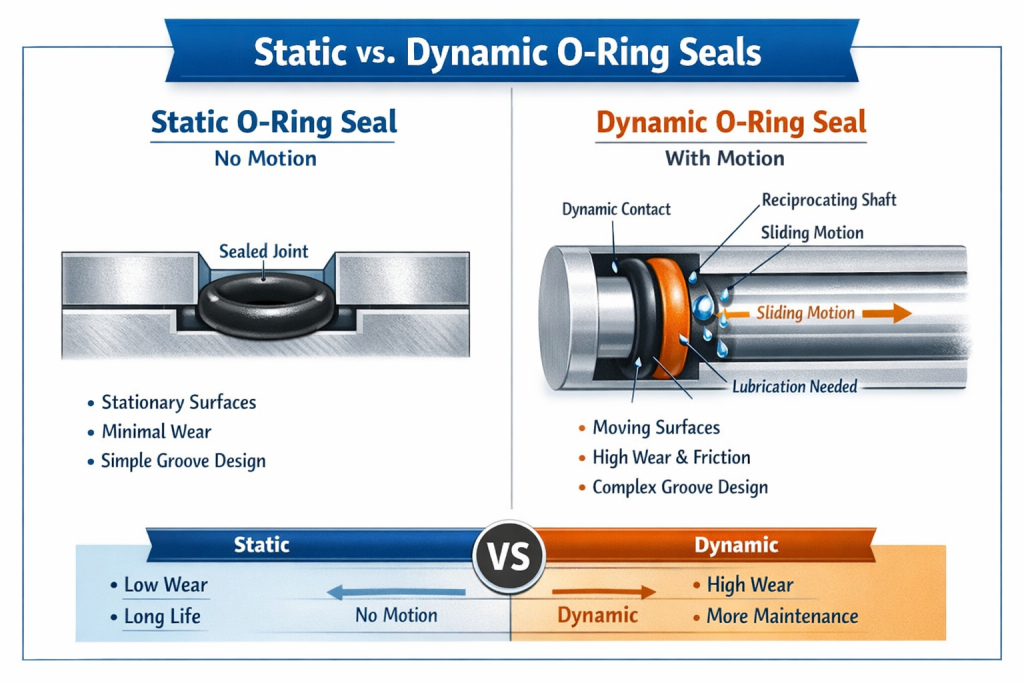
A static O-ring seal is used in applications where there is no relative motion between the sealing surfaces.
Tipik Uygulamalar
- Flange connections
- Hydraulic cylinder end caps
- Valve covers
- Pump housings
How It Works
The O-ring is compressed between two stationary surfaces. The compression creates initial sealing force, and system pressure further energizes the seal by pushing the O-ring against the groove wall.
Key Characteristics
- Minimal wear
- Lower friction concerns
- Longer service life
- Simpler groove design
- Lower failure risk
Common Failure Modes
- Over-compression leading to extrusion
- Chemical incompatibility
- Compression set over long periods
Static sealing is generally more forgiving and reliable compared to dynamic sealing.
2. What Is a Dynamic O-Ring Seal?
A dynamic O-ring seal operates in applications where there is relative motion between sealing surfaces.
Dynamic motion can be:
- Reciprocating motion (e.g., hydraulic cylinders)
- Rotary motion (e.g., rotating shafts)
Tipik Uygulamalar
- Hydraulic pistons
- Pneumatic cylinders
- Rotating shafts
- Pompalar ve kompresörler
How It Works
The O-ring maintains contact while sliding against a moving surface. It must resist friction, heat buildup, and wear.
Key Characteristics
- Subject to friction and abrasion
- Higher heat generation
- Requires lubrication
- More complex groove design
- Greater risk of failure
Common Failure Modes
- Abrasion and wear
- Spiral failure (twisting in groove)
- Thermal degradation
- Extrusion under pressure
- Surface scoring due to poor finish
Dynamic applications are significantly more demanding than static ones.
3. Engineering Comparison
| Özellik | Static O-Ring | Dynamic O-Ring |
|---|---|---|
| Relative Motion | None | Reciprocating or rotary |
| Sürtünme | Minimal | Continuous friction |
| Wear Rate | Very Low | Orta ila Yüksek |
| Lubrication Requirement | Often unnecessary | Usually required |
| Groove Design | Basit | More precise tolerance required |
| Service Life | Typically longer | Typically shorter |
4. Design Considerations
For Static Seals
- Ensure correct squeeze (typically 15–30%)
- Avoid overfilling the groove
- Verify chemical compatibility
For Dynamic Seals
- Control surface finish (Ra typically 0.2–0.8 µm depending on speed)
- Provide proper lubrication
- Optimize groove fill (usually lower than static)
- Consider anti-extrusion backup rings in high-pressure systems
- Select low-friction materials (e.g., FKM, HNBR, PTFE blends)
5. Material Selection Differences
Dynamic applications often require:
- Higher wear resistance
- Better tear strength
- Lower compression set
- Superior thermal stability
Static applications prioritize:
- Chemical compatibility
- Long-term compression resistance
Sonuç
The primary difference between static and dynamic O-ring seals lies in whether motion is present. Static O-rings seal stationary interfaces and generally offer longer life with fewer complications. Dynamic O-rings operate under sliding contact, requiring careful engineering in material selection, lubrication, and groove design to prevent wear and failure.
Selecting the wrong type or designing without accounting for motion conditions can significantly increase leakage risk and maintenance costs.

 Turkish
  English
  Korean
  Japanese
  Russian
  Arabic
  Spanish
  German
  French
  Italian
  Portuguese
  Chinese
  Dutch
Dutch  Polish
  Czech
Czech  Hungarian
  Finnish
  Swedish
  Vietnamese
  Thai
Thai