
Sealing technology is fundamental to modern mechanical systems. From hydraulic cylinders and pumps to aerospace actuators, chemical reactors, and precision instruments, seals determine whether equipment operates reliably, efficiently, and safely. Among all sealing solutions, static seals ve dynamic seals represent two major categories with fundamentally different design principles, working conditions, and failure mechanisms. Understanding their differences is critical for engineers, procurement specialists, and maintenance teams involved in component selection and system design.
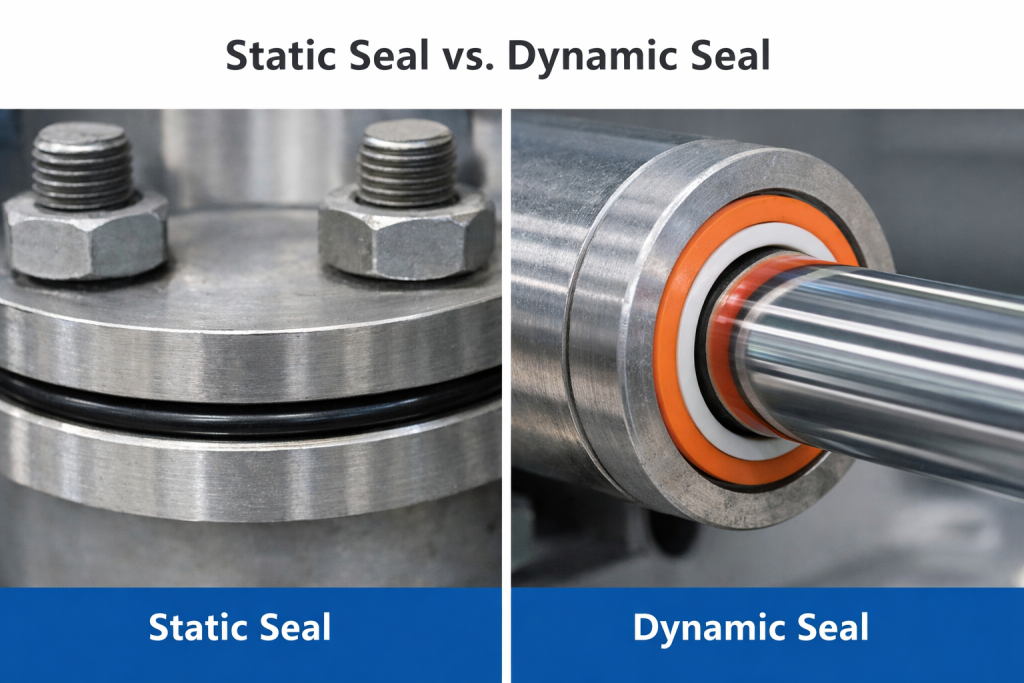
1. What Are Static Seals?
A static seal is designed to prevent fluid leakage between two stationary mating surfaces. In this case, there is no relative motion between the sealed components during normal operation. The sealing effect is achieved primarily through compression, material deformation, and surface conformity.
Tipik Uygulamalar
Common examples of static seals include:
- O-rings in flange joints
- Gaskets in engine blocks
- Flat seals in pressure vessels
- Seals in pipeline connections
In these cases, the two surfaces are clamped together by bolts or mechanical fastening, and the seal material deforms to fill microscopic surface irregularities, blocking fluid passage.
Key Characteristics
Static seals are characterized by:
- No relative motion between mating surfaces
- Compression-based sealing mechanism
- Long service life under stable conditions
- Sensitivity to temperature, pressure, and material aging
The performance of static seals depends heavily on three factors:
- Surface finish of the mating components
- Compression force applied to the seal
- Material compatibility with the working fluid
If the compression is insufficient, leakage can occur. If it is excessive, the seal may experience permanent deformation or extrusion.
2. What Are Dynamic Seals?
A dynamic seal is used where there is relative motion between the sealed components. This motion can be linear (reciprocating), rotational, or oscillatory. Unlike static seals, dynamic seals must maintain sealing performance while experiencing continuous movement and friction.
Tipik Uygulamalar
Dynamic seals are widely used in:
- Hydraulic cylinders (piston and rod seals)
- Rotary shafts in pumps and motors
- Pneumatic actuators
- Gearboxes and bearings
A classic example is a hydraulic cylinder rod seal, which must prevent oil leakage while the rod moves back and forth thousands of times per hour.
Key Characteristics
Dynamic seals must balance two competing requirements:
- Effective sealing to prevent fluid loss
- Low friction to minimize energy consumption and wear
This makes their design significantly more complex than static seals.
Critical factors influencing dynamic seal performance include:
- Surface roughness of the moving shaft or rod
- Lubrication conditions
- Temperature fluctuations
- Speed and pressure of motion
Unlike static seals, dynamic seals are subject to wear and must be replaced periodically as part of maintenance schedules.
3. Core Differences Between Static and Dynamic Seals
| Aspect | Statik Contalar | Dinamik Contalar |
|---|---|---|
| Relative motion | None | Present |
| Primary sealing mechanism | Compression | Combination of compression, friction control, and hydrodynamic effects |
| Wear | Minimal | Significant over time |
| Sürtünme | Negligible | Must be carefully managed |
| Material requirements | Elasticity and chemical resistance | Elasticity + wear resistance + low friction |
| Typical failure modes | Compression set, aging, chemical degradation | Wear, extrusion, heat buildup, abrasion |
This table highlights that static seals prioritize stability, while dynamic seals prioritize durability under motion.
4. Material Selection: A Critical Distinction
The choice of material differs greatly between static and dynamic seals.
Static Seal Materials
Common materials include:
- NBR (nitrile rubber)
- EPDM
- Silicone rubber
- PTFE (in certain high-temperature applications)
These materials are chosen for their ability to deform under compression and maintain sealing over long periods without movement.
Dynamic Seal Materials
Dynamic seals require materials that can withstand friction and repeated motion, such as:
- Polyurethane (PU)
- PTFE with fillers (glass, carbon, bronze)
- High-performance elastomers like FKM (Viton)
These materials are engineered to resist wear, reduce friction, and tolerate temperature and pressure variations.
5. Engineering Implications in System Design
From an engineering standpoint, the selection between static and dynamic seals affects overall system reliability and maintenance strategy.
For systems with:
- No moving parts at the seal interface → choose static seals
- Moving parts → choose dynamic seals
However, many systems require both. For example, a hydraulic cylinder uses:
- Dynamic seals for the moving piston and rod
- Static seals for fixed joints and end caps
This hybrid approach is common in industrial equipment.
6. Failure Modes and Maintenance Considerations
Static Seal Failure
Typical issues include:
- Compression set (loss of elasticity over time)
- Chemical swelling or degradation
- Thermal aging
Preventive measures include proper material selection, correct bolt torque, and periodic inspection.
Dynamic Seal Failure
Common failure modes include:
- Aşındırıcı aşınma
- Heat-induced hardening
- Surface damage on shafts or rods
- Contamination by particles
To extend service life, engineers must ensure:
- Smooth surface finish of moving components
- Proper lubrication
- Clean operating environment
7. Conclusion
The fundamental difference between static seals and dynamic seals lies in whether relative motion exists at the sealing interface. Static seals are optimized for stability and long-term compression, while dynamic seals are engineered to balance sealing performance with friction and wear resistance.
For manufacturers, engineers, and procurement professionals, understanding this distinction is not just academic—it directly impacts equipment reliability, maintenance costs, and operational efficiency.
By selecting the right type of seal for the right application, companies can reduce downtime, improve safety, and enhance overall system performance.

 Turkish
  English
  Korean
  Japanese
  Russian
  Arabic
  Spanish
  German
  French
  Italian
  Portuguese
  Chinese
  Dutch
Dutch  Polish
  Czech
Czech  Hungarian
  Finnish
  Swedish
  Vietnamese
  Thai
Thai