
Wire ropes are essential components in offshore operations, including cranes, winches, mooring lines, and lifting equipment. The harsh marine environment exposes steel wire ropes to saltwater, humidity, strong winds, and variable temperatures, which accelerate corrosion and reduce their operational lifespan. Ensuring the durability and safety of wire ropes in offshore applications requires a comprehensive approach that combines proper material selection, corrosion protection, lubrication, inspection, and maintenance strategies.
Material Selection and Protective Coatings
Selecting the appropriate material is the first step in mitigating corrosion for offshore wire ropes. Carbon steel wire ropes, while strong and cost-effective, are highly susceptible to corrosion in saltwater environments. Stainless steel ropes provide excellent corrosion resistance and are suitable for critical applications but are more expensive. Galvanized steel ropes, coated with zinc, offer a balance between cost and corrosion resistance and are commonly used in general offshore operations.
In addition to material selection, protective coatings enhance the rope’s resistance to the harsh environment. Epoxy-coated or polymer-coated wire ropes provide a barrier against moisture and salt, reducing the risk of surface and internal corrosion. When selecting a coating, it is important to ensure compatibility with the rope construction and the intended working conditions, such as exposure to sunlight, temperature extremes, and mechanical abrasion.
Lubrication and Anti-Corrosion Treatments
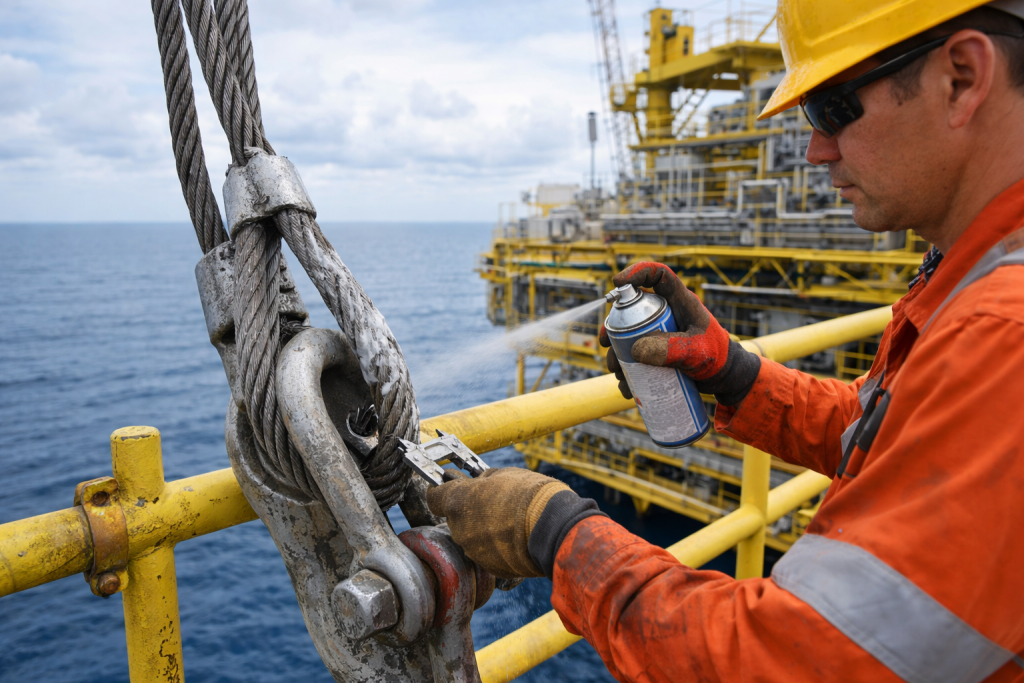
Lubrication plays a critical role in both corrosion prevention and operational efficiency. Lubricants reduce internal friction between strands, minimize wear, and provide a protective layer against moisture and salt deposits. Offshore lubricants are typically formulated with corrosion inhibitors and water-repellent additives to withstand marine conditions.
Regular re-lubrication schedules should be established based on operating frequency, load conditions, and environmental exposure. High-speed lifting applications or ropes subjected to frequent bending and heavy loads may require more frequent lubrication to maintain optimal performance. Additionally, temporary protective coatings such as grease wraps can be applied during storage or transport to further reduce corrosion risk.
Inspection and Monitoring
Routine inspection is critical for offshore wire rope safety. Visual inspections should focus on broken wires, corrosion, kinking, crushing, and wear at contact points such as sheaves and hooks. Special attention should be given to sections of the rope submerged in seawater, as these areas are prone to accelerated corrosion.
Non-destructive testing methods, such as magnetic flux leakage (MFL) or acoustic emission monitoring, provide insight into internal damage that is not visible externally. Advanced monitoring systems can detect broken strands, diameter reduction, and corrosion progress, allowing proactive maintenance before catastrophic failures occur. Maintaining detailed inspection logs and service records is essential for assessing rope health and planning replacements.
Preventive Maintenance and Storage
Preventive maintenance extends wire rope service life and enhances operational safety. Proper handling, including avoiding sharp bends, side loading, and sudden shock loads, reduces mechanical stress on the rope. Operators should ensure that ropes are properly aligned on drums and sheaves to prevent uneven wear and internal strand deformation.
When not in use, offshore wire ropes should be stored in a dry, well-ventilated environment. For ropes that must remain on equipment, temporary protective coatings or covers can prevent saltwater accumulation and UV degradation. During storage and transport, coils should be supported to prevent crushing or kinking, and ropes should be cleaned and inspected before returning to service.
Replacement Criteria and Risk Mitigation
Despite preventive measures, offshore wire ropes eventually reach the end of their service life. Replacement criteria should follow manufacturer recommendations and industry standards such as ISO 4309. Indicators for replacement include excessive broken wires, visible corrosion or pitting, significant diameter reduction, kinking, or internal fatigue.
In addition to mechanical and visual criteria, operational risk assessments should inform replacement decisions. High-stakes offshore applications, such as lifting personnel or heavy equipment, require more conservative replacement thresholds to ensure safety. Combining timely replacement with preventive maintenance and inspection protocols ensures continuous operational reliability and reduces the risk of accidents.
Sonuç
Wire ropes in offshore operations face unique challenges due to the corrosive marine environment. Effective corrosion protection and maintenance strategies encompass material selection, protective coatings, proper lubrication, routine inspection, preventive handling, and timely replacement. By implementing these strategies, operators can maximize the lifespan and safety of wire ropes, minimize downtime, and ensure efficient, reliable offshore operations. Continuous monitoring, adherence to manufacturer guidelines, and operator training are essential for mitigating corrosion-related risks and maintaining safe lifting and hoisting practices in the offshore industry.

 Turkish
  English
  Korean
  Japanese
  Russian
  Arabic
  Spanish
  German
  French
  Italian
  Portuguese
  Chinese
  Dutch
Dutch  Polish
  Czech
Czech  Hungarian
  Finnish
  Swedish
  Vietnamese
  Thai
Thai