
Original Equipment Manufacturers (OEMs) operate in highly competitive markets where performance, reliability, and lifecycle cost directly impact brand reputation. Standard off-the-shelf seals often cannot fully meet unique design requirements, especially in demanding industrial applications. Custom sealing solutions allow OEMs to optimize performance, extend service life, and differentiate their equipment in the market.
Why OEMs Require Custom Sealing Solutions
OEM equipment often involves specific combinations of pressure, temperature, motion, media exposure, and space constraints. Standard seals may not adequately address:
- Non-standard groove dimensions
- Extreme pressure or temperature conditions
- Aggressive chemical environments
- High-speed or high-cycle dynamic movement
- Compact or lightweight design requirements
- Long maintenance intervals
Custom sealing solutions are engineered to match these precise operational parameters.
Key Design Considerations
1. Operating Conditions
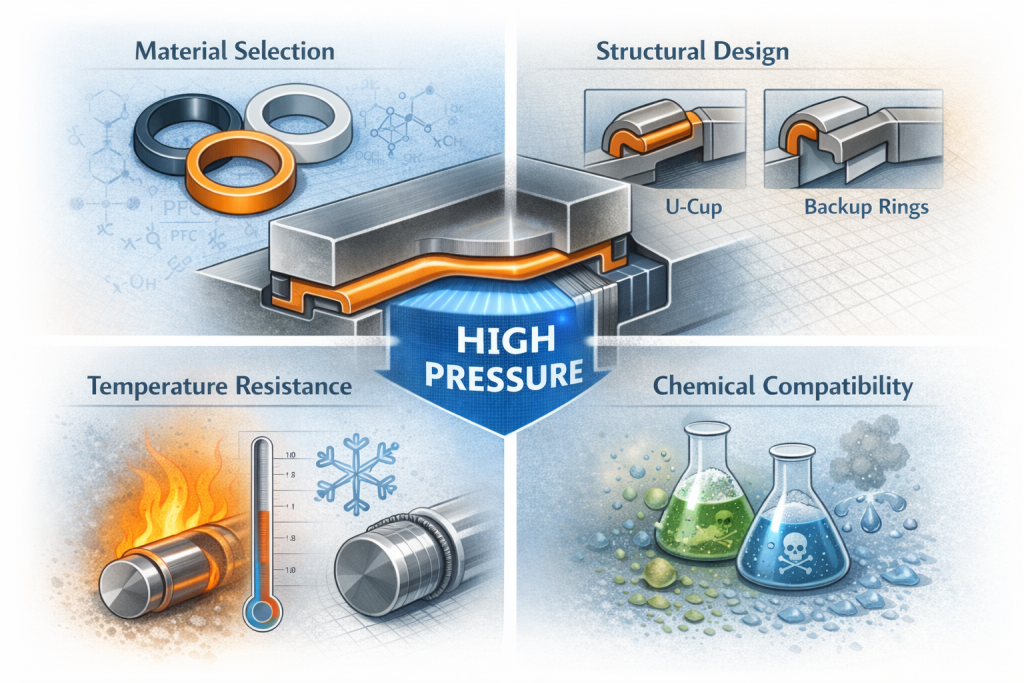
A detailed analysis of working pressure, temperature range, movement type (static, reciprocating, rotary), and environmental exposure is essential. High-pressure hydraulic systems, for example, require anti-extrusion designs, while high-speed rotary systems prioritize low-friction materials.
2. Material Selection
Material choice determines sealing performance and longevity. Options may include:
- NBR for general hydraulic applications
- FKM for high-temperature and chemical resistance
- PTFE for low friction and aggressive media
- Polyurethane for high wear resistance
- FFKM for extreme chemical and thermal stability
Material compatibility testing ensures durability under real-world conditions.
3. Geometry and Groove Design
Custom profiles such as modified U-cups, lip seals, energized PTFE seals, or multi-component sealing systems can significantly improve reliability. Groove tolerances, surface finish, and compression ratio must be precisely engineered to prevent leakage and premature wear.
4. Pressure and Extrusion Control
In high-pressure applications, backup rings or reinforced designs are often required to prevent seal extrusion. Finite element analysis (FEA) can be used during development to simulate stress distribution and optimize performance.
5. Surface Finish and Counterface Materials
Seal performance is strongly influenced by the mating surface. Proper surface roughness and hardness reduce friction and wear while improving sealing efficiency.
Custom Sealing Applications for OEMs
- Hydraulic cylinders in construction machinery
- High-speed spindles in CNC equipment
- Pumps and valves in chemical processing
- Offshore lifting equipment
- Agricultural and mining machinery
- Food processing and pharmaceutical systems
Each industry demands specific sealing solutions aligned with safety standards and environmental conditions.
Advantages of Custom Sealing for OEM Manufacturers
- Improved equipment reliability
- Reduced warranty claims
- Longer maintenance intervals
- Enhanced energy efficiency
- Lower total lifecycle cost
- Competitive product differentiation
Custom solutions also allow OEMs to standardize components across product lines while maintaining performance integrity.
Engineering Collaboration Process
Successful custom sealing development typically includes:
- Technical requirement analysis
- Material selection and compatibility review
- Prototype design and testing
- Performance validation
- Pilot production and feedback optimization
- Mass production with quality control systems
Close cooperation between OEM engineers and sealing specialists ensures the final solution meets performance targets.
Quality and Compliance
OEM projects often require strict quality management and documentation, including:
- Dimensional inspection reports
- Material certification
- Pressure and durability testing
- Compliance with industry standards
Reliable manufacturing processes and traceability systems are critical for long-term partnerships.
สรุป
Custom sealing solutions provide OEM equipment manufacturers with the flexibility to meet complex engineering challenges while enhancing durability and system performance. By integrating material science, precision engineering, and application-specific design, OEMs can achieve superior reliability and long-term cost efficiency.
For manufacturers operating in demanding industrial sectors, customized sealing systems are not just an option—they are a strategic advantage.
 Thai
Thai  English
  Korean
  Japanese
  Russian
  Arabic
  Spanish
  German
  French
  Italian
  Portuguese
  Chinese
  Dutch
Dutch  Polish
  Czech
Czech  Hungarian
  Finnish
  Swedish
  Vietnamese
  Turkish