
Hydraulic cylinders operating in harsh environments face extreme challenges, including high pressure, abrasive contamination, temperature fluctuations, moisture, and chemical exposure. In industries such as mining, construction, offshore drilling, and heavy manufacturing, improper sealing can lead to leakage, pressure loss, premature wear, and costly downtime. Selecting the right sealing solution is essential for maintaining performance, safety, and long-term reliability.
1. Challenges in Harsh Environments
Hydraulic systems in demanding conditions must withstand:
• High operating pressures (often exceeding 30–50 MPa)
• Abrasive particles such as dust, sand, or metal debris
• Corrosive exposure (saltwater, chemicals, humidity)
• Extreme temperatures (sub-zero to high-heat applications)
• Continuous reciprocating motion under heavy load
Without proper sealing, contaminants enter the system, degrade hydraulic fluid, and damage internal components.
2. Key Seal Types for Hydraulic Cylinders
Rod Seals
Prevent hydraulic fluid from escaping the cylinder while maintaining pressure. Critical for dynamic sealing under reciprocating motion.
Piston Seals
Maintain pressure separation between cylinder chambers and ensure smooth load transfer.
Wiper (Scraper) Seals
Remove dirt, moisture, and debris from the rod surface during retraction, preventing contamination ingress.
Guide Rings / Wear Rings
Support lateral loads and prevent metal-to-metal contact, extending cylinder lifespan.
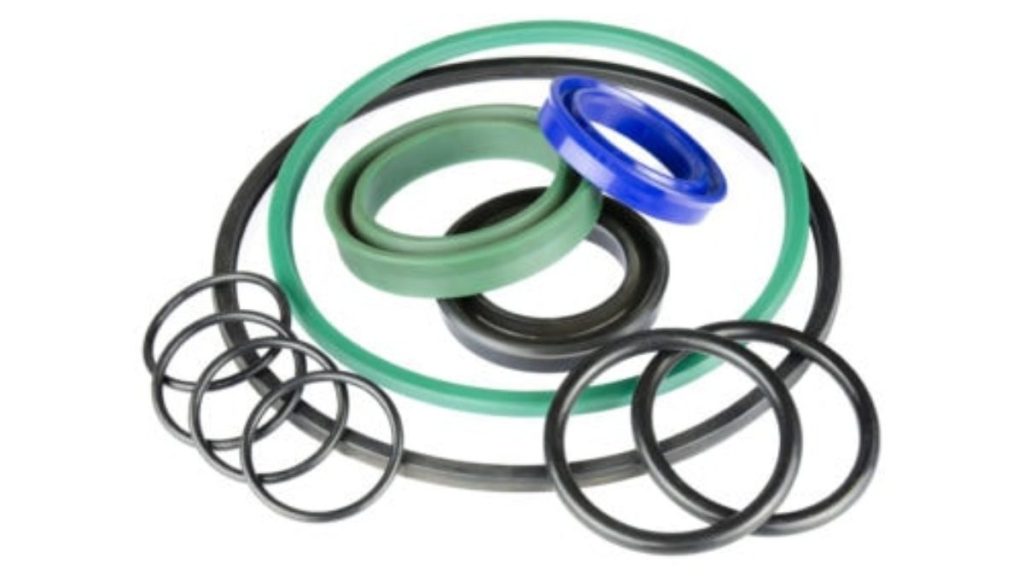
In harsh environments, a combination sealing system is typically required rather than a single seal solution.
3. Material Selection Considerations
Material choice determines chemical resistance, temperature tolerance, and wear performance.
NBR (ยางไนไตรล์)
Suitable for petroleum-based hydraulic fluids and moderate temperatures. Cost-effective for general industrial use.
FKM (Fluorocarbon)
Offers superior chemical resistance and high-temperature capability. Ideal for aggressive fluids and elevated temperatures.
Polyurethane (PU)
Excellent abrasion resistance and high load-bearing capacity. Commonly used in heavy-duty mining and construction cylinders.
PTFE (โพลีเทตระฟลูออรีทีลีน)
Low friction and outstanding chemical resistance. Frequently used in high-speed or high-temperature systems.
Engineering Insight: In abrasive environments, polyurethane or PTFE-based seals significantly extend service life compared to standard elastomers.
4. Pressure and Load Handling
Hydraulic cylinders in heavy-duty operations require seals capable of handling:
• High static and dynamic pressure
• Pressure spikes and shock loads
• Side loading and misalignment
Backup rings are often integrated to prevent extrusion under high pressure. Proper groove design and clearance control are essential to avoid premature seal failure.
5. Contamination Control Strategies
Effective contamination management includes:
• Heavy-duty wiper seals with reinforced lips
• Double-lip rod seals for improved fluid retention
• Corrosion-resistant coatings on rods
• Regular fluid filtration and maintenance schedules
A well-designed sealing system not only prevents leakage but also protects internal components from abrasive damage.
6. Temperature Resistance
Extreme cold can cause elastomer hardening and leakage. Excessive heat accelerates material degradation and reduces elasticity. Seal selection should match the actual operating temperature range, not just theoretical system limits.
High-temperature systems may require FKM or PTFE materials, while low-temperature environments may demand specially formulated elastomers.
7. Maintenance and Service Life Optimization
To maximize seal lifespan:
• Ensure proper installation without twisting or damage
• Maintain correct surface finish on rods and cylinder bores
• Use compatible hydraulic fluids
• Follow preventive inspection schedules
Predictive maintenance and early detection of leakage or wear reduce unplanned downtime.
8. Application Examples
Mining Equipment
Requires abrasion-resistant polyurethane seals with reinforced wipers.
Offshore Hydraulic Systems
Demand corrosion-resistant materials and chemical-resistant seals.
Construction Machinery
Often benefits from multi-stage sealing systems combining wipers, rod seals, and wear rings.
Industrial Press Systems
Require high-pressure seals with backup rings to prevent extrusion.
สรุป
Hydraulic cylinders operating in harsh environments require carefully engineered sealing solutions that address pressure, contamination, temperature, and chemical exposure. Proper material selection, multi-stage sealing systems, and correct installation practices ensure reduced leakage, extended service life, and improved operational safety.
Investing in the right sealing system lowers total lifecycle costs and enhances equipment reliability in the most demanding industrial conditions.

 Thai
Thai  English
  Korean
  Japanese
  Russian
  Arabic
  Spanish
  German
  French
  Italian
  Portuguese
  Chinese
  Dutch
Dutch  Polish
  Czech
Czech  Hungarian
  Finnish
  Swedish
  Vietnamese
  Turkish