
คู่มือทางเทคนิค

Metal Seals vs. Non-Metal Seals: Rethinking Boundaries and Cost Trade-offs in Industrial Systems

In industrial engineering, sealing is often treated as a secondary design consideration—a consumable chosen at the end of the design cycle. This mindset is increasingly dangerous. As operating pressures rise, chemical environments become harsher, and reliability expectations tighten, the choice between metal seals and non-metal seals has evolved into a strategic engineering decision rather than […]
Metal Seals vs. Non-Metal Seals: Rethinking Boundaries and Cost Trade-offs in Industrial Systems อ่านเพิ่มเติม »

FFKM, FKM และ PTFE: วิธีการเลือกวัสดุซีลที่เหมาะสมที่สุดสำหรับสภาวะสุดขีด

Sealing technology plays a decisive role in the reliability, safety, and efficiency of modern industrial systems. In environments characterized by high pressure, extreme temperatures, aggressive chemicals, or high-speed motion, the choice of sealing material can determine whether equipment operates smoothly or fails catastrophically. Among the most widely used high-performance sealing materials are perfluoroelastomers (FFKM), fluoroelastomers

FFKM, FKM และ PTFE: วิธีการเลือกวัสดุซีลที่เหมาะสมที่สุดสำหรับสภาวะสุดขีด อ่านเพิ่มเติม »

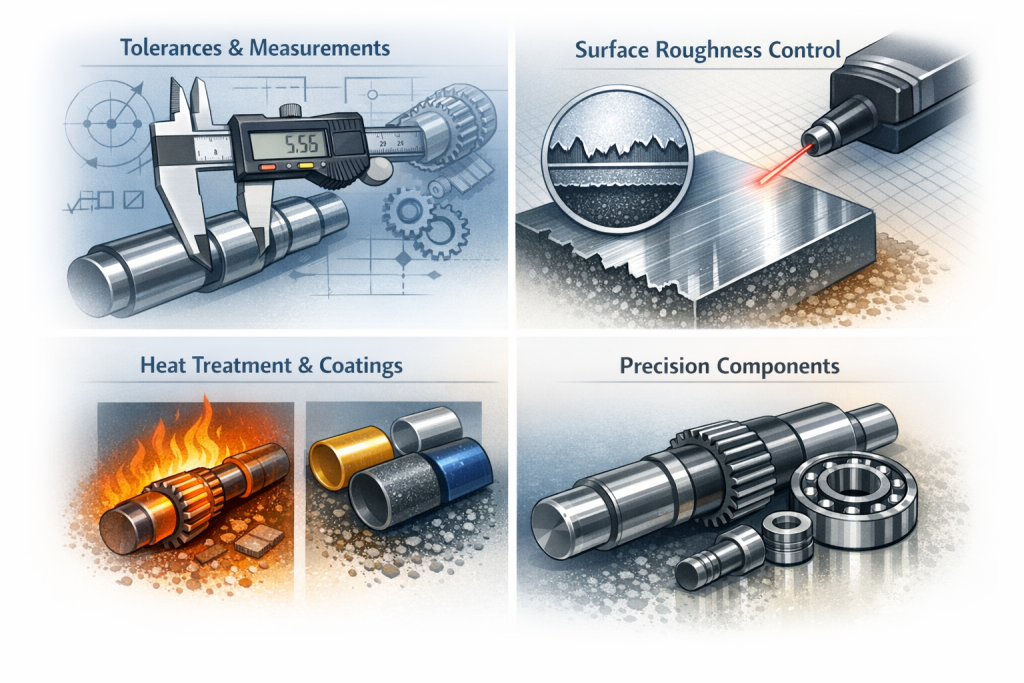
ความคลาดเคลื่อนและการตกแต่งพื้นผิวในชิ้นส่วนเครื่องจักรกลความแม่นยำสูง

High-precision mechanical components are essential in industries such as aerospace, automotive, robotics, semiconductor equipment, medical devices, and advanced manufacturing. The performance, reliability, and service life of these components depend not only on material selection and design but also on two critical engineering factors: dimensional tolerances and surface treatments. Together, these elements determine how well a

ความคลาดเคลื่อนและการตกแต่งพื้นผิวในชิ้นส่วนเครื่องจักรกลความแม่นยำสูง อ่านเพิ่มเติม »

From Design to Manufacturing: The End-to-End Process of Custom Transmission Components

Custom transmission components—such as shafts, gears, couplings, and related powertrain parts—are critical to the performance, reliability, and efficiency of industrial machinery. Unlike standard parts, custom components must be tailored to specific operating conditions, loads, and system constraints. Achieving high-quality results requires a structured, multidisciplinary process that integrates engineering design, materials science, manufacturing technology, and quality

From Design to Manufacturing: The End-to-End Process of Custom Transmission Components อ่านเพิ่มเติม »

ทำไมตลับลูกปืนอุตสาหกรรมจึงหันมาใช้เซรามิกมากขึ้น

1. Introduction: From Steel to Ceramics – A Paradigm Shift For more than a century, industrial bearings have relied primarily on high-carbon chromium steel (such as AISI 52100) as the dominant rolling element material. Steel bearings have powered everything from automobiles and turbines to machine tools and industrial motors. However, as industries push toward higher

ทำไมตลับลูกปืนอุตสาหกรรมจึงหันมาใช้เซรามิกมากขึ้น อ่านเพิ่มเติม »

thThai