
ความรู้เกี่ยวกับผลิตภัณฑ์

Single Lip vs Double Lip Seal: Which Provides Better Protection?

Sealing technology is critical in hydraulic, pneumatic, and rotating machinery. Among lip-type seals, single lip and double lip seals are widely used to prevent contamination, retain lubrication, and extend equipment lifespan. Understanding their structural differences, protection capabilities, and operational suitability is essential for engineers and maintenance professionals. 1. Structural Differences Single Lip Seal: Double Lip […]

Single Lip vs Double Lip Seal: Which Provides Better Protection? อ่านเพิ่มเติม »
O-Ring vs U-Cup Seal: Load Capacity and Leakage Resistance

Sealing components are crucial in hydraulic, pneumatic, and industrial systems. Among the most widely used are O-rings and U-cup seals. While both prevent fluid leakage, they differ in design, load capacity, leakage resistance, and suitability for various applications. Selecting the right seal ensures system efficiency, safety, and long service life. 1. Structural Differences O-Rings: U-Cup

O-Ring vs U-Cup Seal: Load Capacity and Leakage Resistance อ่านเพิ่มเติม »

Wire Rope vs Chain Slings: Pros and Cons for Industrial Lifting

In industrial lifting and rigging operations, selecting the correct lifting medium is crucial for safety, efficiency, and cost-effectiveness. Wire rope slings and chain slings are two of the most common options. Each has unique mechanical properties, load capacities, and suitability for specific applications. Understanding their advantages and limitations allows engineers and safety managers to make

Wire Rope vs Chain Slings: Pros and Cons for Industrial Lifting อ่านเพิ่มเติม »

Single-Strand vs Multi-Strand Wire Rope: Applications and Load Capacity

Wire ropes are essential in lifting, hoisting, and rigging applications across industries such as construction, mining, and marine. Choosing the right type of wire rope significantly impacts operational safety, load capacity, and service life. Two common configurations are single-strand and multi-strand wire ropes, each optimized for specific operational requirements. 1. Structural Differences Single-Strand Wire Rope

Single-Strand vs Multi-Strand Wire Rope: Applications and Load Capacity อ่านเพิ่มเติม »

Ball Bearing vs Roller Bearing: Load Capacity and Application Comparison

Ball Bearing vs Roller Bearing: Load Capacity and Application Comparison Bearings are essential components in machinery, reducing friction, supporting loads, and ensuring smooth rotational motion. Among the most common types, ball bearings and roller bearings are widely used across industries, yet their performance characteristics differ significantly. Understanding these differences helps engineers select the right bearing

Ball Bearing vs Roller Bearing: Load Capacity and Application Comparison อ่านเพิ่มเติม »

Open Bearing vs Sealed Bearing: Maintenance and Lifespan Differences

Bearings are critical components in industrial machinery, ensuring smooth rotation, reducing friction, and supporting radial and axial loads. When selecting bearings, engineers and procurement specialists must decide between open bearings and sealed bearings, each optimized for different operational and maintenance requirements. Understanding their differences in maintenance needs, lifespan, and application suitability can significantly impact equipment

Open Bearing vs Sealed Bearing: Maintenance and Lifespan Differences อ่านเพิ่มเติม »

Hydraulic Seal vs Pneumatic Seal: Key Differences in Performance

Sealing solutions are critical in both hydraulic and pneumatic systems. They maintain pressure, prevent leakage, and ensure long-term equipment reliability. While both hydraulic seals and pneumatic seals share the fundamental purpose of containment, their design, material selection, and performance requirements differ significantly. Choosing the correct seal type is essential for maximizing system efficiency, longevity, and

Hydraulic Seal vs Pneumatic Seal: Key Differences in Performance อ่านเพิ่มเติม »

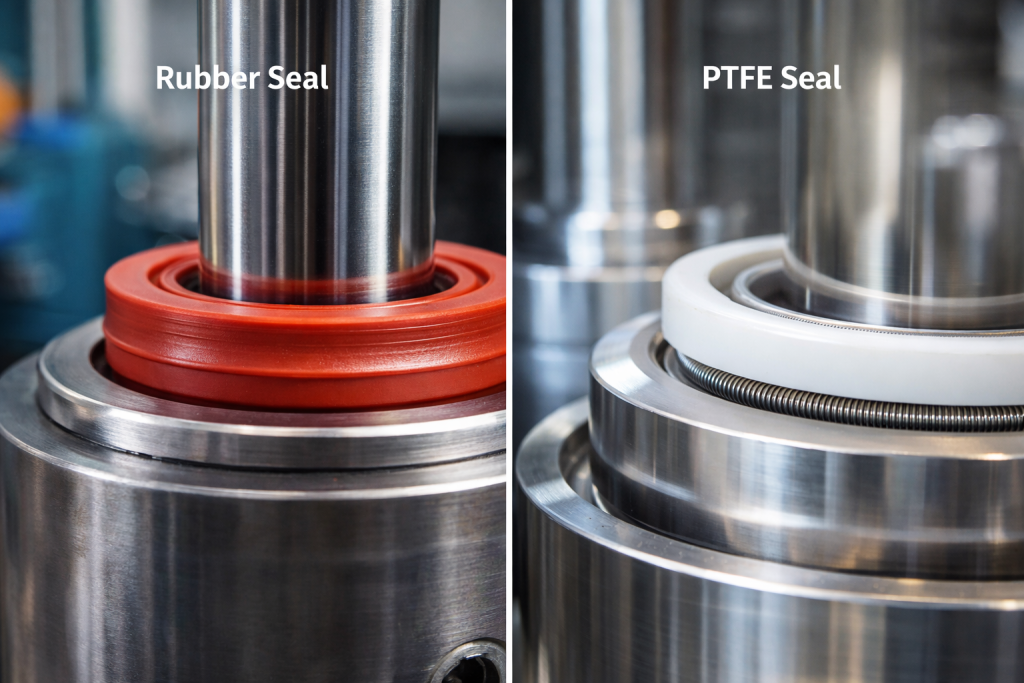
Rubber Seal vs PTFE Seal: Which Material Is Right for Your System?

In industrial hydraulic and pneumatic systems, sealing performance directly determines system efficiency, leakage control, maintenance frequency, and equipment lifespan. Among various sealing materials, rubber-based seals and PTFE (Polytetrafluoroethylene) seals are two of the most widely used options. Although both serve the same fundamental function—preventing fluid or gas leakage—their material properties, operating limits, and long-term behavior

Rubber Seal vs PTFE Seal: Which Material Is Right for Your System? อ่านเพิ่มเติม »

Galvanized Wire Rope vs Stainless Steel Wire Rope: Durability and Cost Comparison

In industrial applications ranging from construction and lifting systems to marine and architectural installations, choosing the right type of wire rope is critical for performance, longevity, and lifecycle cost. Two common options are galvanized wire rope and stainless steel wire rope, each with distinct characteristics, advantages, and cost structures. What Are They? Galvanized wire rope

Galvanized Wire Rope vs Stainless Steel Wire Rope: Durability and Cost Comparison อ่านเพิ่มเติม »

Steel Wire Rope vs Synthetic Fiber Rope: Which Is Better for Heavy Lifting?

In heavy lifting operations such as mining, construction, offshore platforms, and port handling systems, selecting the appropriate lifting medium directly affects safety, operational efficiency, and lifecycle cost. The two dominant solutions in the market are steel wire rope and synthetic fiber rope. Although both are used for load-bearing applications, their mechanical properties, durability profiles, and

Steel Wire Rope vs Synthetic Fiber Rope: Which Is Better for Heavy Lifting? อ่านเพิ่มเติม »

thThai