
In industrial machinery, selecting the correct sealing solution directly impacts equipment reliability, leakage control, and contamination protection. Two widely used radial sealing designs are single lip seals och dubbel läpp seals. While both are designed to retain lubrication and exclude contaminants, their structural differences significantly affect performance in pressure and dirty environments.
Understanding these differences helps engineers optimize sealing systems for hydraulic, pneumatic, and rotating applications.
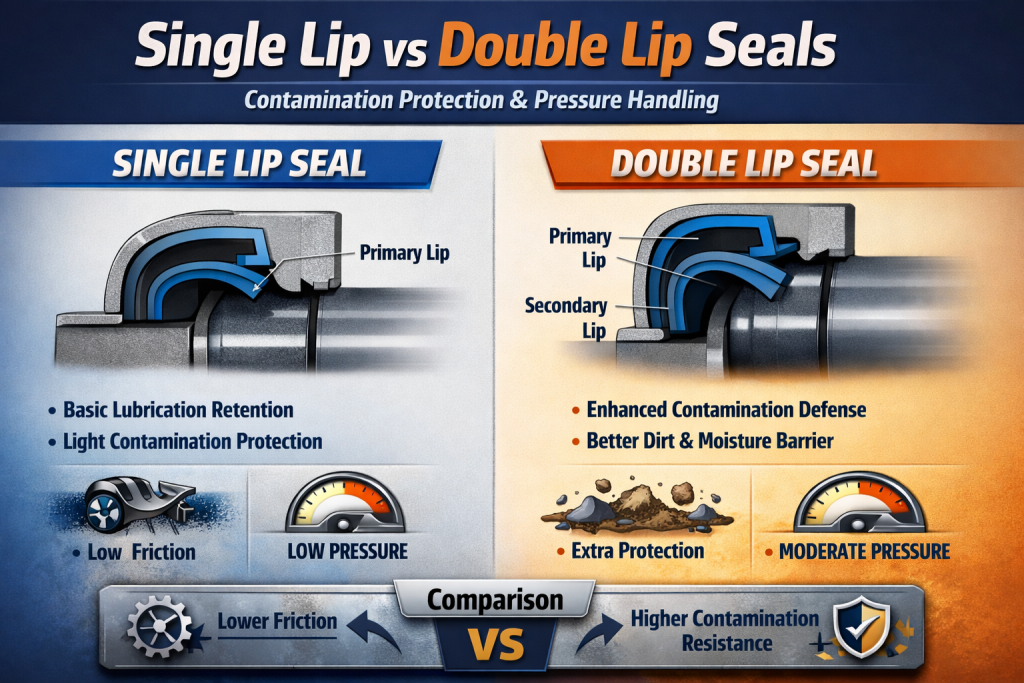
1. Strukturella skillnader
Tätning med en läpp
A single lip seal features one primary sealing edge that contacts the shaft or rod surface. It is primarily designed to:
- Retain lubricants
- Prevent internal fluid leakage
- Operate with low friction
Single lip designs are simpler, generate less heat, and are suitable for clean operating conditions.
Tätning med dubbla läppar
A double lip seal incorporates:
- One primary sealing lip (for fluid retention)
- One secondary lip (for contamination exclusion)
The additional lip provides enhanced environmental protection, especially in dusty or dirty environments.
2. Contamination Protection
Contamination is a leading cause of seal and bearing failure. The choice between single and double lip designs depends heavily on environmental exposure.
Single Lip Seal:
- Suitable for clean indoor environments
- Limited external contamination resistance
- Lower friction due to single contact surface
Double Lip Seal:
- Better protection against dust, dirt, and moisture
- Ideal for construction, mining, and agricultural equipment
- Secondary lip acts as a barrier to abrasive particles
In harsh environments, double lip seals significantly reduce contamination ingress and extend component life.
3. Pressure Handling Capability
Seal performance under pressure varies by design and application.
Single Lip Seals:
- Typically designed for low-pressure applications
- Common in grease-retaining and light-duty shaft systems
- Not ideal for high-pressure hydraulic systems without support rings
Double Lip Seals:
- Also primarily used for low-pressure rotary applications
- Secondary lip is not intended for pressure retention
- For high-pressure environments, specialized hydraulic seals or backup rings are required
It is important to note that standard lip seals are not substitutes for dedicated high-pressure hydraulic sealing systems.
4. Friction and Heat Generation
Friction affects energy efficiency and wear rate.
- Single lip seals produce lower friction and less heat.
- Double lip seals increase contact area, resulting in slightly higher friction.
- Excessive friction can lead to shaft wear and premature seal degradation if not properly lubricated.
In high-speed applications, minimizing friction may favor a single lip configuration.
5. Application Considerations
Single Lip Seals are best suited for:
- Elektriska motorer
- Gearboxes in clean environments
- Indoor industrial equipment
- Light-duty rotating shafts
Double Lip Seals are ideal for:
- Construction equipment
- Gruvmaskiner
- Jordbruksutrustning
- Outdoor or high-dust environments
Application environment is often the deciding factor.
6. Material Selection
Both single and double lip seals are commonly manufactured from:
- NBR (general-purpose oil resistance)
- FKM (high-temperature and chemical resistance)
- PTFE (low friction and chemical compatibility)
Material selection must align with operating temperature, chemical exposure, and rotational speed.
7. Service Life and Maintenance
Double lip seals generally provide longer service life in dirty conditions due to enhanced protection. However:
- Proper shaft surface finish is critical
- Lubrication must be maintained
- Regular inspection prevents premature failure
Seal choice should balance contamination risk, pressure demands, and friction sensitivity.
Slutsats
Single lip and double lip seals each serve specific industrial needs. Single lip seals offer lower friction and efficiency in clean environments, while double lip seals provide enhanced contamination protection in harsh conditions.
For applications involving high pressure, shock loading, or hydraulic systems, specialized sealing solutions should be considered beyond standard lip designs.
Selecting the correct configuration ensures improved equipment reliability, reduced maintenance, and optimized operational performance.

 Swedish
  English
  Korean
  Japanese
  Russian
  Arabic
  Spanish
  German
  French
  Italian
  Portuguese
  Chinese
  Dutch
Dutch  Polish
  Czech
Czech  Hungarian
  Finnish
  Vietnamese
  Thai
Thai  Turkish