
Deep-sea mining represents one of the most challenging environments for mechanical engineering. Equipment such as subsea drills, hydraulic manipulators, and seabed excavation vehicles must operate at depths exceeding 3,000 meters, where hydrostatic pressures can surpass 30 MPa, temperatures are near freezing, and seawater presents highly corrosive and abrasive conditions. In these applications, bearings and transmission components are critical elements that directly affect system reliability, operational efficiency, and safety.
Designing these components to withstand extreme pressure requires a multidisciplinary approach, integrating materials science, tribology, structural mechanics, and system-level engineering.
Challenges in deep-sea mechanical systems
The primary challenges for bearings and transmission elements in deep-sea mining equipment arise from three factors: high hydrostatic pressure, mechanical loading, and environmental degradation.
Hydrostatic pressure imposes uniform external stress on components, potentially causing deformation, misalignment, or extrusion of softer materials. Bearings, gears, shafts, and housings must retain precise geometrical relationships under these compressive forces to maintain smooth operation. Even micrometer-level distortion can significantly reduce efficiency, increase wear, or cause catastrophic failure in dynamic systems.
Mechanical loads in deep-sea mining include high torque from excavation tools, cyclic impact from rock fragmentation, and vibrations transmitted through hydraulic actuators. Combined with pressure, these loads create complex stress states requiring careful analysis.
Finally, seawater introduces corrosion, biofouling, and particulate abrasion. Materials must resist chemical attack, and clearances must be designed to tolerate abrasive particles without jamming or excessive wear.
Material selection strategies
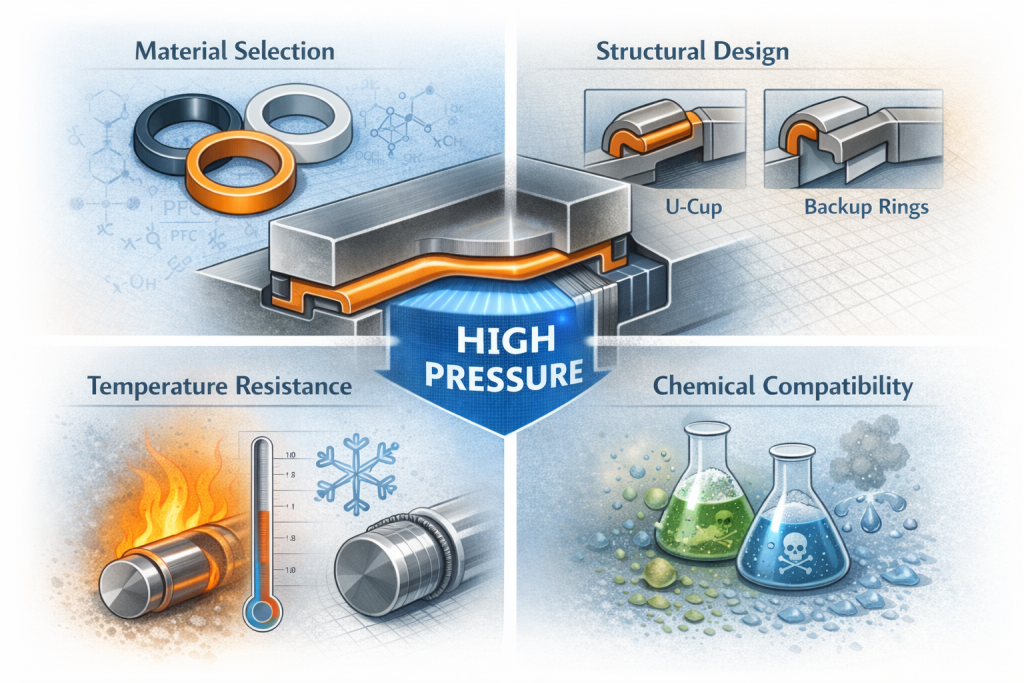
Material selection is the foundation of pressure-resistant design. Bearings and transmission components typically use high-strength, corrosion-resistant metals such as duplex stainless steels, titanium alloys, or nickel-based superalloys. These metals combine high yield strength with excellent resistance to seawater corrosion and fatigue.
For rolling or sliding surfaces, advanced coatings such as ceramic layers, diamond-like carbon (DLC), or hard chromium plating can enhance wear resistance while maintaining low friction. Composite materials and polymer-based inserts may also be used in low-load or alignment-critical interfaces, where elasticity aids in compensating for pressure-induced deformation.
Elastomeric seals and O-rings in bearing housings or gearboxes are commonly made from pressure-adapted FFKM or PTFE composites. These materials maintain sealing integrity under extreme pressures and resist chemical degradation from seawater or lubricants.
Structural design principles
Beyond materials, structural design plays a decisive role in ensuring reliable operation under pressure. Key strategies include:
- Pressure-balanced components: Bearings or gears can be designed with internal cavities or compensating chambers to equalize internal and external pressure, reducing differential stress and maintaining clearances.
- Oversized bearing housings and reinforced races: Increasing structural stiffness prevents distortion under pressure while distributing loads more evenly across rolling elements.
- Redundant support structures: Multiple bearings, bushings, or secondary shafts are often used in parallel to share loads and provide backup in case of localized failure.
- Hydrodynamic lubrication and pressure-assisted film formation: In high-speed rolling elements, lubrication film thickness can be enhanced by pressure distribution, reducing direct metal-to-metal contact and preventing wear.
Finite element analysis is widely employed to model stress, deformation, and fatigue under combined hydrostatic and operational loads. Simulation allows engineers to optimize housing geometry, bearing arrangement, and gear tooth profiles before manufacturing.
Lubrication and thermal management
In deep-sea conditions, fluid viscosity changes due to low ambient temperatures, while internal heat from friction can accumulate within sealed housings. Lubricants must maintain low-temperature flow, high-pressure film strength, and chemical stability. Synthetic oils, greases with extreme-pressure additives, and water-miscible hydraulic fluids are carefully selected based on operational parameters.
Thermal management is critical. Even small temperature gradients can induce differential expansion, reducing bearing clearances and increasing friction. Engineers often integrate passive thermal pathways or fluid circulation to dissipate heat, preserving dimensional stability and reliability.
Redundancy and monitoring
Given the inaccessibility of deep-sea equipment, redundancy and monitoring are integral. Bearings may include dual-row configurations or backup lubrication circuits. Sensors embedded in housings monitor vibration, temperature, and torque, providing early warning of wear or misalignment. This predictive maintenance capability is essential to prevent catastrophic failures and costly retrieval operations.
Applications in subsea mining systems
Deep-sea mining vehicles rely on pressure-resistant bearings and gears in drilling heads, crawler tracks, and manipulator arms. Hydrostatic pressure and abrasive sediment require careful selection of bearing type, seal design, and material coating. High-torque gearboxes transmit power from hydraulic motors to excavation tools, necessitating hardened gear teeth and reinforced housings.
Subsea pumps and rotary valves also benefit from pressure-balanced bearing and shaft arrangements to maintain consistent operation under cyclic loads and variable pressure conditions.
Slutsats
The pressure-resistant design of bearings and transmission components in deep-sea mining equipment requires a systematic integration of material science, structural engineering, lubrication technology, and predictive analysis. By selecting high-strength corrosion-resistant materials, employing pressure-compensating designs, optimizing lubrication strategies, and implementing redundancy with real-time monitoring, engineers can ensure reliable operation in one of the harshest environments on Earth.
Deep-sea mining will continue to challenge mechanical systems, but advances in pressure-resistant design allow critical equipment to operate safely and efficiently at extreme depths, supporting resource extraction while minimizing failure risk.
 Swedish
  English
  Korean
  Japanese
  Russian
  Arabic
  Spanish
  German
  French
  Italian
  Portuguese
  Chinese
  Dutch
Dutch  Polish
  Czech
Czech  Hungarian
  Finnish
  Vietnamese
  Thai
Thai  Turkish