
Oil and gas drilling and production operations involve some of the most extreme environments encountered in industrial engineering. Drill strings, blowout preventers (BOPs), subsea Christmas trees, and high-pressure valves routinely operate under temperatures exceeding 150°C and pressures surpassing 100 MPa. In these conditions, sealing systems are not mere components—they are critical safety and reliability elements whose performance directly impacts operational continuity, environmental compliance, and personnel safety.
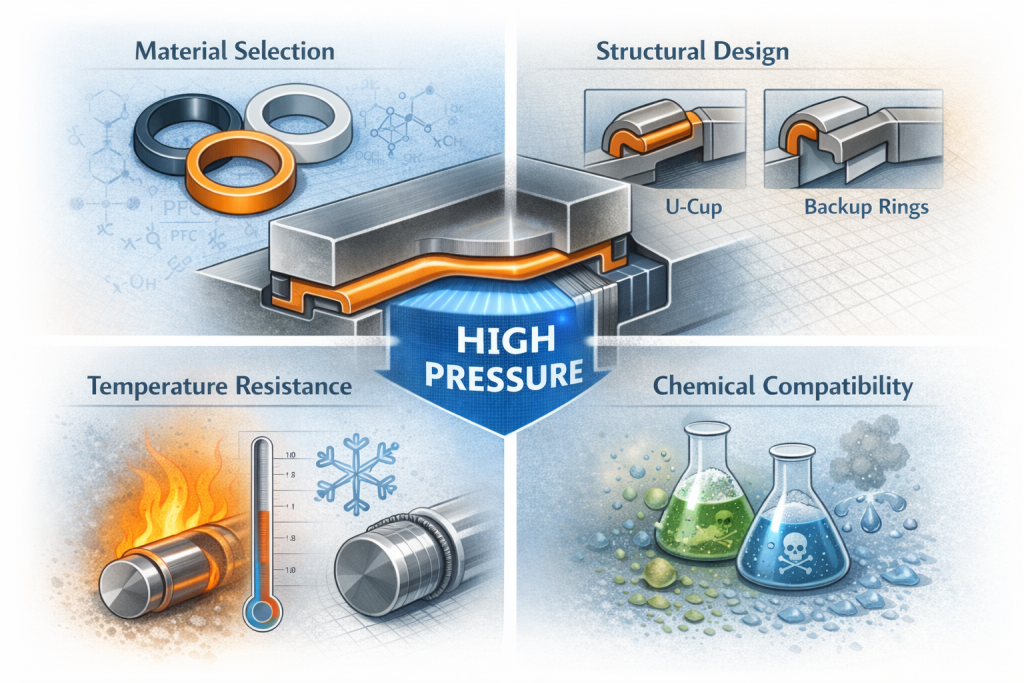
Developing seals for high-temperature, high-pressure (HTHP) applications in oil and gas requires a systematic engineering pathway that integrates material selection, structural design, surface engineering, and predictive lifecycle management.
Understanding the operating environment
HTHP sealing challenges arise from three primary factors:
- Pressure-induced deformation: High internal pressure generates radial and axial forces on seal interfaces, increasing the risk of extrusion, leakage, or material creep.
- Thermal stress: Elevated temperatures reduce the elasticity of polymers and elastomers, accelerate chemical degradation, and can induce thermal expansion mismatches between seal and mating surfaces.
- Chemical aggression: Drilling fluids, hydrocarbons, H₂S, CO₂, and brine create a corrosive and abrasive environment, demanding materials with exceptional chemical resistance.
A comprehensive seal design strategy must simultaneously address all three factors.
Material selection for HTHP seals
Material selection forms the foundation of reliable HTHP sealing. Key categories include:
- Perfluoroelastomerer (FFKM): Offer excellent chemical resistance and high thermal stability, maintaining elasticity at temperatures up to 320°C. Ideal for static and low-speed dynamic seals in subsea and surface equipment.
- Fluorelastomerer (FKM): Commonly used for dynamic seals in temperatures up to 200°C and moderate chemical exposure.
- PTFE and filled PTFE composites: Provide low friction, chemical inertness, and creep resistance. Reinforced PTFE is often used for piston seals, valve seats, and sliding interfaces.
- High-performance metals and alloys: Stainless steel, Inconel, and titanium alloys are essential for metal-to-metal seals in extreme pressure applications, especially in BOP rams and subsea connectors.
Hybrid approaches combine metal carriers with elastomeric or polymeric inserts to balance elasticity, conformability, and pressure resistance.
Structural design considerations
Seal geometry and structure are as critical as material properties in HTHP applications. Key design strategies include:
- Pressure-energized seals: These designs leverage system pressure to increase sealing force, improving performance as pressure rises rather than compromising it.
- Multi-barrier systems: Primary and secondary seals, sometimes separated by a monitoring cavity, reduce the risk of catastrophic leakage. This is standard practice in BOPs, high-pressure valves, and subsea wellheads.
- Backup rings and anti-extrusion devices: Elastomeric seals under HTHP conditions are prone to extrusion into clearance gaps; PEEK or reinforced polymer backup rings prevent this failure mode.
- Thermal compensation features: Bellows, spring-energized seals, or flexible carriers accommodate differential thermal expansion between seal and housing.
Surface engineering and lubrication
Surface finish and coating of mating components are critical for HTHP seal longevity. Smooth, defect-free surfaces reduce friction, wear, and micro-leakage. Advanced coatings such as DLC, ceramic, or hard-chrome plating enhance wear resistance and corrosion protection.
In dynamic applications, proper lubrication or fluid film management is essential to reduce heat generation, prevent stick-slip behavior, and extend seal life. Selecting compatible fluids that maintain viscosity under temperature extremes is part of the engineering pathway.
Testing, qualification, and predictive design
Given the extreme conditions, empirical testing is indispensable. Common protocols include:
- Pressure cycling: Simulates operational load variations over thousands of cycles to assess seal fatigue.
- Thermal cycling: Tests stability under repeated heating and cooling.
- Chemical immersion: Evaluates swelling, embrittlement, and degradation in drilling fluids, hydrocarbons, and corrosive gases.
Finite element analysis (FEA) and computational fluid dynamics (CFD) increasingly support predictive design, allowing engineers to optimize seal geometry, material selection, and interface stress distribution before manufacturing.
Lifecycle and maintenance considerations
HTHP seals must be engineered with predictable service life and maintenance planning. In drilling operations, seal replacement intervals are tightly coordinated with well completion schedules to minimize downtime. Subsea deployments rely on redundant seals and monitoring to detect early degradation.
Integrating reliability engineering, condition monitoring, and risk-based inspection into seal design ensures operational continuity while reducing the probability of catastrophic failure.
Case example: Blowout preventer (BOP) seals
Blowout preventers illustrate the complexity of HTHP sealing. Each ram contains multiple seals, often combining metal-to-metal contact with elastomeric or PTFE inserts. Pressure-energized lip designs maintain contact under transient pressure spikes, while secondary seals ensure containment in case of primary seal degradation. Material selection, gland geometry, and surface finish are tightly controlled to meet API standards and ensure decades-long reliability.
Slutsats
High-temperature, high-pressure sealing in oil drilling and production equipment represents a convergence of materials science, structural design, tribology, and system engineering. Successful HTHP seals are the result of careful material selection, pressure-adaptive geometry, surface engineering, and rigorous testing.
By following a systematic engineering pathway—considering pressure, temperature, chemical exposure, mechanical motion, and lifecycle requirements—engineers can develop seals that ensure safety, reduce downtime, and maintain operational integrity in one of the most demanding industrial environments on Earth.
Reliable sealing in HTHP oilfield applications is not merely a component design problem; it is a multidisciplinary engineering challenge that safeguards both equipment and environment.
 Swedish
  English
  Korean
  Japanese
  Russian
  Arabic
  Spanish
  German
  French
  Italian
  Portuguese
  Chinese
  Dutch
Dutch  Polish
  Czech
Czech  Hungarian
  Finnish
  Vietnamese
  Thai
Thai  Turkish