
I industriella hydrauliska och pneumatiska system bestämmer tätningsprestanda direkt systemets effektivitet, läckagekontroll, underhållsfrekvens och utrustningens livslängd. Bland olika tätningsmaterial är gummibaserade tätningar och PTFE (Polytetrafluoroetyl) tätningar två av de mest använda alternativen.
Även om båda tjänar samma grundläggande funktion—att förhindra vätske- eller gasläckage—skiljer sig deras materialegenskaper, driftgränser och långsiktiga beteende avsevärt. Att välja rätt material kräver förståelse för de specifika driftsförhållandena i ditt system.
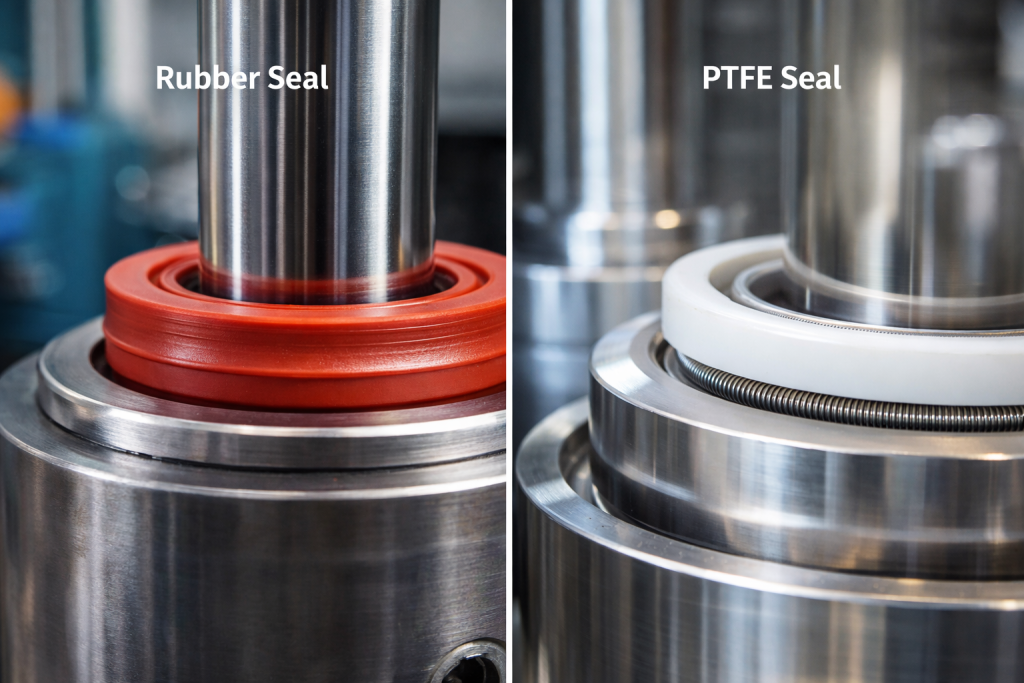
1. Materialstruktur och mekaniskt beteende
Gummitätningar tillverkas vanligtvis av elastomerer som:
- NBR (Nitrile Rubber)
- FKM (Viton)
- EPDM
- Silikon
Dessa material är mycket elastiska och komprimerbara, vilket gör att de kan deformeras under tryck och upprätthålla tätningskontakt.
PTFE-tätningar är tillverkade av fluoropolymerharpiks. PTFE är ett termoplastiskt material känt för:
- Extremt låg friktionskoefficient
- Excellent chemical resistance
- Bred temperaturtolerans
Till skillnad från gummi är PTFE inte elastomeriskt. Det förlitar sig på mekanisk design (fjäderaktiverade strukturer eller läppkonfigurationer) för att upprätthålla tätningskraft.
Ingenjörsmässig innebörd:
Gummi ger elastiskt drivet tätningsförmåga.
PTFE ger kemiskt stabil, lågfriktions tätningsförmåga.
2. Nyckelprestandajämförelse
| Parameter | Gummitätning | PTFE Seal |
|---|---|---|
| Drifttemperaturintervall | -40°C till 120–200°C (beroende på förening) | -200°C till 260°C |
| Kemisk beständighet | Bra (varierar beroende på gummityp) | Utmärkt, mycket inert |
| Friktionskoefficient | Måttlig | Mycket låg |
| Motståndskraft mot slitage | Bra i smorda system | Utmärkt i torra eller högfartssystem |
| Elastisk återhämtning | Utmärkt | Begränsad (kräver mekanisk energizer) |
| Tryckmotstånd | Måttlig till hög | Hög när den stöds korrekt |
| Kostnad | Lägre | Högre |
| Typisk livslängd | Måttlig | Lång i tuffa miljöer |
3. Temperaturbeständighet
Temperatur är ofta den första avgörande faktorn.
Gummitätningar har gränser som beror på sammansättningen:
- NBR: Lämplig för allmänna hydraulolja-system
- FKM: Bättre för hög temperatur och bränsleexponering
- EPDM: Bra för vatten- och ångsystem
Men långvarig exponering över materialgränser leder till härdning, sprickbildning eller förlust av elasticitet.
PTFE-tätningar upprätthåller strukturell integritet över ett mycket bredare temperaturintervall, från kryogena förhållanden till högtemperaturindustriella processer. I extrema termiska cyklingsmiljöer ger PTFE överlägsen dimensionsstabilitet.
Rekommendation:
Om ditt system fungerar över 150–180°C kontinuerligt, är PTFE vanligtvis det säkrare valet.
4. Kemisk kompatibilitet
Gummikompatibilitet beror starkt på sammansättningen. Till exempel:
- NBR presterar bra i petroleumbaserade oljor men dåligt i starka syror.
- EPDM motstår vatten och ånga men är inkompatibel med många oljor.
PTFE är kemiskt inaktivt mot de flesta syror, lösningsmedel, bränslen och aggressiva kemikalier. Detta gör det idealiskt för:
- Kemiska bearbetningssystem
- Läkemedelsproduktion
- Livsmedelsklassade tillämpningar
- Högrenhetsmiljöer
När kemisk exponering är osäker eller aggressiv erbjuder PTFE en högre säkerhetsmarginal.
5. Friktion och hastighetsprestanda
I dynamiska tillämpningar som hydraulcylindrar eller roterande axlar påverkar friktion:
- Energieffektivitet
- Värmeutveckling
- Wear rate
Gummitätningar ger pålitlig tätning men genererar mer friktion, särskilt vid högre hastigheter.
PTFE-tätningar erbjuder extremt låg friktion, vilket minskar energiförlust och möjliggör:
- Högre rotationshastigheter
- Minskat värmeuppbyggnad
- Förlängd livslängd för utrustningen
För höghastighets- eller torrdriftssystem överträffar PTFE gummi avsevärt.
6. Installations- och strukturell flexibilitet
Gummitätningar är lättare att installera på grund av elasticitet och flexibilitet. De anpassar sig väl till mindre ytfel.
PTFE-tätningar är mer styva och kräver precisa bearbetningstoleranser. I många tillämpningar används fjäderaktiverade PTFE-tätningar för att kompensera för begränsad elasticitet.
Om dina systemtoleranser är mindre precisa eller kräver enkel installation kan gummitätningar vara mer praktiska.
7. Kostnads- och livscykelöverväganden
Jämförelse av initiala kostnader:
Gummitätningar är generellt mer ekonomiska och lämpliga för standardindustriella tillämpningar.
PTFE-tätningar har högre material- och bearbetningskostnader men kan erbjuda lägre livscykelkostnader i:
- System för höga temperaturer
- Corrosive environments
- Högfartsdynamiska system
- Tillämpningar där stillestånd är kostsamt
Att välja enbart baserat på enhetspris kan leda till högre långsiktiga underhållskostnader.
8. Tillämpningsriktlinjer
Välj gummitätningar när:
- Driftstemperaturen är måttlig
- Kemisk exponering är kontrollerad
- Budgetbegränsningar är betydande
- Elastisk tätprestanda krävs
Välj PTFE-tätningar när:
- Temperaturextremer är närvarande
- Kemisk resistens är kritisk
- Låg friktion och hög hastighet krävs
- Långa serviceintervall är nödvändiga
Slutsats
Gummi- och PTFE-tätningar är inte konkurrerande material utan komplementära lösningar utformade för olika driftsmiljöer.
Gummitätningar ger flexibel, kostnadseffektiv prestanda för allmänna industriella system.
PTFE-tätningar levererar överlägsen kemisk stabilitet, temperaturbeständighet och lågfriktionsprestanda i krävande tillämpningar.
Den korrekta urvalet bör baseras på driftstemperatur, tryckförhållanden, mediekompatibilitet, rörelsehastighet och underhållsstrategi.
En korrekt teknisk utvärdering säkerställer optimal tätningseffektivitet, minskad stilleståndstid och långsiktig systemtillförlitlighet.

 Swedish
  English
  Korean
  Japanese
  Russian
  Arabic
  Spanish
  German
  French
  Italian
  Portuguese
  Chinese
  Dutch
Dutch  Polish
  Czech
Czech  Hungarian
  Finnish
  Vietnamese
  Thai
Thai  Turkish