
Sealing components are crucial in hydraulic, pneumatic, and industrial systems. Among the most widely used are O-rings и U-cup seals. While both prevent fluid leakage, they differ in design, load capacity, leakage resistance, and suitability for various applications. Selecting the right seal ensures system efficiency, safety, and long service life.
1. Структурные различия
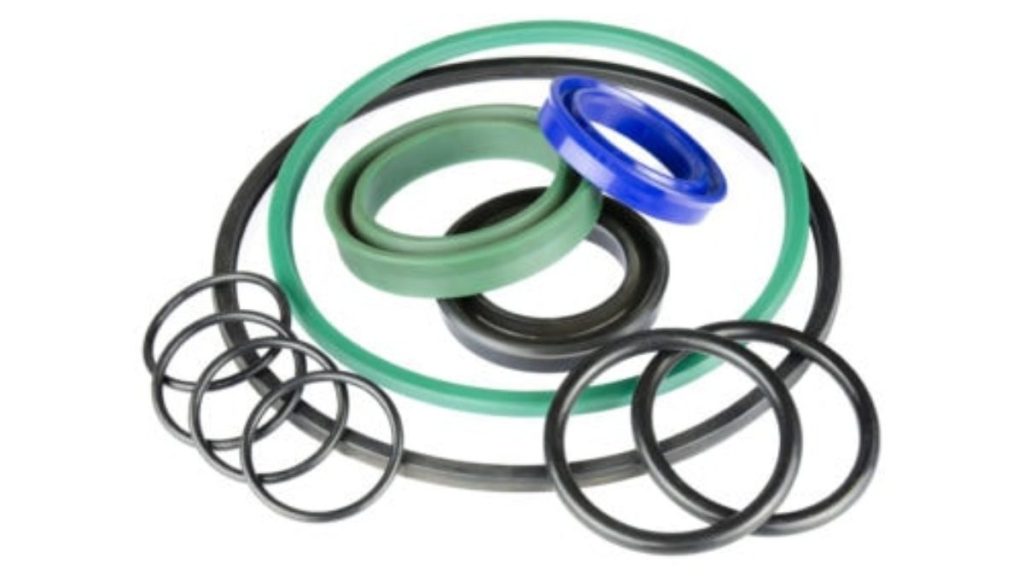
Уплотнительные кольца:
- Simple circular cross-section
- Typically made from elastomers like NBR, FKM, or EPDM
- Designed to seal by compressive force in a gland
Уплотнения U-образных чашек:
- U-shaped cross-section with a hollow cavity and lip
- Often spring-energized or single-lip for enhanced contact
- Made from elastomers or PTFE materials
- Designed to seal dynamically against rod or piston surfaces
2. Load Capacity Comparison
| Характеристика | O-Ring | U-Cup Seal |
|---|---|---|
| Рабочее давление | Moderate to High (up to 50–60 MPa) | High (up to 70–80 MPa with backup ring) |
| Load Support | Limited by cross-sectional area | Better load distribution via lip design |
| Dynamic Load Performance | Умеренный | Excellent for reciprocating motion |
| Трение | Low to moderate | Slightly higher due to lip contact |
| Axial Movement Tolerance | Умеренный | Высокий |
| Suitable Media | Hydraulic fluids, air, water | Hydraulic fluids, lubricants, air |
Инженерный взгляд:
U-cup seals can handle higher dynamic loads due to their lip design, whereas O-rings are simpler and more compact but less suited for high-pressure dynamic applications.
3. Leakage Resistance
- Уплотнительные кольца rely on compression in the gland to maintain a seal. Under static conditions, they are highly effective, but dynamic applications can lead to extrusion or wear.
- Уплотнения U-образных чашек provide enhanced leakage resistance in dynamic systems. The lip design allows the seal to maintain contact under varying pressure and motion, reducing leakage in piston and rod applications.
4. Temperature and Chemical Compatibility
| Характеристика | O-Ring | U-Cup Seal |
|---|---|---|
| Диапазон температур | -40°C to 200°C (depending on material) | -30°C to 250°C (elastomer or PTFE variants) |
| Химическая стойкость | Moderate to High (material-dependent) | High (especially PTFE or reinforced elastomer) |
| Media Suitability | Hydraulic oils, water, air | Hydraulic oils, lubricants, chemicals, air |
Ключевой момент: U-cup seals, especially when made from PTFE, have superior chemical resistance and high-temperature performance compared to standard elastomer O-rings.
5. Применения
Уплотнительные кольца:
- Static seals in hydraulic cylinders and valves
- Pipe connections and fittings
- Low to moderate pressure systems
Уплотнения U-образных чашек:
- Dynamic sealing on pistons and rods
- High-pressure hydraulic systems
- Industrial cylinders with reciprocating motion
- Applications requiring minimal leakage under variable load
6. Maintenance and Lifespan
- Уплотнительные кольца: Easy to replace, compact, but can wear quickly in dynamic applications or under extrusion.
- Уплотнения U-образных чашек: Slightly more complex installation, but longer lifespan in reciprocating and high-pressure conditions, and better retention of lubrication.
7. Cost Considerations
- O-rings are generally low-cost and simple to manufacture.
- U-cup seals are higher in material and manufacturing cost but provide better performance in dynamic, high-pressure systems.
Общая стоимость жизненного цикла favors U-cup seals in high-pressure, high-cycle applications due to reduced downtime and maintenance.
Заключение
- Уплотнительные кольца: Ideal for static or low-pressure applications; simple, cost-effective, easy to install.
- Уплотнения U-образных чашек: Superior dynamic performance, high load capacity, and excellent leakage resistance; ideal for hydraulic cylinders and industrial machinery under high pressure and motion.
Choosing the correct seal type ensures system reliability, reduced leakage, and longer service life, optimizing industrial operations.

 Russian
  English
  Korean
  Japanese
  Arabic
  Spanish
  German
  French
  Italian
  Portuguese
  Chinese
  Dutch
Dutch  Polish
  Czech
Czech  Hungarian
  Finnish
  Swedish
  Vietnamese
  Thai
Thai  Turkish