

1. Introduction: From Steel to Ceramics – A Paradigm Shift
For more than a century, industrial bearings have relied primarily on high-carbon chromium steel (such as AISI 52100) as the dominant rolling element material. Steel bearings have powered everything from automobiles and turbines to machine tools and industrial motors. However, as industries push toward higher speeds, harsher environments, greater energy efficiency, and longer maintenance intervals, traditional steel bearings are reaching their performance limits.
Over the past two to three decades, ceramic materials—particularly silicon carbide (SiC), silicon nitride (Si₃N₄), and zirconia (ZrO₂)—have emerged as increasingly attractive alternatives for rolling elements and hybrid bearings. Today, ceramic bearings are no longer niche products; they are widely used in aerospace, high-speed spindles, electric vehicles (EVs), renewable energy systems, semiconductor manufacturing, chemical processing, and precision machinery.
This article explores why industrial bearings are shifting toward ceramics, examining the scientific, mechanical, and economic drivers behind this transition.
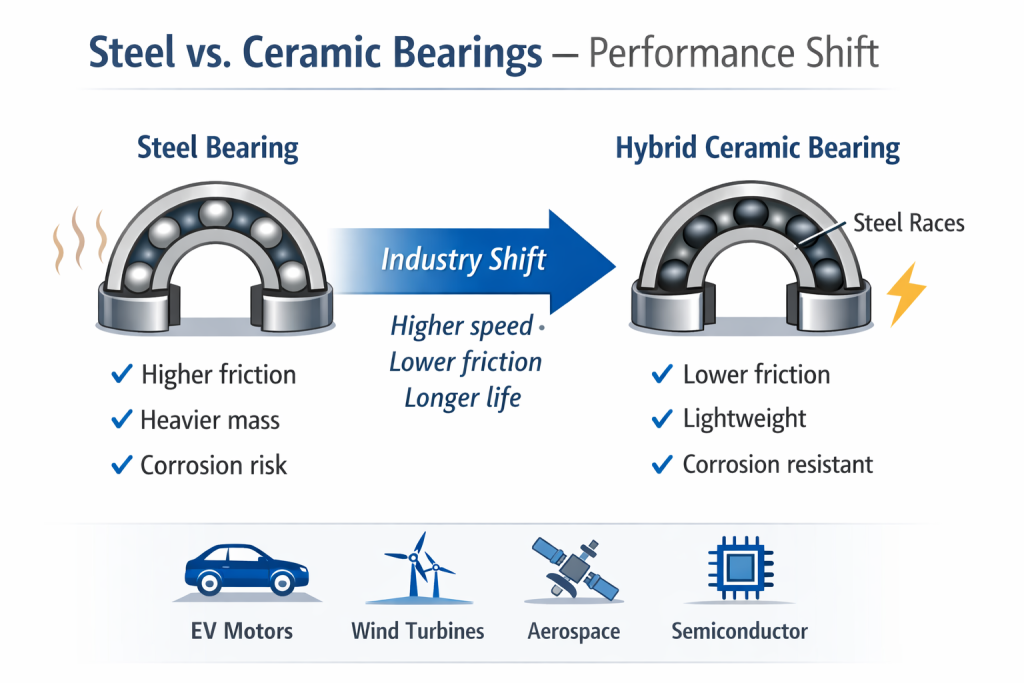
2. Fundamental Material Differences Between Steel and Ceramics
At the heart of this trend lies a fundamental difference in material properties.
2.1 Density and Inertia
Ceramic materials are significantly lighter than steel:
- Steel density: ~7.8 g/cm³
- Silicon nitride density: ~3.2 g/cm³
- Silicon carbide density: ~3.1 g/cm³
This means ceramic rolling elements can be less than half the weight of steel balls. In high-speed applications, this dramatically reduces centrifugal forces, friction, and heat generation inside the bearing.
Lower mass leads to:
- Higher rotational speed capability
- Reduced wear
- Lower energy consumption
- Longer bearing life
For example, in high-speed machine tool spindles, hybrid ceramic bearings can run 30–50% faster than equivalent steel bearings without overheating.
2.2 Hardness and Wear Resistance
Ceramics are far harder than bearing steel:
- Steel hardness: ~60–65 HRC
- Silicon carbide hardness: ~2400–2800 HV
- Silicon nitride hardness: ~1500–1700 HV
This extreme hardness gives ceramics:
- Superior wear resistance
- Lower surface degradation
- Better dimensional stability over time
In abrasive environments (e.g., mining, chemical pumps, or dusty industrial settings), ceramic balls resist pitting and micro-cracking far better than steel.
2.3 Elastic Modulus and Contact Mechanics
Ceramics generally have a higher elastic modulus than steel, meaning they deform less under load. This affects contact mechanics inside a bearing:
- Reduced contact area under load
- Lower frictional losses
- Less plastic deformation over time
However, ceramics are also more brittle than steel, which historically limited their use. Modern manufacturing techniques—such as hot isostatic pressing (HIP) and advanced sintering—have greatly improved ceramic toughness and reliability.
3. Performance Advantages Driving Adoption
3.1 Higher Speed and Lower Friction
One of the biggest reasons industries are adopting ceramic bearings is their performance in high-speed applications.
In conventional steel bearings, friction increases rapidly with speed due to:
- Rolling resistance
- Sliding friction in the cage
- Lubricant shear forces
Ceramic bearings mitigate these issues because:
- They are lighter
- They generate less heat
- They reduce lubricant breakdown
This is why ceramic hybrid bearings are now standard in:
- High-speed CNC spindles
- Aerospace actuators
- Robotics joints
- Electric motor bearings
In electric vehicles (EVs), ceramic bearings help reduce drivetrain friction, improving overall efficiency and range.
3.2 Superior Performance in Extreme Temperatures
Steel bearings struggle in extreme temperatures due to:
- Thermal expansion
- Loss of hardness at high temperatures
- Lubricant degradation
Ceramic materials perform far better:
- Silicon nitride retains strength at temperatures above 1000°C
- Silicon carbide performs well in both high and cryogenic environments
This makes ceramic bearings ideal for:
- Aerospace engines
- Turbines
- High-temperature furnaces
- Semiconductor equipment
- Vacuum systems
In vacuum environments, traditional lubricants evaporate, making steel bearings unreliable. Ceramic bearings can operate with minimal or no lubrication.
3.3 Corrosion and Chemical Resistance
Steel is prone to corrosion in:
- Saltwater
- Acidic environments
- Химические заводы
- Humid conditions
Ceramics are chemically inert, meaning they:
- Do not rust
- Do not oxidize easily
- Resist most acids and alkalis
This has led to their adoption in:
- Marine applications
- Химические насосы
- Food processing equipment
- Pharmaceutical machinery
For example, in corrosive chemical mixers, ceramic bearings can last several times longer than steel bearings.
4. Hybrid Bearings: The Best of Both Worlds
Rather than replacing all-steel bearings entirely, many industries use гибридные керамические подшипники, which combine:
- Ceramic rolling elements (Si₃N₄ or SiC balls)
- Steel inner and outer races
This design offers a balance between performance and cost.
Benefits include:
- Lower friction than all-steel bearings
- Better durability than full ceramic bearings
- Lower cost than full ceramic designs
- Compatibility with existing bearing housings
Hybrid bearings are now widely used in:
- Электродвигатели
- Wind turbines
- High-speed machinery
- Aerospace components
5. The Role of Manufacturing Advances
The growing use of ceramic bearings is not only due to material advantages—it is also enabled by manufacturing progress.
Key developments include:
5.1 Precision Grinding and Polishing
Modern diamond grinding techniques allow ceramic balls to reach:
- Sub-micron roundness
- Extremely smooth surface finishes
This is critical because any surface defect can lead to premature failure.
5.2 Hot Isostatic Pressing (HIP)
HIP processing removes internal porosity and micro-cracks in ceramics, greatly improving:
- Mechanical strength
- Reliability
- Усталостная прочность
This has made ceramics far more dependable than earlier generations.
6. Economic Considerations: Are Ceramic Bearings Worth It?
Ceramic bearings are typically more expensive than steel bearings. However, total lifecycle cost often favors ceramics due to:
- Более длительный срок службы
- Reduced maintenance
- Lower downtime
- Energy savings
In high-performance industries, downtime can cost millions of dollars per hour. In these contexts, the higher upfront cost of ceramic bearings is justified.
For example:
- In wind turbines, ceramic bearings reduce failure rates in harsh offshore environments.
- In semiconductor fabs, ceramic components prevent contamination and increase reliability.
- In EV motors, they improve efficiency and reduce heat-related failures.
7. Limitations and Challenges
Despite their advantages, ceramic bearings are not perfect.
Challenges include:
- Higher brittleness compared to steel
- Sensitivity to impact loads
- Higher manufacturing complexity
- Greater cost
For heavy shock-loading applications (e.g., mining crushers or heavy construction equipment), steel bearings may still be preferable.
8. Future Trends in Ceramic Bearings
The future of industrial bearings is clearly moving toward ceramics. Key trends include:
8.1 More Use in Electric Vehicles
As EV adoption grows, ceramic bearings will become standard in:
- Drive motors
- Редукторы
- Wheel hubs
Their efficiency and heat resistance are ideal for electrified systems.
8.2 Growth in Renewable Energy
Wind turbines operate in harsh environments with:
- Saltwater exposure
- High mechanical stress
- Remote locations
Ceramic bearings reduce maintenance costs and extend service life.
8.3 Expansion in Semiconductor Manufacturing
Semiconductor tools require:
- Ultra-clean environments
- High precision
- Extreme reliability
Ceramic bearings help meet these demands.
9. Conclusion: Why Ceramics Are the Future of Bearings
Industrial bearings are increasingly adopting ceramic materials because they offer a combination of:
- Higher speed capability
- Lower friction
- Better wear resistance
- Superior temperature performance
- Отличная коррозионная стойкость
- Более длительный срок службы
While they are more expensive upfront, their performance benefits make them indispensable in modern high-tech industries.
The transition from steel to ceramics represents not just a material change, but a broader shift toward smarter, more efficient, and more durable industrial systems.
As manufacturing technology continues to advance, ceramic bearings will likely move from specialized components to mainstream industrial standards.
 Russian
  English
  Korean
  Japanese
  Arabic
  Spanish
  German
  French
  Italian
  Portuguese
  Chinese
  Dutch
Dutch  Polish
  Czech
Czech  Hungarian
  Finnish
  Swedish
  Vietnamese
  Thai
Thai  Turkish