
Bearings are critical components in rotating machinery. Whether installed in pumps, motors, conveyors, or gearboxes, their reliability directly affects equipment uptime, safety, and operating costs. Despite their importance, bearing failures are often caused not by product defects, but by improper maintenance practices.
Based on field experience supporting industrial clients, this article outlines the ten most common mistakes in bearing maintenance—and practical solutions to avoid them.
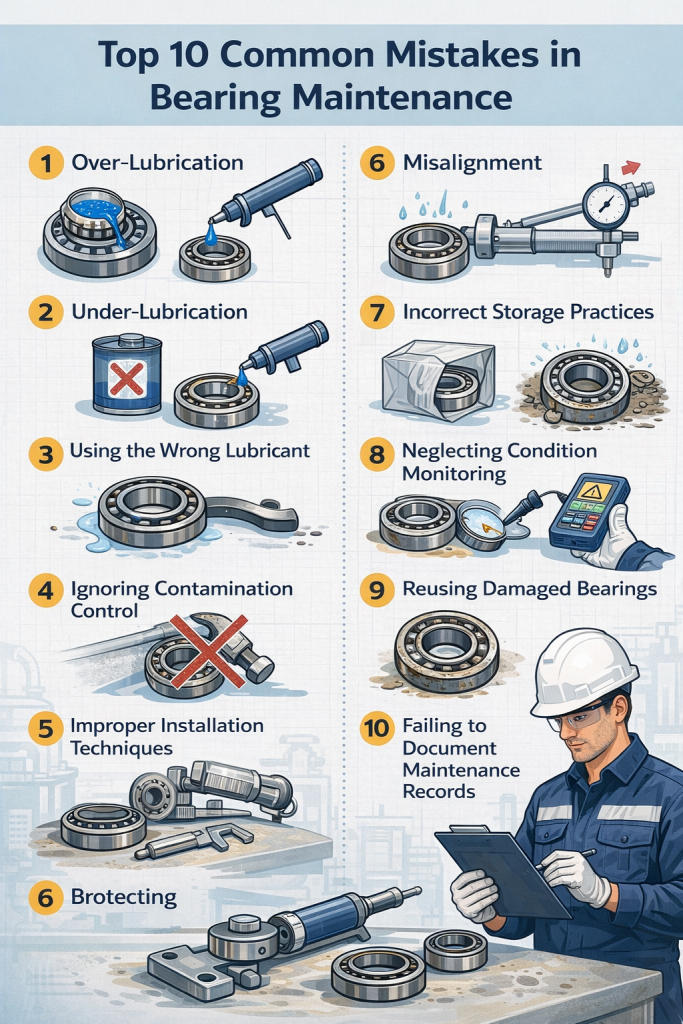
1. Over-Lubrication
One of the most widespread misconceptions is that “more grease means better protection.” In reality, over-lubrication increases internal pressure, causes heat buildup, and can rupture seals.
Best Practice:
Follow manufacturer-recommended grease quantity and relubrication intervals. Use calculated grease volume based on bearing size and operating speed.
2. Under-Lubrication
The opposite mistake is insufficient lubrication. This leads to metal-to-metal contact, increased friction, overheating, and premature failure.
Best Practice:
Establish a lubrication schedule based on operating hours, load, and environmental conditions.
3. Using the Wrong Lubricant
Not all greases are interchangeable. Using incompatible viscosity grades or mixing grease types can cause chemical breakdown and loss of lubricating properties.
Best Practice:
Verify compatibility with operating temperature, speed, and load. Avoid mixing different grease types unless compatibility is confirmed.
4. Ignoring Contamination Control
Dust, water, and chemical particles are major causes of bearing failure. Even microscopic contaminants can damage raceways and rolling elements.
Best Practice:
Maintain clean installation environments. Use proper seals and store bearings in original packaging until use.
5. Improper Installation Techniques
Using hammers directly on bearing rings or applying force through rolling elements can cause internal damage invisible to the eye.
Best Practice:
Use appropriate installation tools such as bearing heaters, hydraulic presses, and fitting sleeves. Apply mounting force only to the correct ring (inner or outer) depending on fit type.
6. Misalignment
Shaft or housing misalignment generates uneven load distribution, vibration, and accelerated wear.
Best Practice:
Check shaft alignment using dial indicators or laser alignment tools. Confirm housing tolerances before installation.
7. Incorrect Storage Practices
Improper storage—especially in humid environments—can lead to corrosion or lubricant degradation before installation.
Best Practice:
Store bearings in dry, temperature-controlled areas. Avoid removing protective packaging prematurely.
8. Neglecting Condition Monitoring
Many facilities operate bearings until failure instead of using predictive maintenance strategies. This increases downtime and repair costs.
Best Practice:
Implement vibration analysis, temperature monitoring, and noise inspection as part of preventive maintenance programs.
9. Reusing Damaged Bearings
In cost-sensitive environments, damaged bearings are sometimes cleaned and reused. This significantly increases the risk of sudden failure.
Best Practice:
Inspect for pitting, discoloration, scoring, and excessive play. Replace bearings when signs of fatigue appear.
10. Failing to Document Maintenance Records
Lack of documentation makes it difficult to analyze recurring failures or optimize maintenance intervals.
Best Practice:
Maintain detailed service logs including:
- Installation date
- Operating conditions
- Lubrication type and interval
- Inspection results
- Replacement history
Data-driven maintenance improves reliability and reduces long-term cost.
Why Proper Bearing Maintenance Matters
Studies across industrial sectors show that improper lubrication alone accounts for a significant percentage of premature bearing failures. Preventive maintenance not only extends service life but also improves energy efficiency and operational safety.
For industrial operators in sectors such as mining, port handling, manufacturing, and power generation, systematic bearing management can reduce unexpected downtime and lower total cost of ownership (TCO).
Conclusão
Bearings are precision components that require systematic and informed maintenance. The majority of failures can be traced back to preventable human errors—over-lubrication, contamination, misalignment, and improper installation.
By implementing structured maintenance protocols, using appropriate tools, and monitoring operating conditions, industrial facilities can significantly enhance equipment reliability and performance.
At WONZH Precision Manufacturing, our engineering team works closely with industrial clients to support proper bearing selection, installation guidance, and maintenance optimization—ensuring long-term operational stability and safety.

 Portuguese
  English
  Korean
  Japanese
  Russian
  Arabic
  Spanish
  German
  French
  Italian
  Chinese
  Dutch
Dutch  Polish
  Czech
Czech  Hungarian
  Finnish
  Swedish
  Vietnamese
  Thai
Thai  Turkish