
Dynamic sealing is one of the most critical yet frequently underestimated disciplines in high-pressure hydraulic engineering. In pumps, cylinders, motors, and valves, seals must simultaneously contain fluid under extreme pressure, accommodate continuous motion, and survive harsh thermal, chemical, and mechanical environments. A failure in a dynamic seal rarely remains isolated; it often cascades into leakage, contamination, energy loss, downtime, and safety risks.
This article explains the fundamental logic behind reliable dynamic seal design in high-pressure hydraulic systems, integrating tribology, materials science, contact mechanics, and system-level engineering.
System-level role of dynamic seals
In a hydraulic system, dynamic seals serve three interconnected functions. First, they maintain pressure integrity by preventing fluid escape across moving interfaces such as piston rods, rotating shafts, or sliding spools. Second, they protect the system from external contamination by blocking dust, moisture, and abrasive particles. Third, they manage friction and wear to ensure long-term efficiency and durability.
Reliability therefore cannot be achieved by selecting a seal in isolation. Instead, the seal must be designed as part of a larger system that includes surface finish, lubrication, temperature control, pressure profile, and maintenance strategy.
Pressure–motion interaction as the core challenge
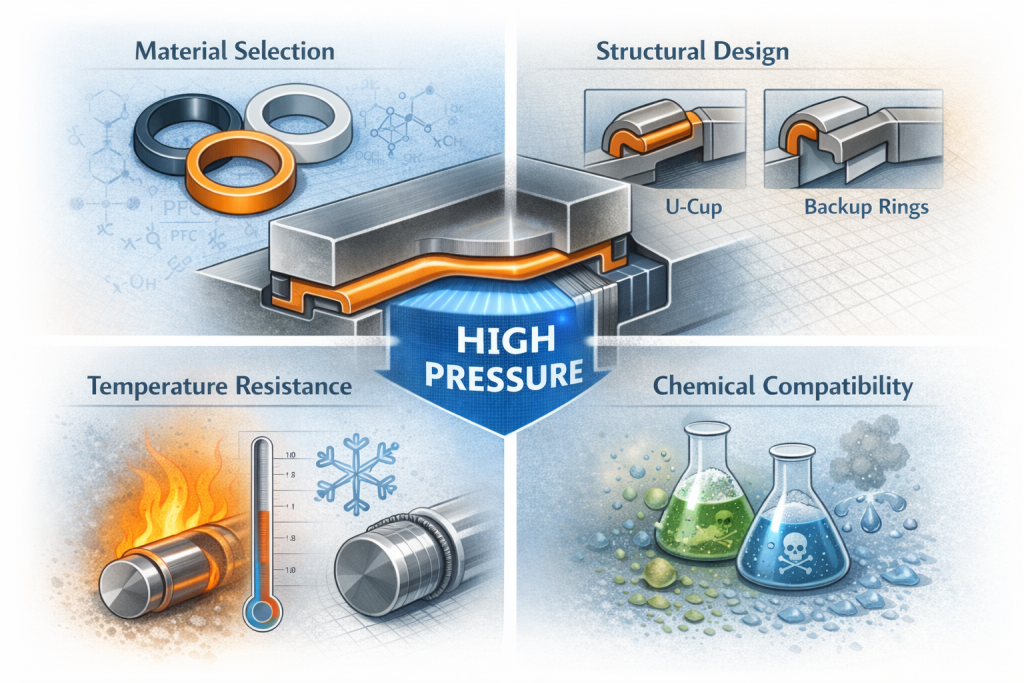
High pressure fundamentally changes how dynamic seals behave. As pressure increases, contact stress between the seal and the mating surface rises, improving leakage resistance but also intensifying friction and wear. If the pressure becomes too high without proper support, elastomeric or polymer seals may extrude into clearance gaps and fail catastrophically.
Engineers must balance this trade-off through several mechanisms. Backup rings made from PEEK or reinforced polymers are commonly used to prevent extrusion. Seal lip geometry is optimized to distribute pressure more evenly, and gland dimensions are carefully designed to control deformation under load.
Friction management and thermal stability
Friction is unavoidable in dynamic sealing, but uncontrolled friction leads to heat buildup, material degradation, and premature failure. Reliable design therefore prioritizes low-friction materials such as PTFE-based compounds or specially formulated elastomers. Surface coatings like DLC or ceramic layers on shafts and rods can further reduce friction while improving wear resistance.
Thermal stability is equally important. In high-pressure hydraulic systems, frictional heating combined with fluid temperature can push seals close to their thermal limits. Material selection must consider not only peak temperature but also long-term thermal aging, which can cause hardening, cracking, or loss of elasticity.
Surface engineering of mating components
The performance of a dynamic seal depends as much on the counterface as on the seal itself. Shaft or cylinder surface roughness must be tightly controlled. If the surface is too rough, abrasive wear accelerates and leakage pathways form. If it is too smooth, lubrication films may become unstable, increasing friction and stick-slip behavior.
Typical targets for hydraulic rod surfaces often fall within a narrow Ra range, combined with specific Rz limits to avoid sharp peaks that damage seal lips. Advanced surface treatments such as hard chrome plating, nitriding, or ceramic coatings are widely used to improve wear resistance and corrosion protection.
Material compatibility with hydraulic fluids
Dynamic seals must withstand continuous exposure to hydraulic oils, water-glycol fluids, or environmentally friendly bio-based fluids. Chemical incompatibility can cause swelling, shrinkage, or embrittlement, all of which compromise sealing performance.
FKM remains a mainstream choice for mineral oil-based systems due to its temperature and chemical resistance. In more aggressive environments, FFKM or specialized PTFE composites may be required. The key is not only initial compatibility but also long-term stability under cyclic pressure and temperature.
Wear mechanisms and lifespan prediction
Seal degradation typically follows a predictable sequence. Initially, micro-wear occurs at the sliding interface. Over time, heat and mechanical fatigue weaken the material. Eventually, cracks form at stress concentration points, leading to leakage.
Modern reliability engineering increasingly uses finite element analysis and tribological modeling to predict wear patterns and service life. By simulating pressure distribution, frictional heating, and material deformation, engineers can optimize seal geometry before physical testing.
Redundancy and layered sealing strategies
In critical hydraulic systems, single-seal solutions are often insufficient. Many designs incorporate primary and secondary seals, as well as scraper seals that remove contaminants before they reach the main sealing interface. This layered approach significantly reduces the risk of sudden catastrophic failure.
For example, in hydraulic cylinders, a rod scraper prevents dirt ingress, a primary rod seal maintains pressure, and a secondary seal acts as a safety backup in case of primary seal degradation.
Maintenance, monitoring, and lifecycle thinking
Reliability does not end at design. Proactive maintenance, fluid cleanliness control, and condition monitoring are equally vital. Contaminated hydraulic oil containing metal particles or silica can rapidly destroy even the best-designed seals.
Some advanced systems now integrate leakage sensors or pressure monitoring to detect early seal deterioration, allowing replacement before major failure occurs.
결론
The reliability of dynamic seals in high-pressure hydraulic systems is a multidisciplinary challenge that combines material science, surface engineering, tribology, and system design. Successful solutions require balancing pressure containment, friction control, thermal stability, chemical compatibility, and wear resistance.
Rather than treating seals as consumable components, modern engineering views them as strategic elements that determine overall system performance, safety, and lifecycle cost. When designed and integrated correctly, dynamic seals become enablers of efficiency and reliability rather than sources of failure.
 Korean
  English
  Japanese
  Russian
  Arabic
  Spanish
  German
  French
  Italian
  Portuguese
  Chinese
  Dutch
Dutch  Polish
  Czech
Czech  Hungarian
  Finnish
  Swedish
  Vietnamese
  Thai
Thai  Turkish