
High-pressure pumps are essential components in industrial applications such as chemical processing, oil and gas, water treatment, and hydraulic systems. The efficiency and reliability of these pumps largely depend on the performance of their sealing elements, which prevent fluid leakage, maintain system pressure, and protect mechanical components from damage. Choosing the right seal materials and optimizing design to minimize leakage are critical to ensuring operational efficiency and safety.
Operational Challenges of High-Pressure Pump Seals
Seals in high-pressure pumps face extreme conditions that challenge their performance:
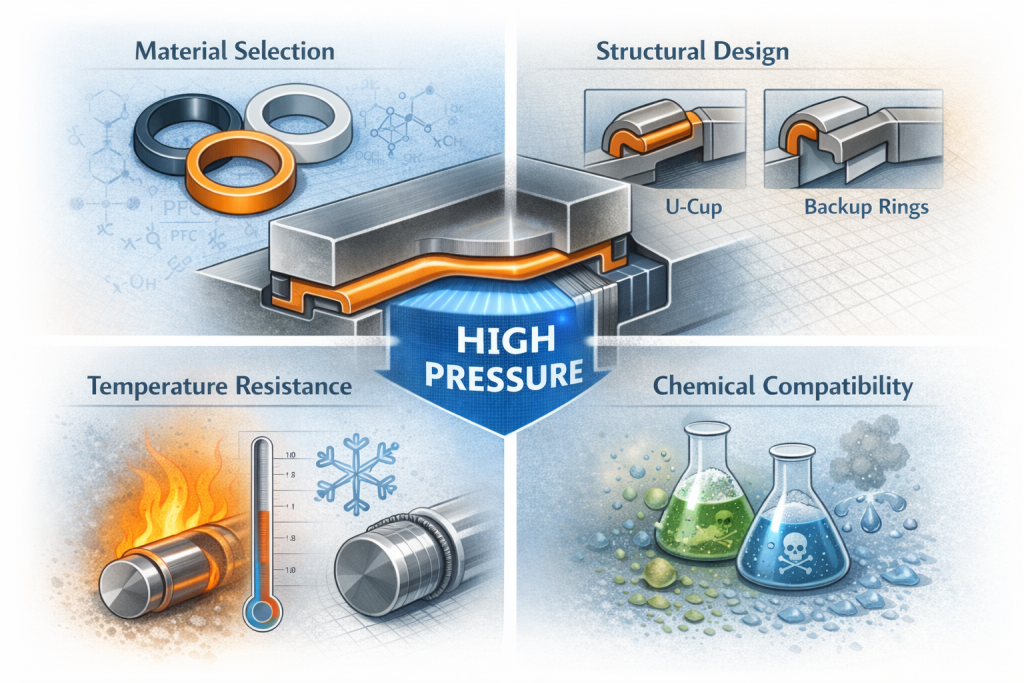
- High pressure: Operating pressures can exceed hundreds of bars, which increases the risk of seal extrusion and material deformation.
- Temperature variations: Fluid compression and mechanical friction generate heat, leading to thermal expansion, material hardening, or softening.
- 화학 물질 노출: Pumped media may be corrosive, abrasive, or contain particulate matter, which can degrade conventional elastomers.
- Dynamic stress: Rotating or reciprocating shafts induce friction and wear on seal lips, affecting service life.
Understanding these challenges is essential for selecting materials and designing seals that maintain performance over time.
Common Seal Materials
The choice of seal material directly impacts leakage performance, durability, and chemical compatibility. Commonly used materials include:
- NBR (Nitrile Butadiene Rubber): Resistant to oils and moderate temperatures, making it suitable for standard hydraulic and water-based applications.
- FKM (Fluoroelastomer): Offers excellent chemical resistance and high-temperature stability, ideal for aggressive fluids and elevated operating temperatures.
- FFKM (Perfluoroelastomer): Provides the highest chemical and thermal resistance, suitable for extreme environments with corrosive media.
- PTFE (Polytetrafluoroethylene): Exhibits low friction, exceptional chemical resistance, and high-temperature tolerance. Often used as a coating or for dynamic seals in abrasive or high-speed applications.
Composite materials, such as PTFE-reinforced FKM or FFKM seals with metal backup rings, combine mechanical strength with chemical and thermal resilience, enhancing leak prevention under high-pressure conditions.
Leakage Optimization Strategies
Reducing leakage in high-pressure pumps involves both material selection and design considerations:
- Seal geometry: Properly designed lip profiles maintain uniform contact with the shaft or housing, preventing gaps that lead to leakage.
- Surface finish: Smooth, finely polished mating surfaces reduce friction, enhance sealing, and extend seal life. Typical surface roughness values for high-pressure seals range from Ra 0.2–0.8 μm.
- Compression and preload: Optimal seal compression ensures adequate contact without excessive deformation or extrusion.
- Backup rings and support elements: In high-pressure applications, rigid backup rings prevent seal extrusion and maintain integrity under extreme load.
- 윤활: Compatible fluids reduce friction, minimize wear, and act as a barrier against contamination.
Quality Assurance and Maintenance
Even the best material and design cannot compensate for poor manufacturing or maintenance practices. Key considerations include:
- Dimensional accuracy: Machined tolerances for seal grooves and shafts must meet design specifications to ensure proper fit.
- Inspection: Visual and non-destructive inspection detect defects, cracks, or surface damage before assembly.
- Monitoring: Pressure sensors, flow meters, and leak detection systems provide early warnings of seal failure.
- Scheduled replacement: High-pressure pump seals should be replaced based on operating hours, fluid conditions, and observed wear patterns.
Case Application
In a high-pressure chemical pump operating at 250 bar and 120°C, FFKM seals with PTFE coatings are used for dynamic shaft sealing. The FFKM core provides chemical and thermal resistance, while the PTFE coating reduces friction and wear, resulting in minimal leakage over extended operation. Backup rings prevent extrusion, and periodic inspections coupled with fluid analysis ensure long-term reliability.
결론
Material selection and leakage optimization are critical for the performance and longevity of high-pressure pump seals. Understanding operating conditions, chemical exposure, and mechanical stresses allows engineers to choose the right elastomers, composites, or coatings, while design strategies like optimized lip geometry, backup rings, and surface finishing minimize leakage.
Integrating high-quality materials, precise design, and proactive maintenance ensures safe, efficient, and reliable pump operation in demanding industrial environments.
 Korean
  English
  Japanese
  Russian
  Arabic
  Spanish
  German
  French
  Italian
  Portuguese
  Chinese
  Dutch
Dutch  Polish
  Czech
Czech  Hungarian
  Finnish
  Swedish
  Vietnamese
  Thai
Thai  Turkish