
Air compressors rely on the precise coordination between the motor and the compression unit to deliver consistent and efficient performance. Two critical components in this system are the motor bearings and couplings, which transmit rotational motion while supporting axial and radial loads. Ensuring their durability is essential to reduce downtime, maintenance costs, and energy losses, particularly in industrial compressors operating under continuous or high-demand conditions.
Durability design involves careful material selection, engineering tolerances, surface treatments, lubrication, and monitoring strategies. Understanding the operating stresses and failure mechanisms of these components is key to achieving long-term reliability.
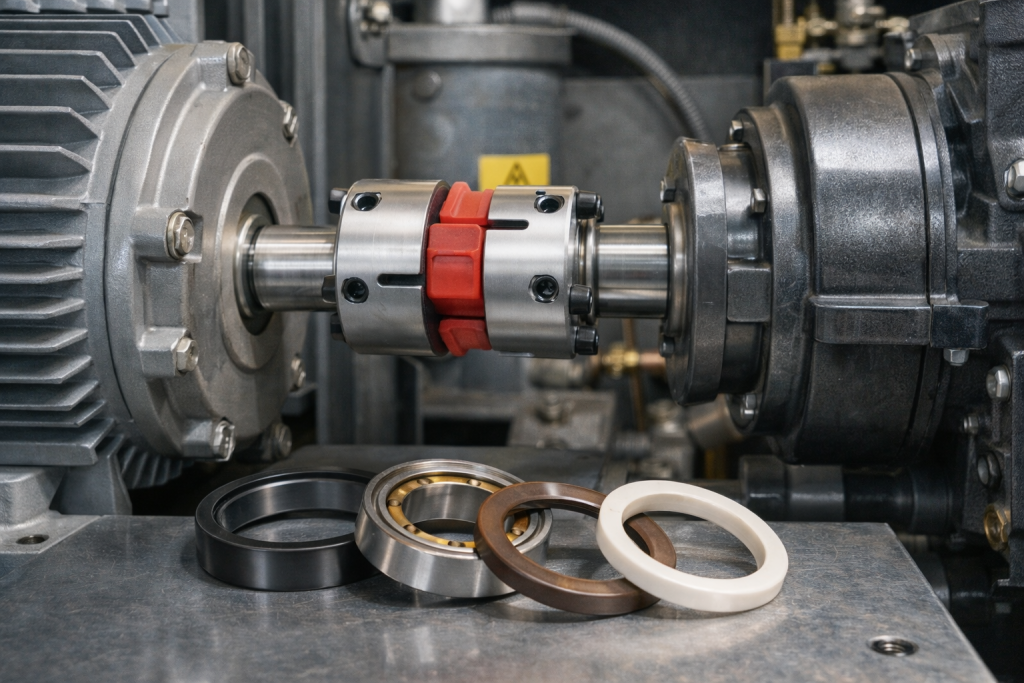
Motor Bearings in Air Compressors
Motor bearings are designed to support the rotor shaft, maintain alignment, and allow smooth rotation. In air compressors, bearings are exposed to:
- Radial and axial loads: Generated by rotor imbalance, coupling misalignment, and compression forces.
- High-speed rotation: Inducing centrifugal and frictional forces that increase wear and generate heat.
- Environmental factors: Dust, moisture, and lubricant contamination can accelerate surface degradation.
- Vibration and shock: Mechanical vibrations transmitted from the compressor can lead to premature fatigue.
Bearing Material and Design
Durable bearings require a combination of strength, wear resistance, and corrosion resistance. Key materials and features include:
- High-carbon chromium steel (52100): Commonly used for standard bearings, offering excellent hardness and fatigue resistance.
- Stainless steel bearings (440C or 316L): Used for humid or corrosive environments to prevent rust and chemical degradation.
- Ceramic hybrid bearings: Featuring ceramic balls with steel races, providing reduced friction, higher stiffness, and longer life under high-speed or high-temperature conditions.
- Precision tolerances: Bearings must be manufactured to tight dimensional tolerances to minimize vibration, misalignment, and uneven load distribution.
Lubrication and Maintenance
Lubrication is critical to reduce friction and prevent surface fatigue:
- Grease selection: High-quality greases with thermal stability and corrosion inhibitors extend bearing life.
- Oil circulation: In high-load or high-speed applications, oil-lubricated bearings provide superior cooling and continuous lubrication.
- Monitoring: Vibration analysis and temperature sensors allow early detection of bearing wear or lubrication failure.
Couplings: Torque Transmission and Misalignment Compensation
Couplings connect the motor shaft to the compressor unit, transmitting torque while accommodating slight misalignments and thermal expansion. Improper coupling design can lead to excessive shaft loads, bearing failure, and energy loss.
Coupling Types and Material Considerations
- Flexible couplings: Elastomeric or composite couplings absorb vibrations and compensate for minor angular or parallel misalignment, reducing stress on bearings.
- Metallic couplings: High-strength steel or aluminum couplings handle higher torque loads but require precise alignment.
- Hybrid designs: Combining metallic hubs with elastomer inserts balances torque capacity and vibration damping.
디자인 최적화
Durable couplings require:
- Torque rating matching: Coupling torque capacity should exceed the maximum motor output to prevent fatigue.
- Misalignment allowance: Flexible elements reduce bearing stress by accommodating angular, axial, or parallel shaft deviations.
- Fatigue-resistant materials: Elastomers and metals must withstand cyclic loading without cracking or deformation.
Integrated Bearing and Coupling Design
Bearing and coupling design should not be treated independently:
- Load distribution: Proper coupling alignment minimizes radial and axial loads on bearings, extending service life.
- Thermal management: Bearings and couplings must accommodate heat generated by friction and motor operation.
- Vibration mitigation: Couplings act as dampers, reducing transmission of shocks and vibrations to the motor and compressor shafts.
Predictive Maintenance and Reliability
Implementing predictive maintenance strategies enhances component durability:
- Vibration monitoring: Detects imbalance, misalignment, or bearing defects.
- Lubrication analysis: Ensures grease or oil remains uncontaminated and maintains viscosity.
- Scheduled inspections: Replace worn bearings and couplings before failure occurs to prevent downtime.
- Alignment checks: Periodic shaft alignment ensures couplings function within design tolerances.
결론
The durability of motor bearings and couplings directly influences the performance, reliability, and operational efficiency of air compressors. Material selection, precision engineering, lubrication, alignment, and predictive maintenance are key factors in achieving long-term service life.
By integrating high-quality bearings with optimized couplings and implementing proactive monitoring, engineers can minimize failures, reduce maintenance costs, and ensure energy-efficient operation. Continuous innovation in materials, surface treatments, and design approaches further enhances the durability of these critical components, meeting the demands of industrial compressors in challenging operational environments.
 Korean
  English
  Japanese
  Russian
  Arabic
  Spanish
  German
  French
  Italian
  Portuguese
  Chinese
  Dutch
Dutch  Polish
  Czech
Czech  Hungarian
  Finnish
  Swedish
  Vietnamese
  Thai
Thai  Turkish