
Deep-sea environments represent one of the most extreme operating conditions for engineering systems. At depths of 3,000 to 6,000 meters, hydrostatic pressure can exceed 30 to 60 megapascals, accompanied by low temperatures, corrosive seawater, and limited maintenance accessibility. In this context, sealing systems are not merely auxiliary components; they are mission-critical barriers that determine whether subsea vehicles, sensors, and energy infrastructure can function safely and reliably.
Traditional sealing approaches developed for surface or shallow-water applications are often inadequate for these conditions. Over the past decades, significant progress has been made in both material science and structural design to create seals capable of withstanding extreme pressure, cyclic loading, and long-term exposure to seawater. This article explores these innovations and their engineering rationale.
The fundamental challenges of deep-sea sealing
Deep-sea seals must simultaneously resist high external pressure, prevent seawater ingress, tolerate temperature gradients, and maintain performance over long deployment periods without human intervention. Unlike surface systems, where leakage can often be detected and repaired quickly, subsea failures typically require costly retrieval operations or result in total equipment loss.
One core challenge is pressure-induced deformation. Under extreme hydrostatic pressure, elastomeric materials tend to compress, flow, or creep, which can reduce contact stress and create leakage paths. Metal components may also deform slightly, altering seal geometry and compromising tightness. Therefore, deep-sea seal design must account for three-dimensional stress states rather than simple radial compression.
Advanced elastomer materials for subsea seals
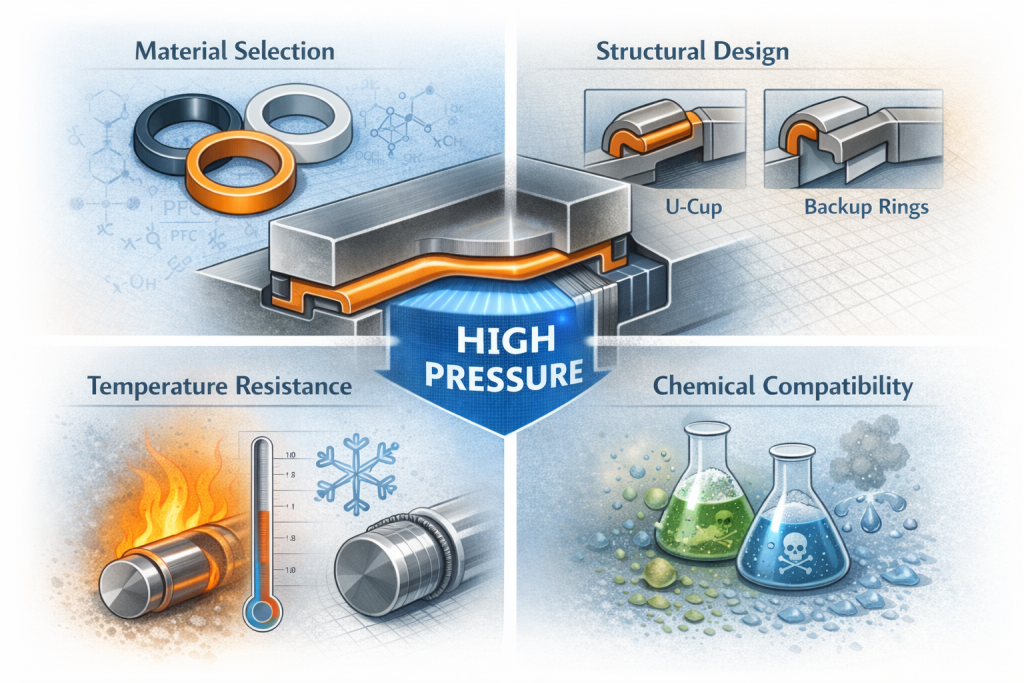
Modern deep-sea sealing increasingly relies on specially formulated elastomers rather than standard FKM or NBR. Perfluoroelastomers and hydrogenated nitrile rubber blends have been engineered to maintain elasticity under high pressure and low temperature. These materials exhibit reduced gas permeability, improved chemical resistance to seawater, and enhanced fatigue life under cyclic loading.
Another promising development is pressure-adaptive elastomers that stiffen under compression. By tailoring polymer crosslink density and filler distribution, researchers have created materials that maintain sealing contact even as external pressure increases, reducing the risk of gap formation.
Metal and hybrid sealing solutions
For critical subsea connectors and penetrators, metal-to-metal seals have gained prominence. These seals rely on precisely machined conical or spherical contact surfaces that plastically deform slightly under load to create a tight barrier. Nickel-based alloys, titanium, and duplex stainless steels are commonly used due to their corrosion resistance and high strength.
Hybrid seals combining metal carriers with elastomer inserts offer a balance between resilience and structural integrity. The metal component bears most of the pressure load, while the elastomer accommodates minor misalignments and thermal expansion. This approach reduces the risk of catastrophic failure compared to purely elastomeric seals.
Structural innovations in seal geometry
Beyond material improvements, structural design has evolved significantly. One key innovation is pressure-energized sealing, where external hydrostatic pressure is intentionally used to enhance sealing force rather than degrade it. In these designs, the seal geometry channels pressure to increase contact stress at the sealing interface, creating a self-reinforcing barrier.
Multi-barrier sealing systems are also widely used in deep-sea equipment. Instead of relying on a single seal, designers implement primary and secondary seals separated by monitoring cavities. If the primary seal begins to leak, pressure sensors detect the change before seawater reaches sensitive components.
Another structural approach is the use of flexible bellows or compensating chambers that equalize internal and external pressure, reducing differential stress across seals. This strategy is common in subsea oil and gas instrumentation and remotely operated vehicles.
Surface engineering and corrosion protection
Even the best seal materials can fail if mating surfaces degrade due to corrosion or biofouling. Deep-sea components often receive specialized coatings such as ceramic layers, hard anodizing, or advanced polymer films to reduce wear and prevent seawater attack.
In dynamic subsea systems, such as rotating thrusters or manipulators, low-friction coatings like DLC or PTFE composites are applied to minimize wear at sliding interfaces while maintaining sealing integrity.
Reliability testing and qualification
Before deployment, deep-sea seals undergo rigorous testing that goes far beyond standard industrial benchmarks. Pressure cycling tests simulate thousands of depth changes to evaluate fatigue behavior. Long-term immersion trials assess chemical stability and water absorption. Thermal cycling replicates cold seabed temperatures combined with warmer internal electronics.
Finite element analysis plays a central role in predicting deformation, stress distribution, and potential failure points. Modern digital twins of sealing systems allow engineers to optimize designs before costly physical prototypes are built.
Applications across subsea industries
In offshore oil and gas production, pressure-resistant seals are critical in subsea wellheads, risers, and umbilicals. In deep-sea exploration, they protect sensitive cameras, sensors, and sampling tools. In marine renewable energy, robust seals ensure the longevity of underwater turbines and power cables.
Each application imposes different priorities. Oil and gas systems emphasize extreme pressure tolerance, while scientific instruments prioritize ultra-low leakage to protect electronics. Renewable energy systems focus on decades-long durability with minimal maintenance.
Future directions in deep-sea sealing
Research is moving toward smart seals that integrate sensing capabilities. Embedded fiber optics or conductive fillers could allow real-time monitoring of pressure, temperature, or micro-leakage. Self-healing polymers are also being explored to automatically repair small defects caused by fatigue or impact.
Additive manufacturing may enable complex internal seal geometries that were previously impossible to machine, further improving pressure distribution and resilience.
Következtetés
Pressure-resistant sealing for deep-sea equipment has evolved from simple material substitution to a sophisticated integration of advanced polymers, high-performance metals, and innovative structural design. By leveraging pressure as an ally rather than an enemy, modern seals achieve unprecedented reliability in some of the harshest environments on Earth.
As human activity extends deeper into the oceans for energy, research, and exploration, sealing technology will remain a cornerstone of subsea engineering—quietly ensuring that critical systems survive where few other components can.
 Hungarian
  English
  Korean
  Japanese
  Russian
  Arabic
  Spanish
  German
  French
  Italian
  Portuguese
  Chinese
  Dutch
Dutch  Polish
  Czech
Czech  Finnish
  Swedish
  Vietnamese
  Thai
Thai  Turkish