
Air leakage is one of the most common yet underestimated reliability issues in compressed air systems. It directly leads to energy loss, reduced system efficiency, unstable pressure, overheating, and accelerated component wear. In many industrial facilities, minor leakage is tolerated as unavoidable. However, from an engineering perspective, most leakage problems are predictable, measurable, and correctable through systematic analysis and design optimization.
Compressed air is often referred to as the “fourth utility” in industrial plants. Studies consistently show that leakage losses can account for 20–30% of total compressed air production in poorly maintained systems. Therefore, identifying root causes and implementing engineering-based corrective actions is critical for operational efficiency and long-term cost control.
Classification and Typical Manifestations of Leakage
Air compressor leakage can generally be divided into external leakage and internal leakage.
External leakage refers to compressed air escaping into the surrounding environment. Common locations include pipe joints, threaded fittings, flanges, valve connections, oil separator housings, drain valves, and pressure relief interfaces. These leaks are usually detectable by audible hissing sounds, visible soap bubble formation during inspection, or measurable pressure drops.
Internal leakage occurs within the compressor or system components. Examples include discharge valve sealing failure, worn piston rings in reciprocating compressors, increased clearance between screw rotors, or malfunctioning check valves that allow backflow. Internal leakage is less visible but often more costly, as it reduces volumetric efficiency and increases power consumption without obvious external signs.
External leaks are easier to detect but internal leaks typically cause greater long-term energy losses.
Root Causes of Leakage
Leakage rarely results from a single factor. It is usually the combined effect of material degradation, structural design limitations, operating conditions, and maintenance practices.
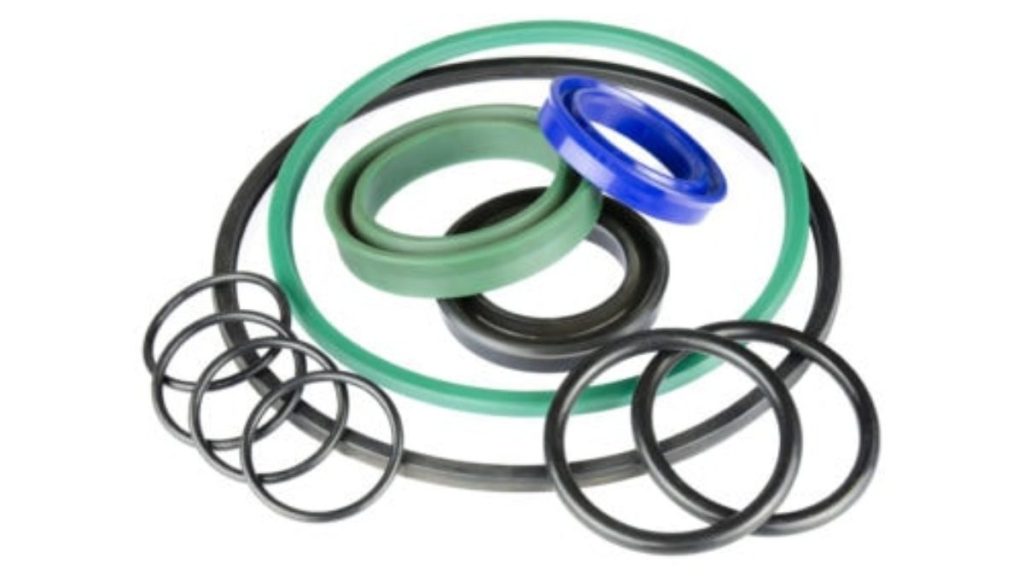
Material aging is one of the most frequent causes. Elastomeric seals such as NBR or FKM gradually harden, crack, or lose elasticity under high temperature, pressure cycling, oil exposure, and oxidation. PTFE seals offer better chemical and thermal resistance but require precise compression control; improper installation can create micro-leakage paths.
Design deficiencies also contribute significantly. Insufficient flange flatness, uneven bolt preload distribution, excessive surface roughness at sealing interfaces, or poor valve seat geometry can all compromise sealing integrity. In high-pressure systems, lack of proper backup support may allow seal extrusion.
Operating condition fluctuations further accelerate degradation. Frequent start-stop cycles, rapid pressure variations, and thermal expansion-contraction cycles create micro-movements at sealing interfaces. Over time, these cyclic stresses generate fatigue damage and leakage channels.
Installation and maintenance errors are equally important. Misalignment, inadequate torque control, contamination, improper lubrication, or clogged filters that allow abrasive particles into sealing surfaces can dramatically shorten seal life.
Engineering Diagnostic Methods
A structured diagnostic approach is essential for effective resolution.
The first step is quantitative assessment. Measuring system pressure decay under isolated conditions provides an estimate of total leakage rate. Ultrasonic leak detectors are highly effective for pinpointing external leakage in noisy industrial environments.
The second step involves component-level inspection. Valve sealing surfaces, gasket compression levels, and shaft seal conditions should be examined for wear, deformation, or contamination. Surface roughness measurements and flatness verification may be necessary in persistent cases.
For internal leakage, performance monitoring is crucial. Indicators include increased energy consumption per unit airflow, abnormal discharge temperatures, extended loading times, and reduced volumetric efficiency. Comparing actual performance curves with manufacturer specifications can reveal hidden leakage.
Engineering Solutions for External Leakage
Addressing external leakage requires both immediate corrective action and structural optimization.
Replacing aged seals with materials matched to operating temperature and chemical exposure is fundamental. For high-temperature compressors, FKM or FFKM may provide superior durability compared to NBR.
Optimizing flange design improves sealing reliability. Controlled bolt tightening sequences and torque calibration ensure uniform gasket compression. In high-pressure systems, spiral wound or metal-reinforced gaskets offer enhanced stability.
Surface finishing improvements can significantly reduce leakage probability. Lowering sealing surface roughness to appropriate Ra values enhances contact integrity and reduces micro-channel formation.
Additionally, implementing regular leak detection programs as part of predictive maintenance can prevent small leaks from escalating.
Engineering Solutions for Internal Leakage
Internal leakage mitigation often involves more complex interventions.
For reciprocating compressors, piston ring material upgrades and cylinder honing can restore sealing efficiency. In screw compressors, rotor clearance must be precisely controlled; excessive wear may require re-machining or replacement.
Discharge and check valves should be inspected for seat erosion and spring fatigue. Upgrading valve plate materials or improving seat surface finishing reduces leakage risk under high cycling frequencies.
In some applications, improved lubrication management plays a decisive role. Proper oil viscosity selection and filtration prevent abrasive wear that could enlarge internal clearances.
Lifecycle and Energy Efficiency Perspective
From a lifecycle perspective, leakage is not merely a maintenance issue but an energy management challenge. Even small leaks can result in substantial annual electricity waste in continuous-operation facilities.
Investing in high-quality seals, precision machining, and systematic monitoring typically yields a rapid return on investment through energy savings and reduced downtime. Engineering-driven solutions outperform reactive repairs in both economic and operational terms.
Conclusión
Air compressor leakage is fundamentally a systems engineering issue involving materials science, structural mechanics, thermodynamics, and maintenance management. Effective control requires accurate diagnosis, material optimization, structural refinement, and disciplined installation practices.
By shifting from reactive repair to root cause analysis and preventive engineering, industrial operators can significantly improve reliability, reduce energy consumption, and extend equipment service life.

 Spanish
  English
  Korean
  Japanese
  Russian
  Arabic
  German
  French
  Italian
  Portuguese
  Chinese
  Dutch
Dutch  Polish
  Czech
Czech  Hungarian
  Finnish
  Swedish
  Vietnamese
  Thai
Thai  Turkish