
In industrial hydraulic and pneumatic systems, sealing performance directly determines system efficiency, leakage control, maintenance frequency, and equipment lifespan. Among various sealing materials, rubber-based seals and PTFE (Polytetrafluoroethylene) seals are two of the most widely used options.
Although both serve the same fundamental function—preventing fluid or gas leakage—their material properties, operating limits, and long-term behavior differ significantly. Selecting the correct material requires understanding the specific operating conditions of your system.
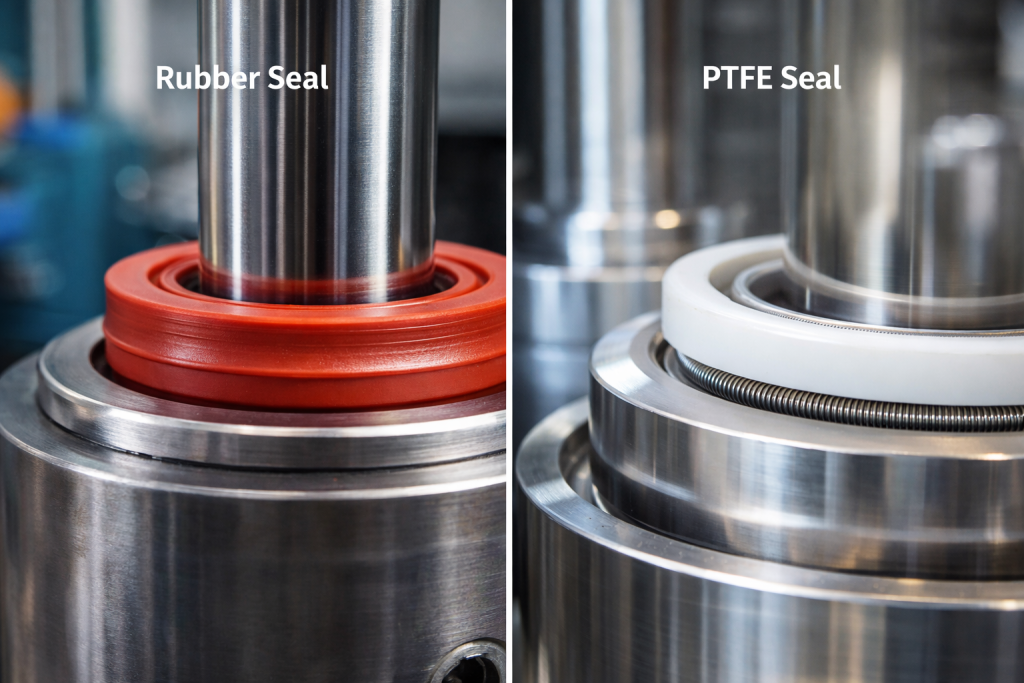
1. Material Structure and Mechanical Behavior
Rubber seals are typically manufactured from elastomers such as:
- NBR (Nitrilkautschuk)
- FKM (Viton)
- EPDM
- Silikon
These materials are highly elastic and compressible, allowing them to deform under pressure and maintain sealing contact.
PTFE seals are made from fluoropolymer resin. PTFE is a thermoplastic material known for:
- Extremely low friction coefficient
- Excellent chemical resistance
- Wide temperature tolerance
Unlike rubber, PTFE is not elastomeric. It relies on mechanical design (spring-energized structures or lip configurations) to maintain sealing force.
Engineering implication:
Rubber provides elasticity-driven sealing.
PTFE provides chemically stable, low-friction sealing.
2. Key Performance Comparison
| Parameter | Rubber Seal | PTFE-Dichtung |
|---|---|---|
| Operating Temperature Range | -40°C to 120–200°C (depending on compound) | -200°C to 260°C |
| Chemische Beständigkeit | Good (varies by rubber type) | Excellent, highly inert |
| Reibungskoeffizient | Mäßig | Sehr niedrig |
| Abnutzungswiderstand | Good in lubricated systems | Excellent in dry or high-speed systems |
| Elastic Recovery | Ausgezeichnet | Limited (requires mechanical energizer) |
| Druckbeständigkeit | Moderate to high | High when properly supported |
| Kosten | Unter | Höher |
| Typical Lifespan | Mäßig | Long in harsh environments |
3. Temperature Resistance
Temperature is often the first deciding factor.
Rubber seals have compound-dependent limits:
- NBR: Suitable for general hydraulic oil systems
- FKM: Better for high-temperature and fuel exposure
- EPDM: Good for water and steam systems
However, prolonged exposure above material limits leads to hardening, cracking, or loss of elasticity.
PTFE seals maintain structural integrity across a much wider temperature range, from cryogenic conditions to high-temperature industrial processes. In extreme thermal cycling environments, PTFE provides superior dimensional stability.
Empfehlung:
If your system operates above 150–180°C continuously, PTFE is typically the safer choice.
4. Chemical Compatibility
Rubber compatibility depends heavily on compound formulation. For example:
- NBR performs well in petroleum-based oils but poorly in strong acids.
- EPDM resists water and steam but is incompatible with many oils.
PTFE is chemically inert to most acids, solvents, fuels, and aggressive chemicals. This makes it ideal for:
- Chemical processing systems
- Pharmaceutical production
- Food-grade applications
- High-purity environments
When chemical exposure is uncertain or aggressive, PTFE offers a higher safety margin.
5. Friction and Speed Performance
In dynamic applications such as hydraulic cylinders or rotary shafts, friction affects:
- Energy efficiency
- Heat generation
- Wear rate
Rubber seals provide reliable sealing but generate more friction, especially at higher speeds.
PTFE seals offer extremely low friction, reducing energy loss and allowing:
- Higher rotational speeds
- Reduced heat buildup
- Extended equipment life
For high-speed or dry-running systems, PTFE significantly outperforms rubber.
6. Installation and Structural Flexibility
Rubber seals are easier to install due to elasticity and flexibility. They adapt well to minor surface imperfections.
PTFE seals are more rigid and require precise machining tolerances. In many applications, spring-energized PTFE seals are used to compensate for limited elasticity.
If your system tolerances are less precise or require simple installation, rubber seals may be more practical.
7. Cost and Lifecycle Considerations
Initial cost comparison:
Rubber seals are generally more economical and suitable for standard industrial applications.
PTFE seals have a higher material and machining cost but may offer lower lifecycle cost in:
- Hochtemperatur-Systeme
- Corrosive environments
- High-speed dynamic systems
- Applications where downtime is expensive
Selecting based solely on unit price may lead to higher long-term maintenance costs.
8. Application Guidelines
Choose Rubber Seals when:
- Operating temperature is moderate
- Chemical exposure is controlled
- Budget constraints are significant
- Elastic sealing performance is required
Choose PTFE Seals when:
- Temperature extremes are present
- Chemical resistance is critical
- Low friction and high speed are required
- Long service intervals are necessary
Schlussfolgerung
Rubber and PTFE seals are not competing materials but complementary solutions designed for different operating environments.
Rubber seals provide flexible, cost-effective performance for general industrial systems.
PTFE seals deliver superior chemical stability, temperature resistance, and low-friction performance in demanding applications.
The correct selection should be based on operating temperature, pressure conditions, media compatibility, movement speed, and maintenance strategy.
A proper technical evaluation ensures optimal sealing efficiency, reduced downtime, and long-term system reliability.

 German
  English
  Korean
  Japanese
  Russian
  Arabic
  Spanish
  French
  Italian
  Portuguese
  Chinese
  Dutch
Dutch  Polish
  Czech
Czech  Hungarian
  Finnish
  Swedish
  Vietnamese
  Thai
Thai  Turkish