
O-Ringe gehören zu den am häufigsten verwendeten Dichtelementen in Industrieanlagen aufgrund ihrer Einfachheit, Zuverlässigkeit und Kosteneffizienz. Ihre Leistung hängt jedoch stark davon ab, ob sie in statischen oder dynamischen Anwendungen eingesetzt werden. Das Verständnis des Unterschieds ist entscheidend für die richtige Materialauswahl, das Design der Nut und die langfristige Zuverlässigkeit.
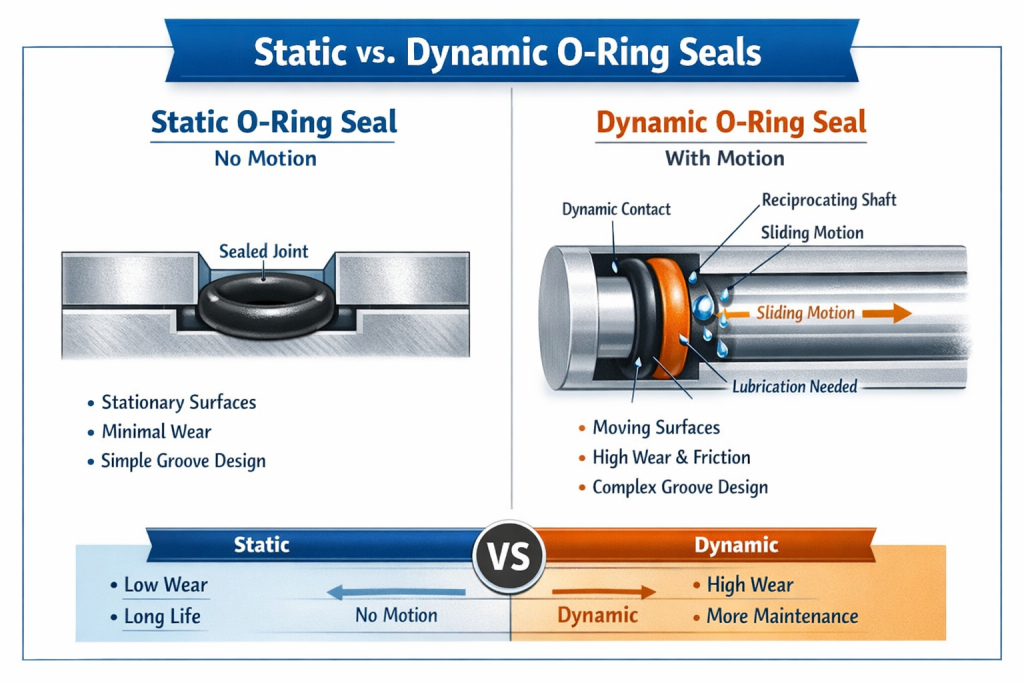
1. Was ist eine statische O-Ring-Dichtung?
A statische O-Ring-Dichtung wird in Anwendungen verwendet, in denen es keine relative Bewegung zwischen den Dichtflächen gibt.
Typische Anwendungen
- Flanschverbindungen
- Endkappen von Hydraulikzylindern
- Ventildeckel
- Pumpengehäuse
Wie es funktioniert
Der O-Ring wird zwischen zwei stationären Flächen komprimiert. Die Kompression erzeugt eine anfängliche Dichtkraft, und der Systemdruck aktiviert die Dichtung weiter, indem er den O-Ring gegen die Nutwand drückt.
Hauptmerkmale
- Minimale Abnutzung
- Geringere Reibungsprobleme
- Längere Nutzungsdauer
- Einfacheres Nutdesign
- Geringeres Ausfallrisiko
Häufige Ausfallmodi
- Überkompression, die zu Extrusion führt
- Chemische Unverträglichkeit
- Kompressionseinstellung über lange Zeiträume
Statische Dichtungen sind im Allgemeinen nachsichtiger und zuverlässiger im Vergleich zu dynamischen Dichtungen.
2. Was ist eine dynamische O-Ring-Dichtung?
A dynamische O-Ring-Dichtung funktioniert in Anwendungen, in denen es relative Bewegung zwischen den Dichtflächen gibt.
Dynamische Bewegung kann sein:
- Hin- und Herbewegung (z.B. hydraulische Zylinder)
- Drehbewegung (z.B. drehende Wellen)
Typische Anwendungen
- Hydraulikzylinder
- Pneumatische Zylinder
- Drehende Wellen
- Pumpen und Kompressoren
Wie es funktioniert
Der O-Ring hält den Kontakt, während er gegen eine bewegte Oberfläche gleitet. Er muss Reibung, Wärmeentwicklung und Verschleiß widerstehen.
Hauptmerkmale
- Unterliegt Reibung und Abrieb
- Höhere Wärmeentwicklung
- Benötigt Schmierung
- Komplexeres Nutdesign
- Größeres Risiko eines Ausfalls
Häufige Ausfallmodi
- Abrieb und Verschleiß
- Spiralversagen (Verdrehung in der Nut)
- Thermische Degradierung
- Extrusion unter Druck
- Oberflächenkratzern aufgrund schlechter Verarbeitung
Dynamische Anwendungen sind erheblich anspruchsvoller als statische.
3. Ingenieurvergleich
| Merkmal | Statischer O-Ring | Dynamischer O-Ring |
|---|---|---|
| Relative Bewegung | Keine | Hin- und her oder drehend |
| Reibung | Minimal | Kontinuierliche Reibung |
| Verschleißrate | Sehr niedrig | Mäßig bis hoch |
| Schmierungsbedarf | Oft nicht erforderlich | In der Regel erforderlich |
| Nutdesign | Einfach | Präzisere Toleranz erforderlich |
| Lebensdauer | Typischerweise länger | Typischerweise kürzer |
4. Konstruktionsüberlegungen
Für statische Dichtungen
- Sicherstellen, dass der Druck korrekt ist (typischerweise 15–30%)
- Überfüllung der Nut vermeiden
- Chemische Verträglichkeit überprüfen
Für dynamische Dichtungen
- Oberflächenfinish kontrollieren (Ra typischerweise 0,2–0,8 µm, abhängig von der Geschwindigkeit)
- Angemessene Schmierung bereitstellen
- Nutfüllung optimieren (in der Regel niedriger als bei statischen Dichtungen)
- Berücksichtigen Sie Anti-Extrusions-Rückhaltering in Hochdrucksystemen
- Wählen Sie reibungsarme Materialien (z. B. FKM, HNBR, PTFE-Mischungen)
5. Unterschiede bei der Materialauswahl
Dynamische Anwendungen erfordern oft:
- Höhere Verschleißfestigkeit
- Bessere Reißfestigkeit
- Niedrigere Verformung unter Druck
- Überlegene thermische Stabilität
Statische Anwendungen priorisieren:
- Chemische Verträglichkeit
- Langfristige Druckbeständigkeit
Schlussfolgerung
Der Hauptunterschied zwischen statischen und dynamischen O-Ring-Dichtungen liegt darin, ob Bewegung vorhanden ist. Statische O-Ringe dichten stationäre Schnittstellen ab und bieten in der Regel eine längere Lebensdauer mit weniger Komplikationen. Dynamische O-Ringe arbeiten unter gleitendem Kontakt und erfordern sorgfältige Ingenieurarbeit bei der Materialauswahl, Schmierung und Nutgestaltung, um Verschleiß und Ausfälle zu verhindern.
Die Auswahl des falschen Typs oder das Design ohne Berücksichtigung der Bewegungsbedingungen kann das Risiko von Leckagen und die Wartungskosten erheblich erhöhen.

 German
  English
  Korean
  Japanese
  Russian
  Arabic
  Spanish
  French
  Italian
  Portuguese
  Chinese
  Dutch
Dutch  Polish
  Czech
Czech  Hungarian
  Finnish
  Swedish
  Vietnamese
  Thai
Thai  Turkish