
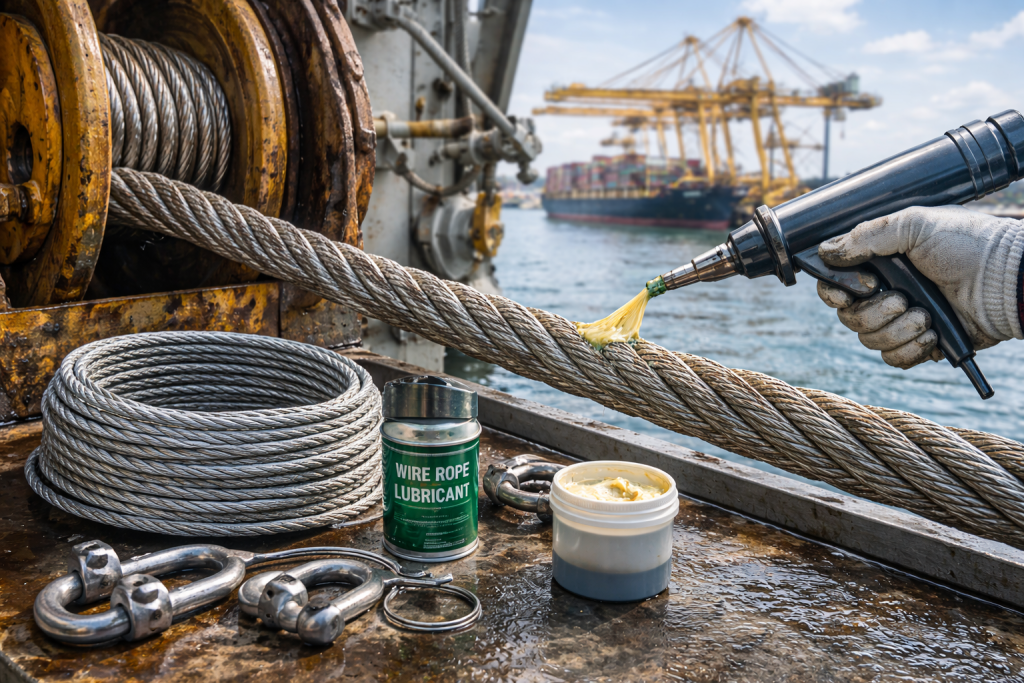
Wire ropes used in coastal and marine environments face some of the harshest operating conditions in industrial applications. High humidity, salt spray, temperature fluctuation, and cyclic loading significantly accelerate corrosion. Without proper protection strategies, corrosion reduces tensile strength, increases fatigue failure risk, and shortens service life.
This article outlines practical, field-tested corrosion protection solutions designed for port cranes, offshore lifting systems, and marine infrastructure.
1. Why Coastal Environments Accelerate Corrosion
Salt-laden air contains chloride ions that aggressively attack steel surfaces. When combined with moisture and oxygen, this creates an electrochemical reaction leading to:
- Surface rust formation
- Pitting corrosion
- Internal strand corrosion
- Reduced metallic cross-section
- Premature wire breakage
Unlike inland industrial environments, coastal corrosion penetrates not only the outer wires but also the rope core—especially if lubrication is insufficient.
2. Selecting the Right Wire Rope Material
Galvanized Wire Rope
Hot-dip galvanized wire ropes offer improved resistance to saltwater exposure. The zinc coating provides sacrificial protection, slowing oxidation of the steel core.
Advantages:
- Cost-effective
- Good resistance to atmospheric corrosion
- Widely used in port cranes and marine lifting
Limitation:
Once the zinc layer is depleted, corrosion accelerates rapidly.
Stainless Steel Wire Rope
Stainless steel ropes provide superior corrosion resistance, especially in high-salinity environments.
Advantages:
- Excellent resistance to chloride attack
- Lower maintenance requirements
- Longer service life in constant marine exposure
Limitation:
Higher cost and generally lower tensile strength compared to high-carbon steel ropes.
3. Advanced Coating Technologies
Modern corrosion protection extends beyond basic galvanization.
Plastic-Coated Wire Rope
PVC or nylon coatings provide an additional barrier against moisture and salt spray. These are commonly used in secondary lifting systems and static applications.
Compacted Strand Technology
Compacted strands reduce internal voids where moisture accumulates, lowering internal corrosion risk.
Zinc-Aluminum Alloy Coatings
Zn-Al alloy coatings provide better long-term corrosion resistance than standard zinc coatings, particularly in marine atmospheres.
4. Proper Lubrication: The Most Critical Defense
Lubrication is the primary defense against internal corrosion. Marine-grade wire rope lubricants must:
- Penetrate to the rope core
- Displace moisture
- Form a protective barrier
- Resist wash-off from rain or sea spray
Recommended Lubrication Practices:
- Apply lubricant during installation
- Re-lubricate every 1–3 months in heavy marine exposure
- Use pressure lubrication systems for deep penetration
- Remove old contaminated grease before reapplication
In many failure analyses, inadequate lubrication was the leading cause of internal corrosion—even when galvanized ropes were used.
5. Installation and Operational Factors
Corrosion risk increases when:
- Rope is improperly spooled on the drum
- Water accumulates inside drum grooves
- Sheaves retain salt deposits
- Rope operates under low tension, allowing moisture ingress
Best Practice:
Maintain proper tension during installation and ensure sheaves and drums are regularly cleaned to prevent salt buildup.
6. Inspection and Monitoring Standards
Coastal applications require more frequent inspection cycles than inland operations.
Inspection Checklist:
- Measure rope diameter reduction
- Inspect for rust discoloration
- Check for pitting and broken wires
- Examine end terminations for corrosion
- Conduct internal inspection where feasible
Standards from organizations such as ISO and OSHA provide discard criteria for broken wires and diameter reduction. However, in marine conditions, operators should adopt stricter internal inspection practices.
7. Environmental Mitigation Strategies
In addition to rope selection and lubrication, consider:
- Installing protective covers on idle cranes
- Improving drainage systems to prevent water accumulation
- Applying corrosion inhibitors on exposed components
- Using sealed storage areas for spare ropes
These environmental controls significantly extend service life.
8. Cost vs. Service Life Consideration
Although stainless steel or advanced-coated ropes may have higher upfront costs, the total cost of ownership (TCO) is often lower due to:
- Reduced replacement frequency
- Less downtime
- Lower maintenance labor
- Improved operational safety
For high-cycle container cranes in coastal ports, upgrading rope grade and lubrication programs can extend service life by 30–50%.
Závěr
Wire rope corrosion in coastal areas is inevitable—but it can be effectively controlled. The most reliable protection strategy combines:
- Proper material selection (galvanized, stainless, or alloy-coated)
- Marine-grade lubrication programs
- Correct installation and tensioning
- Frequent inspection cycles
- Environmental management practices
By implementing a structured corrosion prevention strategy, port operators and marine industries can significantly improve safety, reduce downtime, and optimize lifecycle costs.
At WONZH Precision Manufacturing, we support port and offshore clients with engineered wire rope solutions designed specifically for high-humidity, high-salinity environments, backed by technical consultation and field application experience.
 Czech
Czech  English
  Korean
  Japanese
  Russian
  Arabic
  Spanish
  German
  French
  Italian
  Portuguese
  Chinese
  Dutch
Dutch  Polish
  Hungarian
  Finnish
  Swedish
  Vietnamese
  Thai
Thai  Turkish