
Industrial wire ropes are essential components in material handling, lifting, and hoisting equipment. They are designed to withstand dynamic loads, torsion, and environmental stress while ensuring operator safety and operational reliability. Evaluating the safety and service life of wire ropes is critical to prevent accidents, reduce maintenance costs, and maximize equipment efficiency.
This article provides a structured framework for assessing wire rope performance, lifespan, and risk factors based on engineering principles and real-world operating conditions.
1. Understanding Wire Rope Construction
Wire ropes are composed of multiple strands of metal wires twisted around a core. The main types include:
- Strand type: Single-layer vs. multi-layer strands
- Core type: Fiber core (FC) vs. independent wire rope core (IWRC)
- Lay direction: Right-hand lay or left-hand lay
- Wire material: Carbon steel, stainless steel, or coated wires
The construction determines mechanical properties, flexibility, wear resistance, and load-bearing capacity. For example, IWRC cores provide higher strength and resistance to crushing, while fiber cores offer better flexibility but reduced load capacity.
2. Load Conditions and Safety Considerations
The primary factors affecting wire rope service life are load type, magnitude, and operating frequency:
Tensile Load
- Wire ropes are rated for maximum tensile load; exceeding this limit leads to permanent deformation or strand breakage.
Bending and Fatigue
- Frequent bending over sheaves or pulleys causes fatigue, leading to wire breakage and internal damage.
- Fatigue life is influenced by rope diameter, sheave diameter, and bending frequency.
Dynamic Loading
- Shock loads, vibration, and sudden impacts accelerate wear and internal wire failure.
- Dynamic load analysis is critical for cranes, hoists, and lifting equipment.
Safety Factor
- Industry standards recommend safety factors of 5:1 to 8:1 depending on application criticality.
- Proper safety margins ensure operational reliability under unexpected loads.
3. Environmental Factors
Wire ropes often operate in harsh industrial environments. Environmental conditions significantly influence safety and longevity:
- Corrosion: Exposure to water, chemicals, or humidity can weaken wires and reduce fatigue life. Stainless steel or galvanized wires are recommended in corrosive environments.
- Temperature: Extreme heat or cold affects wire flexibility and fatigue resistance.
- Abrasion and contamination: Dust, sand, or metallic particles accelerate wear between strands and sheaves.
4. Inspection and Maintenance Practices
Regular inspection is key to evaluating wire rope safety and predicting service life. Recommended practices include:
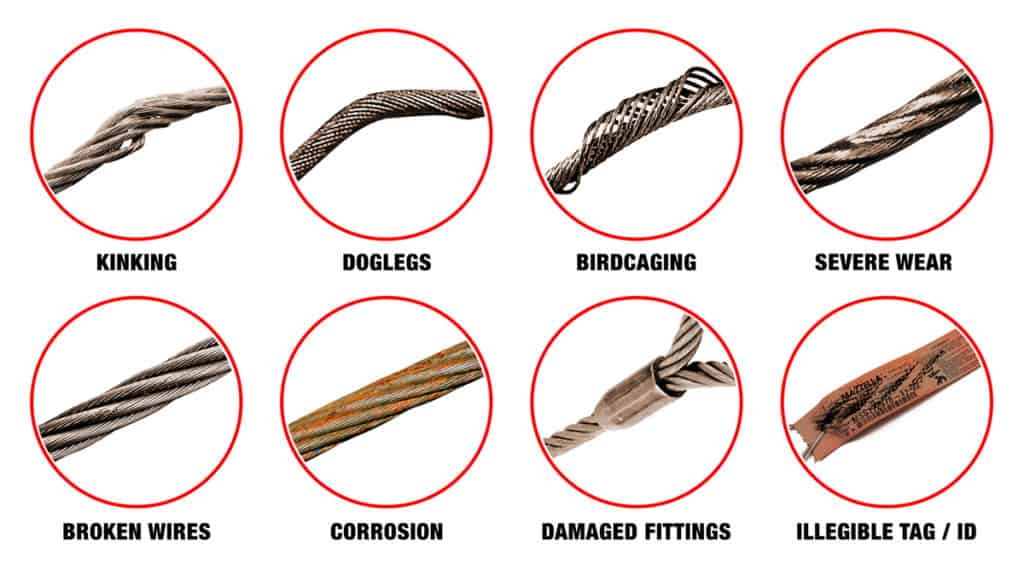
- Visual Inspection: Check for broken wires, kinks, corrosion, and uneven wear.
- Lubrication: Adequate lubrication prevents corrosion and reduces friction between strands.
- Non-Destructive Testing (NDT): Magnetic flux, ultrasonic, or radiographic methods detect internal wire damage.
- End Terminations and Fittings: Inspect sockets, thimbles, and clamps for deformation, wear, or improper installation.
Replacement Criteria:
- Number of broken wires exceeding manufacturer guidelines
- Reduction in rope diameter due to wear
- Corrosion or pitting compromising structural integrity
- Evidence of kinking, crushing, or core failure
5. Calculating Service Life
Wire rope service life depends on multiple factors:
- Design Life: Determined by the manufacturer based on diameter, material, and construction.
- Operational Use: Includes load magnitude, frequency, bending cycles, and environmental exposure.
- Maintenance History: Regular lubrication, inspection, and proper storage extend life.
Engineers often use fatigue analysis models nebo load-cycle calculations to estimate expected service life and plan preventive replacement schedules.
6. Material and Coating Selection
Material choice significantly affects durability and performance:
- Carbon Steel: High strength, general-purpose, cost-effective.
- Stainless Steel: Excellent corrosion resistance, suitable for marine or chemical environments.
- Coated Wires (Galvanized or Polymer): Protects against wear and corrosion, extending service life.
Selecting the appropriate coating and material for the specific operating environment enhances safety and reduces unexpected failures.
7. Best Practices for Safe Operation
To maximize wire rope safety and service life:
- Ensure proper installation and alignment with sheaves and drums.
- Avoid shock loads or sudden dynamic impacts.
- Maintain recommended lubrication schedules.
- Replace ropes before reaching end-of-life indicators.
- Document inspections, replacements, and operational conditions.
By following these practices, operators can prevent accidents, reduce downtime, and optimize total cost of ownership for lifting and material handling systems.
8. Conclusion
Evaluating the safety and service life of industrial wire ropes requires a systematic approach considering construction, load conditions, environmental exposure, and maintenance practices. Proper inspection, material selection, and adherence to operational limits are crucial to ensuring reliable performance and safety.
Engineers and maintenance professionals should collaborate with trusted suppliers to select wire ropes that meet specific operational requirements and provide technical documentation for inspection and replacement planning.

 Czech
Czech  English
  Korean
  Japanese
  Russian
  Arabic
  Spanish
  German
  French
  Italian
  Portuguese
  Chinese
  Dutch
Dutch  Polish
  Hungarian
  Finnish
  Swedish
  Vietnamese
  Thai
Thai  Turkish